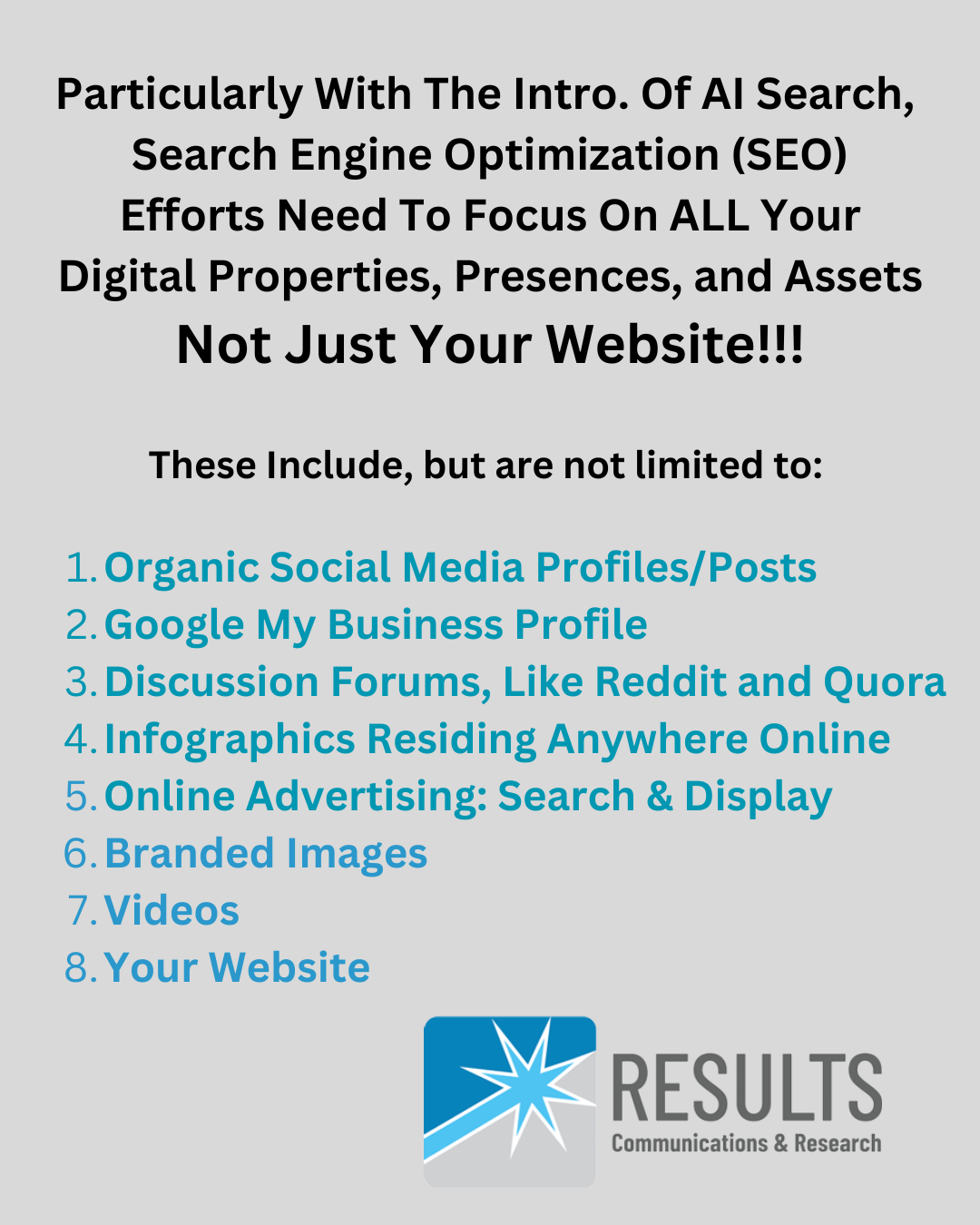
As we’ve explained in numerous spots throughout our website, SEO (Search Engine Optimization) is the practice of ensuring your organization is found online for relevant search-engines searches in relevant geographies. But a huge mistake in 2025, and beyond, would be to only focus on your website and Google My Business Profile being optimized to be found by appropriate searchers/target audiences, as shown in the image below.
The answer to the above is “no way!” In fact, just the opposite, although some digital marketing experts are saying it is, or are reluctant to use/expand the SEO acronym or search engine optimization phrase to describe maximizing your opportunities for all and any digital assets, presences, or properties to be served up in search-engine results vs. just an organization’s website, Google My Business Profile, and paid search/search-engine ads (think Google and Bing ads).
Hey, right now in this time of constant change on the SEO front, no-one really is the one true expert or SEO guru, so we’re going to take our stand vs. following the crowd or one expert, and say that Search Engine Optimization (SEO) is about making sure all your digital assets, presences (think social media posts and presences and discussion forum presences) and properties serve you well related to being found online for the right search terms, questions, and topics in relevant geographies.
Let’s Chat About What SEO Means In This New Era And How Your Organization Can Plan and Respond To It!
As shown in the image below, my husband, Jay, and I had the good fortune of attending a women’s basketball game this past Sunday, at my undergraduate alma mater, University of Connecticut (better known as UCONN). If you’re a fan of college basketball and/or of March Madness, you know that UCONN has had a very strong women’s basketball team for years, and in recent years, the men’s basketball team has played quite well and won the NCAA championship for the last two years! I share all of this because their great success means it’s very hard to land tickets to watch either of the two teams play. Fortunately, we were gifted some tickets from our nephew for Christmas!
Being back on UCONN’s main campus in Storrs, CT brought back so many wonderful memories of my three years spent there (I spent my entire senior year abroad in France as a participant in their JYA (junior year abroad, although as previously stated I went my senior year) program in Rouen, Normandy.
A French Major To An SEO Expert
As a French major back in the 1980’s, I never would have imagined that I would eventually become a marketing professional nor that such a powerful networking enterprise/system/solution (I really don’t know the best way to refer to something that impacts our daily lives to the degree it does) like the internet would ever exist. Heck, PCs (personal computers) didn’t exist when I was at UCONN. The only computer courses that students had access to were ones where you created punch cards that fed some crazy big computer contraption (I think it was called a mainframe computer, but maybe someone will correct me?). Of course, that meant there were no knowledge or dreams of e-mail, social media, or search engines back then!
But, after working at financial services companies post-college-graduation for a few years, I went back to school part-time, and then full-time, to get my Master’s in Business Administration (M.B.A.) at Boston University (B.U.). Post graduate-school, I worked in many a corporate marketing role, and lead various marketing teams, at healthcare and financial institutions. And then, in 2014, I hung the shield for my digital marketing agency, Results Communications and Research, where I greatly enhanced my knowledge of search engine optimization (SEO) and eventually began to specialize in it because I was so passionate about it!
If I had told my 17 – 21-year-old under-graduate self that, one day, many hours of my work day would be spent helping for-profit businesses and nonprofit organizations be found on search engines for relevant terms in relevant geographies, and be found on the internet, in general, I’m sure she and my UCONN friends would have laughed.
But, here I find myself in 2025 and I’m loving every minute of it!
Mark Knopfler fans will understand where the quoted phrase in our blog headline comes from. I was first introduced to Mark’s wonderful storytelling abilities by my husband, Jay, when we were dating or first married. One of Mark’s songs that I first took a great liking to was his song “Quality Shoe.” Be prepared for the earworm that comes from wanting to listen to this song over and over!
“Quality Shoe” by Mark Knopfler YouTube video
What Do Shoes Have To Do With SEO?
The answer to the question above is this: a great deal!
As we’ve called out in a number of blog posts over the past year, the SEO landscape continues to shift — and on a daily basis. As we recently expressed in this blog post about thriving — not just surviving — in the SEO jungle, it’s our belief at our Boston SEO Company/digital marketing agency that the organizations who will continue rank well in search-engine results, despite all the change on the search-engine front, are those that really try to walk in their target audiences’ shoes and answer the questions and concerns they have. And, keep in mind, that these questions and concerns may be related to the product or service the organizations who succeed at SEO offer, or they may be unrelated, or only distantly related.
Sure, as we discussed in another blog post about succeeding at SEO, entitled “Give The People What They Want, you can use keyword research tools to determine on which topics, particularly questions, your target audiences are regularly conducting Google searches. But part of walking in your target audiences’ shoes also includes:
digging down deep mentally and emotionally to really understand your marketplace and your organization’s place in it
brainstorming with individuals at all levels of your organization, particularly those who are in customer-service roles, or who actually provide or deliver your product or service, to determine what client “pain points” your product or service addresses
reaching out to customers with whom you have a strong and longstanding relationship to ask them for feedback about why they chose to work with your organization or buy your product, and how the product or service has made their life or job easier
In addition to chatting with your organization’s staff and clients about the problems your products or services solve and using those to inform website and other online content your organization publishes, as part of such internal and external discussions, ask about other pains/challenges your target audiences deal with regularly (even if you don’t offer a solution to them). Simply providing helpful information online on topics or questions that are tangential to your products or services, but important to your target audiences, is a great way to have search engines serve up your website or Google My Business Profile in related to searches being conducted by your target audiences even if they aren’t directly related to your organization. It’s a win-win.
We recently did an audit for one of our SEO (search engine optimization) clients because we were surprised to see that the organization’s Google My Business Profile was no longer being served up as high in Google search results for relevant “near me” searches, as it had been. We took a close look at the organization’s competition (firms whom our SEO rankings audit tool showed were ranking far better for desirable search terms than our client). Since the client and our firm make sure their Google My Business Profile is very comprehensive, the only key differentiator we could determine between the client’s profile and competitor profiles that were ranking better was that the competitor profiles had far more Google reviews since all of our client’s’ Google reviews were positive.
Of course, we are making some assumptions that the above is the key reason why our client’s Profile isn’t ranking as well as competitors. But, given that service areas and business categories are accurate and complete, we’re posting to the Profile regularly and employing other Google My Business Profile best practices, it’s worth a shot to try to obtain more Google reviews from satisfied customers to see if it moves the SEO needle right?
How To Get More Positive Google Reviews
Google makes it so easy to ask satisfied customers to write a Google review on your organization’s behalf. Just follow these simple steps:
Log into your Google My Business Profile by having the e-mail address you created the account with open, and either typing the name of your organization into Google or your browser, or going to https://business.google.com.
You should see your profile laid out in the fashion below with the following menu of activities you can complete.
Click on the icon shown in the print screen above for “Ask For Reviews.”
Google will provide you with the URL you can share on your website, in an e-mail or text, or on social media for individuals to provide you with a Google review, such as the following URL: https://g.page/r/CblxOCik2bHfEBM/review (and, yes, that’s for our organization and we always welcome positive reviews).
Share the link with internal team members/employees, particularly those who interact regularly with prospective or existing customers, such as account and customer service representatives. If a customer mentions how happy they were/are with your service when interacting with your employee, your team member should be proactive about sharing the link to the URL you obtained from Google (following the steps outlined above) for someone to write a review about your organization.
It’s all so easy-peasy. So why wait to start growing your number of positive Google reviews to support your Google My Business Profile ranking higher up in results for relevant local searches?
Don’t Forget These Best Practices Related To Soliciting and Responding To Google Reviews:
For ethical and legal issues, never offer an incentive of any kind for a customer to write a Google Review on your behalf. Similarly, never imply that there will be negative ramifications if a customer doesn’t write a Google Review about your organization.
Post a reply to any reviews you receive. If a review is negative and appropriate, acknowledge what you could have/should have done differently, and regardless of whether it was warranted, share that your organization always strives to offer the highest quality products and exceptional service. Even if you don’t agree with the feedback, thank the reviewer for it, and definitely don’t get into an online argument about the feedback. Thank anyone who provides a comment or feedback for doing so. Visit our Google My Business Profile for examples or appropriate replies to comments received.
Because one of the services my agency offers is PR — and we’ve had some decent success obtaining meaningful media coverage for some of our for-profit and non-profit clients (as documented in our Public Relations Portfolio) — of course, we reached out to The Patriot Ledger to see if they wanted to do a “then and now” story about our South Shore organization since they covered our story nine years back. We’re still awaiting news, literally and figuratively on that one, but we figured why not go ahead and share a similar version of that story on our blog using the highlights we shared with them? So, here goes…
I prefer to refer to my business as a digital marketing agency vs. a marketing consultancy because we do as much as hands-on work as we do developing & recommending marketing strategies.
Our story actually began with me launching my own WordPress website without the help of anyone else, and my officially hanging my digital marketing agency’s shingle via that site. And, if I knew as much as I know about WordPress and website development now as I knew then, I would have originally launched my site with WordPress.org (the platform that it’s on now) vs. WordPress.org, so I could use the many great WordPress plug-ins from the get-go! Or, I might also have considered Joomla instead, but owning a business and getting it right is all about the journey. And, you can’t learn what you need to learn without making a few mistakes and getting your hands dirty, right?
What’s been particularly challenging as an organization who helps others with their own marketing is, sometimes, as I’ve been known to share, “the cobbler’s kids have no shoes.” That means often we are so busy helping our clients with their marketing, we don’t have time for our own. The aforementioned said, we make every effort to have our firm’s own marketing activities (such as our website and social media profiles) serve as a shining example of how to maintain a strong online presence, and it’s great that we’ve been able to use our own business to test and try out various marketing activities — therefore, serve as a bit of a guinea pig — before we test or try something brand new with clients.
I believe and hope my story can motivate and inspire others considering opening their own business. Before, or right after I launched my business, I was told by one individual who works with entrepreneurs that 80% of female marketing consultants fail. I refused to be a statistic, and regularly told myself that during the first 5 years, which were the hardest. It takes a good five years to get the word out there and have business come to you organically/naturally thru referrals, leads, and recommendations from others — made by former co-workers and clients, existing clients, other marketing consultants and agencies, and other organizations who serve the same vertical/target audiences whom you serve.
My philosophy and dreams when I started my business have remained pretty constant and I’m pleased to report I’ve followed them. I’m particularly proud that I’ve been able to continue to offer what I believe, based on research, are very reasonable rates to small for-profit and non-profit organizations. Due to my years of experience and expertise, clients have access to the same level of knowledge and skills that they’d have access to via a larger marketing agency, but at much lower rates than what a larger agency might offer. And, because we have significant experience in both traditional marketing AND digital marketing, we can offer the majority of services a larger, full-service agency can.
The biggest lesson I’ve learned that I’d love to share with others starting a business is this: don’t think of others in your space as competitors. Think of them as collaborators – people who serve the same target audiences who may need your services.
Our Impact: Local (South Shore of Boston), National, and International
I’ve helped a number of young adults who grew up on the South Shore, or elsewhere in MA, get hands-on experience that they were able to parlay into a post-graduation job elsewhere.
Related to the above, I’ve had the great fun and pleasure of working with my nephews, my brother, my brother-in-law, and my late sister-in-law on various client projects.
I’ve also met with a number of college or graduate school students looking to pick my brain about careers in marketing and learn from me – including one in my neighborhood who found me thru a Google search! Yes, because early on I recognized I needed to create a Google My Business Profile for my own business to be found by local, relevant searchers and this is something I regularly help my clients with now!
I’ve given a large number of pro bono hours to nonprofits as part of a totally free consulting/volunteer situation or discussion, or as part of their paid arrangement with me. I’ve had a number of very interesting local nonprofit clients, including ones in the faith-based space, arts and music space, ones serving vulnerable populations, ones serving individuals with special needs, and one providing financially challenged teens the opportunity to serve vulnerable teens abroad, and more! Some have an international impact.
One of my specialties is helping nonprofits apply for a Google Nonprofit Ad Grant. I, then, often stay on and manage the Grant for them – $120,000 in free Google Search advertising annually. I can explain more.
I also have a number of for-profit clients on the South Shore, but my client base is national and I have had clients in New Orleans, CA, Texas, and more!
I’ve served over 120 for-profit and non-profit organizations in the 10 years I’ve been running my digital marketing agency/SEO company.
I had no idea when I launched my business that I would become an expert in something that I only had very little knowledge of at the time when I launched my business – search engine optimization (SEO). Many of my referrals for or sub-contracted work come from other agencies, marketing consultants, and website designers who need to pull someone into their client work/project who knows how to get websites and Google My Business Profiles ranking well in Google via organic and paid search (Google Ads) SEO activities. I’ve become a self-taught SEO expert and very proud of it. I just read and watched everything I could get my hands on, took Google Ads certification classes, and attended free webinars. I still do that daily as Google’s Search Engine will be switching to an AI one, and I’m already helping my clients be proactive about that and prep for it (Google SGE).
As indicated above, while I do sub-contracted or referred work for other agencies, marketing consultants, and website designers, many of my clients are my own clients, and I usually have a plate of about 12 – 15 clients for whom I’m doing ongoing, digital marketing work for on a monthly basis, plus also juggling several one-off/one-time clients at the same time. At any given point in time, I’m normally doing work for about 17 – 25 clients with the help of some fabulous interns and associates, as they were/are available.
I’ve given a number of free workshops for SCORE and other organizations serving entrepreneurs, and I’m a SCORE volunteer and have provided tons of free advice to entrepreneurs by meeting with them on a complimentary basis. And, related to all of this, I’ve had a blast partnering with fellow marketing experts to give presentations that address multiple marketing areas of expertise! Thank you! You know who you are!
I’m a data geek and SEO geek and proud of it. I’m a huge data slicer and dicer and that’s what separates me from a lot of others in my space. I always say I won’t encourage clients to start or continue with marketing activities that don’t make sense for them based on what data is showing. I consider myself to be my clients’ accountability partner, and I’m not afraid to give tough love when I need to. I’m not afraid to voice a different opinion than other marketers. If I think something isn’t going to work, or isn’t working, I speak up.
I’m also proud that my marketing agency survived our recent COVID-19 pandemic and was extremely proactive about providing helpful insights from the very start of the pandemic for marketers to appropriately respond to the pandemic/pivot, such as these blog posts about using paid ads during the pandemic and how to make sure your social media presence wasn’t offensive and was relevant.
I give back significantly to the community. I was involved with the Braintree Relay For Life Committee for a while, and now, I do a number of charity walks in addition to all the other beneficial work I mentioned above.
Our Focus On Health & Wellness
If you’re a regular reader of our blog, you’ll know that I’ll throw in a good blog post about walking once in a while. You can use the categories search tool/drop-down menu to search on “walking” to see the various walking topics about which I’ve written.
Since my corporate marketing days, I’ve always loved to share health & wellness tips — whether they be with fellow employees as part of an internal communications role, or with members of a health plan I worked for, and from the get-go with Results Communications & Research, I’ve aimed to inspire those with health (and other challenges) to never give up, and keep fighting via my “Keep Up The Fight” website page. And, I recently put up a new blog post about an invisible disease with which many health warriors who have battled or are battling other forms of illness have to contend.
Our Thank You
My digital marketing agency/SEO company and I would have never made it this far without all the help of great collaborators, cheerleaders (friends, family, my husband Jay, and other fellow small business owners), and most importantly, our clients who looked to us for expert marketing guidance and assistance. We have many clients with whom we’ve served as an outsourced marketing department for years, and we thank you for your faith in us! We’ve so enjoyed being a part of your business family! We also thank those who we haven’t had the opportunity to work with for as long as some of our long-term clients, but have enjoyed or are enjoying being a part of your organization’s success story.
What’s Next
I don’t know what the future holds for Results Communications & Research, but I’m excited about what’s to come! And, I know I will continue to try to give back as much as possible with the platform that this fun, educational, and interesting business provides!
Want To Benefit From The Marketing Services Of A Digital Marketing Agency/SEO With A Long Tenure And Who Gives Back?
Note: Because executing, monitoring, tweaking, analyzing, and reporting on Google Ads campaigns is one of our SEO company’s specialties, we decided to write a number of blog posts on the topic this spring that are more granular, and therefore, provide more detail and really get into the Google Ads weeds! So, enjoy this second post in our Spring 2024 Google Ads series of posts!
Sometimes, it’s hard to hear or accept that there may be challenges with the features/characteristics of the products, services, and solutions you offer. But, if you’ve been checking the “Search Terms” report under Auction Insights in your Google Ads account (and made sure your Google Search ads are being served up to the right “searchers”), your ads are achieving a decent click-thru rate (2.5% or higher), and you’ve followed landing page best practices (outlined in our blog posts about ensuring ad clickers have a smooth landing and about making sure your landing page isn’t too-self serving), then there’s a high probability that website visitors who arrived on your website from online advertising ad clicks just aren’t that interested in your products, services, and solutions.
Obviously, before you reach the above conclusion — that there’s something about your products, services, and solutions that may be turning website visitors off — you need to give your ads appropriate time to “convert.” If there’s a high cost associated with your product, service, or solution, and/or it tends to be a purchase or engagement decision that’s not made lightly/overnight, then you need to wait one or several months to determine whether or not your ads eventually “convert,” and therefore, cause ad clickers to take desirable actions on your website like completing an inquiry form, or reaching out to you by clicking on a hyperlinked e-mail address or phone number.
Revisiting Product & Service Features and Characteristics
The below list is not meant to be all-inclusive since the number of different products, services, and solutions available to businesses and consumers throughout the world is immeasurable, and there are countless different industries offering products, services, and solutions — each requiring very different product and service specifications, having different features, and meeting very different needs.
Some common product and service features and characteristics that should be considered and revisited to determine if they may be the reason behind website visitors NOT purchasing a product or engaging you for your service — or at least reaching out to your organization to learn more include:
Ease of use – how difficult is to use or learn to use product or service?
Convenience – how convenient is it to use product or service? Can it only be used in certain places at certain times?
Appearance/Look/Feel – of course, opinions about whether or not something is attractive can vary, but, overall, is the product or service something appealing/attractive?
Price – does the value or benefit of the product or service warrant what is being charged for it? What are competitors charging for similar products and what makes yours stand out if you’re charging far more? Will prospective clients recognize the “value-add” and be willing to pay for it?
Ability to solve target audiences’ problem(s) – does the product or service solve a common problem, or among everyone whose problem it solves, will it accomplish what it needs to accomplish in all/most cases?
Portability – can the product or service be used outside your home, town, or state, etc.? Therefore, is it “portable?”
Uniqueness – is your product or service different enough from other similar products or services, and unique enough to make the purchaser feel “special?”
Durability/Lifespan – how long will the product or service or the effects of it last? Is current pricing warranted given the product or service lifespan?
Relevancy – is your product or service in step with current times and your current marketplace, or is it dated or out-of-touch? Have competitors entered your marketplace to offer a more modern or relevant product/service?
Being an organization that offers both traditional and digital marketing services, but specializes in SEO and SEM, we get asked all the time by prospective and existing clients whether they need to invest in both SEO and SEM strategies. We’ll be providing an answer to that further on in our blog post. But first, we need to explain the difference between SEO and SEM.
What’s The Difference Between SEO and SEM?
SEO is the acronym for “search engine optimization.” SEO is all about employing a variety of initial/one-off/one-time tactics, as well as implementing ongoing SEO tactics, to ensure your website and other digital properties/assets — such as your Google My Business Profile, and social media profiles — rank well in search engines. And, by ranking well, we mean listings for your digital properties appear high up in search-engine results for desirable, relevant phrases that your target audience(s) enters into a search engine to find an organization like yours.
The following activities fall under the broader SEO umbrella:
Organic SEO tactics: these are tactics you implement on your various digital properties that you don’t pay for (except for in the cost associated with the human time and energy spent on these tactics); these tend to include activities such as writing and posting content that answers target-audiences questions and that they find helpful, and appropriately “tagging” content and “images” using meta and alt-tags (behind-the-scenes tags)
Paid SEO tactics: unlike the two tactics outlined above where the primary cost associated with the tactics are human resource ones (either in-house marketing team or a marketing agency or marketing consultant you hire), these are tactics for which you have to pay for a media or advertising buy, in addition to the human time involved. And, as you’ll learn below, paid SEO = SEM.
SEM is the acronym for “search engine marketing.” As we mentioned above, SEM is paid SEO. Some also refer to SEM as “paid search.” It involves paying for advertising, like Google Ads or Bing Ads, so that your ad appears at the top of search-engine results for relevant, desirable search terms used by prospective customers.
When Should You Employ SEM/Paid SEO Tactics?
For many clients, we both oversee their organic SEO and their SEM/paid SEO tactics. So, why do these clients need to employ both types of tactics to appear at the top of search-engine results? These are the three key reasons.
The client is in a very competitive marketplace. This means there are numerous other organizations offering similar products, services and solutions in the same geography — which likely means there are numerous organizations who are employing best organic SEO tactics, too, to appear naturally at the top of search-engine results.
Several or many key competitors are running paid Google or Bing Ads, which means the only way the client can appear at the top of search-engine results (since those paid ads vs. organic listings will take up the first few results listings related to a particular relevant search) is by buying and running “paid search” ads themselves.
A page of the client’s website is being served up in search-engine results for a particular search phrase, when the client actually wants and needs a different page of their site to appear in search-engine results.
The SEO Bottom Line
So, what should you take from all of this? If you’re an organization offering products, services, and solutions in a crowded marketplace, you’ll probably want and need to employ all of the three types of tactics listed above: organic SEO, technical SEO, and paid SEO/SEM.
Reach Out To Speak With Our SEO Services Team
Our SEO team is glad to speak with you about your organization’s SEO opportunities and challenges. We can help you determine which types of SEO tactics need to be implemented in the short-term, and which make sense for the longer-term. So please reach out for a complimentary discussion with our SEO experts.
As we’ve shared in other blog posts, we don’t love the use of the phrase “traditional marketing” to refer to activities that marketing teams at organizations, and advertising agencies, employed prior to the arrival of the internet and the digital marketing tactics made possible by it, but it’s become a tradition now to use the word “traditional,” and it’s something we don’t see changing. As we just alluded to, digital marketing activities are those that require the internet for execution and/or present information in a digital fashion or on some form of digital media.
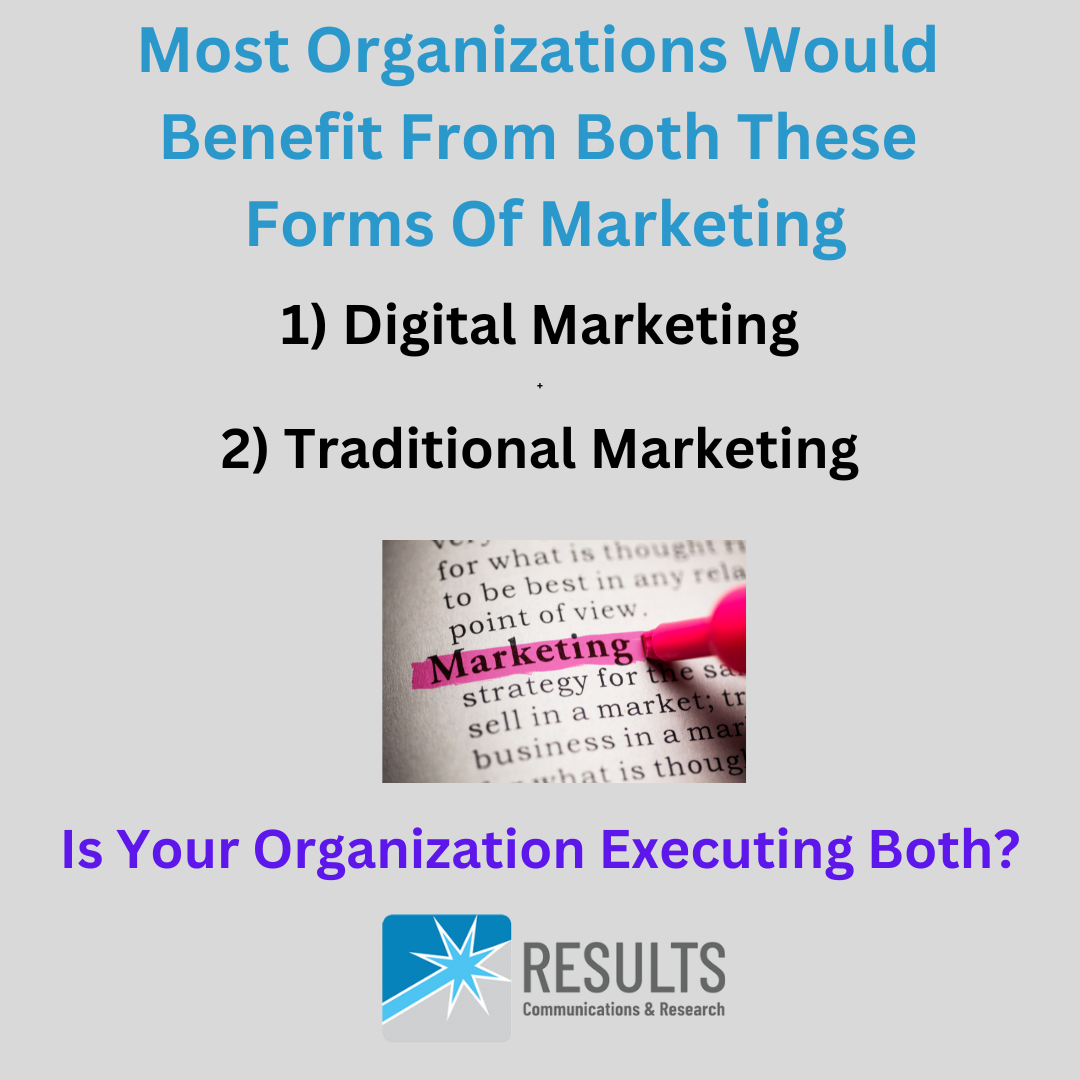
Per our blog post heading, the aim of this discussion is to provide some insight on the difference between traditional and digital marketing and when to use each form. Most organizations will benefit from employing a combination of traditional and digital marketing for the reasons outlined below.
What Is Digital Marketing?
As we expressed above, digital marketing activities are those that require the internet or other digital technology/platforms for execution. Unlike traditional marketing opportunities that are all about putting the idea of your products, services, and solutions in the heads of individuals who might be a good fit for them, many digital marketing activities, such as organic search/SEO, paid search advertising, and social media posting are focused on getting information in front of individuals who are actively searching for your particular organization and/or the products, services and solutions you provide. Digital marketing activities include:
E-mail marketing – sending an e-mail/e-blast to existing clients, or to prospective customers who meet your target-audience criteria, e.g., meet certain age, geography, income, gender, job title, industry, or other demographics.
Display advertising/social media advertising – this includes running paid ads that are served up by a social media platform, such as Instagram or Facebook (you can buy ads on the two aforementioned platforms together) to people meeting the targeting requirements you set, such as those outlined above for e-mail marketing; plus, Google Ads offers display (image) advertising to allow you to reach individuals whose behaviors, interests, and demographics make them a good fit for your products and services.
Search Engine Optimization (SEO) – employing free/unpaid/organic tactics such as optimizing behind-the-scenes meta/SEO post and page title tags to ensure your website and Google My Business Profile rank as well as possible in Google and other search-engine results for relevant searches conducted by your target audiences.
Paid search advertising – think Google Ads or Bing Ads – these are ads that are served up a the top of search results for search terms used by target audiences that are relevant to the products, services, and solutions an organization offers. This former blog post addresses when it makes senses to employ paid search/paid SEO tactics.
Banner advertising – this is advertising that is bought from an external website that serves the same target audience your organization wants to reach.
Other – the above list is not exhaustive, but highlights the most common forms of digital marketing. Other examples of digital marketing include, but are not limited to, digital billboards or transit posters, and ads that run on a TV-type monitor at transit stations, such as subway stations.
Broadcast Advertising – radio and TV (network and cable — of course now, you can also run advertising on streaming channels and stations)
Print Advertising – magazine, newspapers, and other print publications
Direct Mail – a postcard or letter is mailed to a purchased or existing list of current or prospective clients
When the list is purchased, the names and addresses you obtain would meet certain criteria that you specify, like geography, age, gender, income, job title, industry, etc.
Outdoors Advertising – billboards (static poster, and now digital options as well)
Transit Advertising – posters and signage (static, and now digital options as well) that appear inside a bus, train, or subway car, or on train, bus, or subway platforms. You can also “wrap” a bus or train, or a bus stop kiosk, with your branding.
Mall or movie theater advertising – posters and signage (static, and now digital options as well) that are placed throughout mall corridors or advertising that appears at the beginning of a movie while one is waiting for a movie to start.
Event Attendance/Tabling – the aforementioned could refer to having a table at a community or some other event where prospective customers can walk up to your table to obtain information about your organization and your products and services.
Tradeshow Attendance/Booth – the aforementioned is all about setting up a booth at a trade show which is expected to draw your target audience, and sharing information about your products and services with booth visitors.
PR/Publicity – distributing press releases to gain media coverage of an announcement made by your organization, or pitching your story to media/reporters who serve your target audience in hopes the media/reporter will “cover” your story.
Other – the above list is not exhaustive, but highlights the most common forms of traditional marketing. Other examples of traditional marketing include but are not limited to distribution of branded, promotional items, and lobby merchandising (if your organization has physical locations that customers can visit).
Why Most Organizations Should Employ Both Traditional and Digital Marketing Tactics
As we’ve discussed with many of our clients, some target audience members may not be “online” regularly. Perhaps, their busy personal and work lives just don’t allow for them to be regularly viewing social media posts and profiles, and/or conducting search-engine searches. Or, they may just not like being online.
While, individuals who visit your social media profiles and/or land on your website because they conducted an appropriate search-engine search might be warmer/hotter leads — therefore, they may be more poised to buy your products, or engage you for your services/solutions in the near future — some other target audience members may need some prodding or reminders (delivered to them via traditional media) about your products, services, and solutions.
Sometimes, there’s just not enough people searching regularly related to the products, services, and solutions that your organization offers. Target audiences just don’t know you and/or your products and services exist. All the more reason to employ some traditional marketing tactics.
Free Marketing Brainstorm With Marketing Experts
Our Boston marketing agency has experience related to executing the majority of the digital marketing and traditional marketing tactics above. Unsure which tactics to execute when, or need more detail on what’s involved in executing them, and/or more information on production and media-buy costs?
On average, 110 individuals a month enter the question posed in our blog post title into Google. That’s over 1,300 individuals a year wondering whether they should be investing their time, energy, and money in social media.
Obviously, our Boston digital marketing agency and SEO company doesn’t know the intent behind the posing of this question. Are the searchers posing this question related to their personal use of social media or use of social media for their business? We’re guessing it’s a combination of both. That said, the purpose of this blog post is not to answer the question of how much time you should spend on social media related to your personal life, but rather, with a new year about to get underway, whether you should continue to invest time, energy, and money related to posting on social media and how much.
How Much Time & Energy Should My Organization Spend On Social Media?
The answer to the above is it all depends on the nature of your organization and the products and services you offer, plus the social media results you’ve seen to-date. I remember when organizations first started using social media to promote their businesses — I recall that happening in the early 2010’s. Both for-profit and non-profit organizations felt that if they didn’t jump on the social media bandwagon, they’d be left behind, have a huge competitive disadvantage, and maybe suffer great financial consequences. At the time I was in a marketing role at a health care organization, and quite honestly, I did champion the use of social media to create awareness of my organization’s services, but I don’t think I ever believed that social media was going to have an immediate, large impact on sales results. In many cases, as discussed below, social media has a less immediate impact and is more about creating awareness.
As a marketer, while I’ve often felt hesitant to voice the above and related thoughts about social media to other marketers, I’ve always been nervous and apprehensive about organizations moving too much of their marketing team’s or agency’s time and/or budget away from other traditional and digital marketing activities, and into organic social media activities vs. paid social media ones and/or investing too heavily in organic social media. Why? Because I just wasn’t seeing organic social media vs. social media ads moving the “conversion” needle, i.e., causing desired actions by target audiences, particularly when they visited an organization’s website.
Website Data Doesn’t Lie
For years now, I’ve been able to use various forms of Google Analytics to track either my employer’s or my clients’ website visitors — how they arrived on the site and what actions they took there. In many cases, very regular social media posting was driving very little traffic to their websites, and the traffic that was visiting their sites (due to clicking on a link to their website shared via a social media post or profile) wasn’t taking a desired action like completing a lead or inquiry form, or buying a product or service.
2024 Recommended Social Media Use By Businesses
So, what does that mean for organizations and their use of social media in the new year?
Consider how much time and money you have to spend on all forms of marketing, not just organic social media posting. Whether it be internal staff or an outside marketing consultant or agency that does the work, how many hours and what marketing $ budget will you have to spend in the new year for all forms of marketing?
Based on 2023’s time and $$ spend on social media (fees to agencies and/or consultants for their organic social media post work vs. social media advertising work and/or advertising buy), how much of your 2024 marketing budget and time would be spent on organic social media posting vs. social media advertising, and does it warrant that percentage of your overall marketing budget and time being spent on it? So, how will you know if it’s warranted? Ask yourself the following:
Do any sales or leads tracking systems, including Google Analytics (GA4) indicate that you are getting a sufficient number of inquiries or sales to justify the time and $$ associated with organic social media posting?
Do you often learn anecdotally from new and prospective clients that they learned about you on social media due to your posts or profile?
Does the product or service that you offer have a long lead time, i.e., do target audiences often take a long time and do a lot of research about your products and services before they make a decision, and therefore, is awareness creation among target audiences an important first step in the sales process?
Is your product or service one that target audiences tend to investigate on social media such as a consumer goods or consumer service one, like jewelry, clothing, a hairdresser, or a restaurant?
If you can answer “yes” to any of the questions above, then it’s likely you still want to have a fairly robust presence on social media in 2024 and, therefore, do want to continue to put out a steady stream of social media posts on the various platforms in which you participate. Keep in mind that daily posting is likely unnecessary and may actually be considered by target audiences as annoying. 3-5 posts a week is likely the ideal cadence for most organizations posting on social media.
Do I Need To Have A Social Media Profile On All Social Media Platforms?
The answer to the above is “no,” and if you do, it’s likely because you haven’t taken the time to really understand your particular target audiences and their social media preferences. Which profiles are they most likely to hang out on based on their age and interests — and are they personal platforms vs. professional ones like LinkedIn? Are there particular platforms like “X,” (formerly Twitter) or TikTok that your target audiences won’t/don’t visit and on which your organization wouldn’t want to have a profile simply because of all the negative press and sentiment associated with those platforms?
Add “first user source/medium” as a second dimension to your Google Analytics traffic acquisition report to determine which forms of social media are driving the most traffic to your website and/or your Google Analytics conversions/events reports (and add same “first user source/medium” dimension) to see which site visitors coming from social media are taking desired actions on your site. That will help you determine which platforms you should continue to post to most regularly, if at all (although don’t completely vacate a platform without encouraging visitors to follow you on another social media platform).
The Social Media Platform You Should Always Be Posting To
Being the SEO geeks and SEO experts that we are, we always say to our existing and prospective clients, “always think of your Google My Business Profile as another form of social media.” As we explain in our blog post about ranking locally, when Google decides to serve up your website in search engine results for relevant terms, depending on whether or not a geographic (city, town) or “near me” term was included in the search phrase, Google might serve up your website or it might serve up your Google My Business Profile.
To keep your Google My Business Profile ranking as well as possible in search results, be sure to keep it fresh/current, as Google rewards such profiles the way it does websites.
Need Help Related to 2024 Strategic Marketing Planning?
Need help figuring out where and how to spend your 2024 marketing $$ and time? Reach out for a complimentary discussion of your marketing challenges and opportunities.
I recently watched a video from an SEO expert who stated that, for certain organizations, regular blogging may no longer be an effective SEO strategy.
The above is not what I’ve seen in the past and what I continue to see. My clients who make and take the time to write and post new blog posts on topics that their particular target audiences are interested in and need to better understand, continue to drive traffic to their website from audiences who have great potential to buy their products or use their services. And, they are driving those relevant audiences because they are ranking well on Google for desirable search terms (known as keywords) because Google is indexing their blog content and serving it up in search results in relevant geographies.
How To Blog Effectively
Anyone can “blog,” but how do you blog effectively to support SEO and actual sales?
Employ a keyword planner tool, like Google Ads’, to determine on which high-volume keywords your target audiences are searching
Use tools like Ubersuggest, Google Trends, and Answer The Public to see what questions your audiences has or what they are searching most about, and create blog posts that speak to those searches and questions
Use Google Analytics and Google Search Console to determine what new, or long-time, blog posts on your site individuals are visiting most and make sure that you:
include strong calls-to-actions and call-outs on those blog posts to other main pages of your site
add updates regularly to those older, frequently-visited blog posts, so that Google indexes that new content and also makes note of the fact that you are regularly updating and refreshing your content. As we explained in our “How Not To Let Your SEO Strategy Slide When You’re Short On Time” blog post, the aforementioned is an approach that will help you to continue to succeed in the game of SEO.
Need Ideas About What To Blog About?
Our team can help you develop a blogging strategy that would include research to determine what you should be blogging about. Depending on the complexity of the products and services you offer, we can even write and post your blog posts for you and make sure they get crawled/indexed by Google.
Reach Out To Our Boston SEO Company Today!
We love a good complimentary discussion about any organization’s marketing challenges or opportunities — whether the organization be a nonprofit or for-profit. To-date, we’ve supported approximately 125 different brands, so there’s very few industries, products, or services for which we don’t have at least some relevant marketing experience; plus, we’re quick to learn new industries, products, and services. So, schedule your free call with our team of SEO experts today!