If you’re considering a career in digital marketing, and particularly within that, a specialty or expertise in SEO (search engine optimization), read on to learn what a typical work day look likes.
How An SEO Consultant Starts Her Day
8:30a.m. – 9:30a.m.
Check/read (and send response e-mail) e-mails, which inevitably include the following:
Notifications from paid search (SEM) ad platforms (Google Ads or Microsoft (Bing) Ads) about:
Policy changes that have caused a Google or Bing Search Ad to be disapproved
Ad extensions and ads that have become disapproved because “page destinations” are no longer working (sometimes, clients of ours take down or move website pages to which site links (one form of ad extension/asset) point or ads point and forget to let me know that pages have been taken down, moved, etc.
Payment form (credit card) can’t be charged — therefore, the credit card information that a client provided to Google Ads or Microsoft Ads is no longer accurate/has changed
E-blasts and e-newsletters about SEO and invites to various SEO webinars and classes (due to the large # of search engine optimization experts we follow)
Client questions about how well their website is or isn’t ranking in search engines, particularly Google
Use Google Analytics data, Google Search Console data, paid search platforms, and SEO rankings audit reports to analyze and document KPIs (key performance indicators) for upcoming monthly/standing client meetings
Have a mid-to-late morning #SEOStrong snack, particularly one with lots of protein like swiss cheese or hummus because you definitely need a sharp brain and a lot of energy to do SEO work!
Employ “Answer The Public” and Google Ads keyword planner tools to conduct keyword research in relevant geographies using approved “inputs” from client about what terms they believe their target audiences would use to identify someone who offers the services, products, and solutions to problems they offer
Check client Google Ad and Microsoft Bing Ad campaigns (including Google Nonprofit Ad Grant ones) to see how they are performing, including reviewing cost-per-click (CPC) and click-thru rate (CTR); plus, review and apply or dismiss recommendations from Ad platform to improve optimization score, and check for appropriateness of “search terms” for which ad platforms are serving up ads.
12p.m. – 6:00p.m.
Review SEO diagnostics reports to determine possible website issues and/or missed SEO opportunities related to a particular client’s website ranking situation.
Facilitate client discussion about next steps/implications of their SEO rankings audit, diagnostics reports, and/or monthly KPIs. Where do we go from here to move the SEO needle and drive more relevant searchers to the client’s website in the month ahead?
Write and enter SEO page/post title tags (this might be in WIX, GoDaddy, Joomla, WordPress, Expression Engine, or a propriety software such as a CMS platform used in a particular industry), and submit the revised pages/posts for indexing by Google and/or Bing using Google Search Console and Bing Webmaster tools.
7:00p.m. – 8:30pm
Check e-mail again and/or continue to complete client SEO work of the nature outlined above. Being an SEO consultant is not just a 9 to 5 job!
While I’ve referred to myself and my business as a marketing consultant or marketing consulting firm, it never struck me that individuals would use the term “SEO consultant” to refer to someone who offers the SEO services (search engine optimization services) that I and my firm does.
Just by chance, while conducting some keyword research for a client that offers business and management consulting services, I stumbled across the term and the average monthly search volume for it. Did you know that 27,100 individuals a month, across the whole U.S., search on this term in Google? That’s a lot of searches on an annual basis!
An SEO Consultant is an individual or firm who can help your organization be found on Google and on other search engines for relevant terms, and in relevant geographies.
So, What Exactly Do SEO Consultants Do?
Every SEO consultant’s approach to SEO is likely slightly different, but, in general, SEO consultants not only help your website rank well “organically (via unpaid/non-advertising tactics)” in search engines, but also your Google My Business Profile or Bing Places Profile (collectively referred to in this post going forward as “Business Profiles”). In addition, they may also help you identify presences you can have on social media platforms and discussion forums, like Reddit and Quora, to support your organization being found in search engines, since social media presences and discussion threads can also be served up in search results — not just your website or Business Profiles.
We believe that, ideally an SEO assessment to arrive at an SEO state-of-the union (an understanding of how your website and Business Profiles already support or don’t support your being found on search engines) should be completed first. Hey, we and you don’t want to break something that’s already working and doesn’t need fixing, right? That, should, then, be followed by implementation of various SEO tactics and best practices, based on what the audit/assessment reveals is warranted and appropriate.
Step 1: Initial SEO Assessment/SEO State-of-the-Union Evaluation
To achieve the objectives above, common initial activities that an SEO consultant may complete to arrive at an SEO state-of-the-union include, but are not limited to:
Conducting keyword research to identify what terms your target audiences are searching on most to identify someone who offers the services, products, and solutions to problems your organization offers — and in the right geographies.
Employing website diagnostics tools to run reports that assess how well your website employs best practices, including what’s known as technical SEO practices (think your website performing well and loading quickly), and provides for a good user experience.
Reviewing what’s known as your “behind-the-scenes” meta tags to ensure that they inform search engines and searchers what your website is all about.
Analyzing your Google Analytics, Google Search Console, and Bing Webmaster data to see what percentage of your website traffic comes from search engines, and for what terms Google and Bing are serving up your website most.
Conducting an SEO rankings audit to see just how well your Google My Business Profile and website rank on Google, and how well your website ranks on Bing.
Step 2: SEO Tactic Implementation To Address Areas For SEO Improvement Revealed By An SEO Assessment
Once the analyses listed above are completed, an SEO consultant will come up with a list of one-off/one-time SEO tactics and ongoing/regular/monthly tactics that should be implemented to support your website and various Business Profiles ranking better, plus your organization being found more online. These may include, but are not limited to the following:
One-Off/One-Time SEO Tactics To Support Being Found On Search Engines
Rewriting, or if they are missing, writing your meta tags for various website content (pages, posts, and images), and implementing and/or working with you or your website developer to implement them on your website.
Suggesting and/or writing new blog, FAQ, or website content to support your site ranking better in search-engines for certain high-volume keywords (search terms.)
Submitting any revised website pages and posts for indexing/crawling by Google and Bing by using Google Search Console and Bing Webmaster tools.
Posting content regularly, including new blog post links, on Business Profiles
Writing, or making suggestions for blog topics, plus ensuring meta tags are appropriate and new website blog content is submitted for crawling/indexing by Bing and Google
Using Google Analytics, Google Search Console, Bing Webmaster, and SEO rankings audit tools and diagnostic reports to monitor how your website and aforementioned Business Profiles are ranking in search-engines and making regular recommendations about tactics to improve rankings, as necessary
Speak With An SEO Optimization Consultant To Learn More
Bing continues to develop a number of AI search tools, so why not test the Bing and Microsoft waters?
How To Dip Your Toes In the Bing Pool
So, what are some easy, first steps you can take to start building a presence for your organization on Bing?
Maintain a business profile on Bing the way your organization does on Google with your Google My Business Profile.
You’ll be psyched to learn that when you go to Bing Places For Business to set up your Bing Places Profile, you’ll be able to import your Google My Business Profile information and integrate the two Profiles. That means any updates you make to your Google My Business Profile will automatically appear on your Bing Places Profile.
The way you use your Google Search Console account to submit new or revised website content (posts or pages) on your site for crawling and indexing on Google, you can set up a Bing Webmaster account to submit a request for Bing to crawl and index a page or post on your site.
Earlier this year, our Boston SEO Company wrote a number of blog posts to help our readers understand the paid-search side of search engine optimization (SEO). Two key organizations who offer opportunities to run ads that will appear at, or near the top of search results for the search terms (known as keywords) and geographies you provide them with when setting up your account, include Google Ads and Microsoft Bing Ads.
We highlighted Google Ads in our headline above because, despite the recent anti-trust lawsuit against Google, and more than 30 AI Search engines vying to be the top search-engine as use of AI search engines grows, Google’s search engine is still used by more than 90% of search-engine users. Regardless, the opinion we share below about whether or not to use a call ad extension (also known as a call ad asset) in your ads pertains to both Google and Bing Ads.
What Is A Call Extension Or Call Asset?
A call extension or call asset is a hyperlinked phone # (housed behind a phone icon labeled “call us” that the advertising platform serves up) that you can include along with your main ad body content when employing paid search advertising (also know as SEM, or search engine marketing). Any time someone clicks on this hyperlinked phone #/phone icon (see print screen below) the organization with whom you’ve placed your advertising will charge you for that click, the same way you pay a certain cost-per-click when someone clicks on the main body content of your ad or a different type of ad asset, such as a sitelink.
Reasons Not To Include Call Assets In Paid Search Advertising
Getting back to the answer to the question in the title of our blog post, the answer is “no, you shouldn’t include a call/phone extension/asset in your paid-search advertising.” We’ve run countless Google Ads campaigns for clients and our own business, and are now running Bing Ads for our own and client organizations. Based on our own experience and what we’ve heard/learned from other marketing professionals, our reasons for this are simple, and outlined below.
Call Assets/Call Extensions Waste Advertisers’ And Ad Clickers’ Time, Plus Advertisers’ Money Because:
Bots may click on call assets/extensions and each click on your hyperlinked phone #/phone icon that represents your call asset/extension will cost you money. As we explained above, the same way that search advertising platforms charge you each time someone clicks on the main ad body content of your ad or other ad extensions like site links, paid search advertising platforms will charge you for clicks on hyperlinked phone #’s.
In addition to the actual fee you pay to an advertising platform for clicks on phone # assets, you’ll also be paying for the time of your organization’s team member who answers the phone and interacts with someone who isn’t the right fit for what your organization offers, and of course, if they aren’t the right fit, the ad clicker will have also wasted their time. Even if your organization is a nonprofit one and not paying for your advertising clicks because of having a Google Nonprofit Ad Grant in place, you still don’t want to waste your team’s time or that of an ad clicker.
Searchers, i.e., individuals who have your ad served up to them, are usually in a big hurry. Search advertising platforms often serve up your ads to individuals who aren’t the right fit for your product, service, and solution, despite your ad body copy and keywords indicating who would be the right fit. Searchers often don’t take the time to read ad body content, and they may simply click on your call extension without visiting your website to see if your products, services, and solutions are the right for them. We’ve seen this happen over and over again.
Here’s an example that supports our above thinking. As you’ll see from the below print screen, we typed “designers near me” into Google. These ads (identified by the word “sponsored”) appeared. But, the search terms we entered into Google are very vague. Are we looking for a home designer, an interior designer, a graphic designer, etc.? If we clicked on the “Call Us” phone icon (call asset/extension which is hyperlinked to a phone #) without reading the ads and were looking for a graphic designer vs. a home designer or home renovator, we’d be wasting the advertisers’ money and time and our own time.
In sum, while it might seem ideal to make it easy for searchers to call you right away when they have an ad served up to them, you are better off from a financial standpoint, and good will standpoint (therefore, avoiding clickers getting frustrated with your organization) if you force them to 1) read the ad and 2) visit your website to learn more before they call you.
Check Out These Other Recent, Helpful Blog Posts For More Google Ads Wisdom From Our Boston SEO Company
After 30 years working in corporate roles, and many of them in marketing and marketing leadership, our Principal, Gail Snow Moraski, decided to launch a digital marketing agency that would allow small business owners and nonprofits the same breadth/depth of experience they’d get from a larger marketing or adverting agency, but at lower rates, and more personal attention.
From corporate roles, our Principal knew a decent amount about paid SEO (Google Ads) because of working with ad agencies (for whom she was a client) on various campaigns, but her knowledge of organic SEO (search engine optimization) was fairly limited. Since she’s always been a very technical and analytical person — characteristics that are required to really succeed at both paid SEO and organic SEO — needing to slice ‘n dice data and use technical skills really appealed to her. So she set out to better educate herself on both organic SEO (tactics that support ranking well in search engine results without paying for a media/advertising buy) and paid SEO (search engine marketing/SEM).
Gail’s first marketing job after completing her MBA with a marketing concentration at Boston University was at a market research firm where she oversaw market research studies for well-known consumer brands. She loves “peeling back the onion,” to see what the data reveals and that’s an exercise she does all day long related to all of the following activities (and many more!):
Employing website diagnostic and SEO ranking audit tools to access whether or not an organization’s Google My Business Profiles and/or website are ranking well in Google search results for relevant terms in desired geographies
Making and/or recommending organic SEO revisions to websites and Google My Business Profiles, or revisions to Google Ads campaigns, and assessing how those revisions impacted results
Plus, per our recent blog post, “Is Social Media Worth It?,” our Principal has always been a bit apprehensive about organizations relying too heavily on social media posts to move the marketing & sales needle. Based on years of analyzing Google Analytics website visitor data and behavior for a diverse mix of clients, our experience has been that social media posts, in most cases, do not generate sales, leads, or inquiries. There are exceptions to this, particularly when it comes to consumer goods and service organizations, but we’ve seen many an organization invest a very disproportionate amount of their marketing $$ and time in social media post creation and scheduling when very little, if any new business, is generated from it. Should all organizations maintain a social media presence of some sort? Sure. You want your organization to be viewed as “relevant,” and social media also creates awareness, the first step in the sales cycle, but don’t expect social media to move mountains.
Given the above, Our Principal wanted to focus our energy and time for clients on marketing activities that most move the sales needle and has always believed that, as long as your products, services, and solutions are ones that research shows individuals are searching to find, why not put a good chunk of your marketing $$ and time in being found by those individuals since they are “hot” leads?
Let Us Bring Our Passion For SEO To Helping Your Organization Be Found On Google (and other search engines, of course!)
We can regularly be seen on LinkedIn responding to SEO conversations, and we read everything we can get our hands on about SEO. We also passed a number of Google Ads certification exams. Plus, as mentioned above, we constantly test and evaluate ideas for getting our own Google My Business Profile and website, and well as those of our clients, ranking higher in relevant search results. Let us bring that passion, knowledge, and expertise to your organization’s SEO efforts. Reach out today to schedule a complimentary discussion with us about your marketing challenges and opportunities!
As I’ve shared in a number of blog posts, I tend to get my ideas for new blog posts from encountering the same client questions or challenges over a short period of time. Recent questions about Google My Business and its impact on an organization being found for relevant searches in geographies non-local to the organization prompted this one.
Why Do You Need A Google My Business Profile?
You want your organization to be found on Google for relevant “near me” and “city” and “town” searches. When I say “relevant,” I mean searches that contain terms related to the products, services, and solutions you offer, such as property management services or roof installation services.
Even if, in addition to being found locally, you want to found and hired by individuals and businesses residing far outside of where your main physical address/headquarters is located, you still want and need a Google My Business Profile and you want to embed it on the “Contact page” of your website.
Creating/claiming a Google My Business Profile for your organization is just an SEO best practice and no-brainer, because, hey, if you can’t even rank locally, how are you going to rank regionally and nationally? I always say if you try to “rank everywhere, you’ll end up ranking nowhere (unless you’re a household brand like Pepsi, of course.)” And, I’ve always heard that ranking locally via a Google My Business Profile indirectly supports ranking more globally even if it doesn’t directly cause the aforementioned ranking.
So, What Can A Google My Business Profile Do For You?
The answer is quite simple. As indicated above, a Google My Business Profile can help you be found locally, but its primary purpose is not to cause your organization to be found regionally or nationally, even though, as also mentioned above, having such a Profile can support ranking (being found) regionally or nationally in search engine results for relevant search terms, known as “keywords”.
Again, Google My Business Profiles are all about helping organizations be found for local, relevant searches. That was the primary intention/purpose when Google first introduced such Profiles.
On The Flip Side, What Can’t A Google My Business Profile Do For You?
I’ve read that a Google My Business Profile is unlikely to be served up to anyone searching for an organization who offers the products, services, and solutions you do who is conducting such a search from a location more than a two-hour drive away from the physical address associated with your Google My Business Profile. And, as I always say to clients, “the further away the physical address associated with your Google My Business Profile is from the geography in which you hope to be found, the less likely Google is to serve up your Google My Business Profile, and the more likely it is to serve up a competitor’s Google My Business Profile that has a physical address associated with it that is closer to, or in, that specific geography.”
As alluded to above, your Google My Business Profile can’t cause you to be found for searches related to your products, services, and solutions, in cities, towns, states, regions, zip codes, and countries that are nowhere near your physical offices. It’s just not going to happen that having such a Profile is going to be the primary driver of your organization being found for geographies far outside your physical address.
Other Means For Your Organization To Rank Regionally/Nationally/Globally
Fortunately, there are other digital marketing tactics/activities that can help your organization be found by searchers who live or work far from your physical offices. That’s where your website and/or Google Search advertising or Bing advertising (paid search, SEM, search engine marketing, paid SEO) come in. Related to your website, there a number of best practices that our organization can help you to employ to support your organization being found in geographies that extend far beyond your local service area and physical office, and we also have more than 10 years experience in implementing search-engine advertising campaigns for organizations of all shapes and sizes including Google Nonprofit Ad Grant campaigns for nonprofits. Reach out today to learn more, or read more about our organic SEO services.
March 2025 Update To Previously Published Blog Post:
You can find some information at the bottom of this post about the cost-per-click and click-thru rate we experienced related to running Microsoft Bing Ads for our own company, and we’ve been running Bing Ads now for a number of months for one our clients, and they also achieved an impressive cost-per-click related to their SEM (Search Engine Marketing) ads on Bing. While we continue to run one campaign for the client in-question on Bing, we paused a number of their campaigns recently. Why? Because while the cost-per-click was far cheaper than it was for Google Search Ads, the ads did not “convert” well, i.e., Bing ad clickers who visited the client’s website did not take desired actions such as e-mailing, calling, or submitting an inquiry form nearly as much as Google Ads clickers did. This ultimately meant that the cost-per-conversion was far higher for Bing Ads than it was for Google Ads, even though the cost-per-click was far lower. We can’t say or predict if this would be the case for another client or advertiser.
Why Microsoft Bing Search Ads Might Have A Higher Cost-Per-Conversion Than Google Search Ads
Our theory for why the Microsoft Bing Ads achieved a much higher cost-per-conversion than Google Ads is this. We believe that, because far fewer people use Microsoft Bing’s search-engine tool to complete a relevant search in relevant geographies, Bing takes greater liberties related to the search terms for which it will serve up an advertiser’s ads. While, as with all search engine marketing/paid search ads, you provide Microsoft Bing with keywords — both positive ones (ones you want ads served up for) and negative ones (ones you don’t want ads served up for) — and you can also use “phrase match” keywords to add further limitations to which search terms Bing can serve up your ads, we still found Bing taking far too many liberties. Therefore, ads were being served up to people who weren’t the right fit, and some of those “wrong fits” were clicking on the ads. But, of course, because they weren’t the right fit for our client’s products and services, they weren’t taking any kind of inquiry type action on the site.
Original Post:
Recently, we’ve been hearing more about organizations running paid search ads on Bing. And, more clients are interested in employing them to see how effective they are in creating awareness, generating leads, and causing sales of products or engagements for services. Here’s some of the reasons why Microsoft Bing Search Advertising is suddenly becoming hot:
if available data is accurate, there’s been a recent uptick as of the time of this blog post (June 2024) in the % of search-engine users who are using Bing vs. other search engines like Google
searchers using Bing’s search engine skew older, and therefore, may have higher incomes — ultimately, making them more likely to make a purchase
Bing searchers tend to be more mission-driven and are using Bing’s search-engine to really hone in on information that will answer their question(s) or allow them to complete a desire action — ultimately, leading to a strong ad click-thru rate. And, since they tend to spend a longer amount of time on the websites they visit as a result of conducting a search, they tend to “convert” better
since to-date, far fewer advertisers advertise on Bing vs. Google, there’s less competition to have ads shown to searchers on relevant search terms who meet other targeting criteria, such as geography
cost-per-click paid for search ads on Bing vs. Google tends to be significantly lower (we’re talking 50% or more), which means an advertiser’s budget goes much further
as with Google Search ads, whose ads appear on Partner sites, such as YouTube, Bing ads can appear on Yahoo and LinkedIn
Our Boston SEO Company Now Offers Microsoft Bing Advertising
With over 15 years of experience related to Google Search advertising, we’ve got lots of very relevant experience related to search marketing, and we can help you import existing Google Ads campaigns into Microsoft Bing’s advertising tool.
Reach Out Today To Get Your Microsoft Bing Ad Campaign Going!
July 9 2024 Update: To test the waters and get to know the Bing Ads manager tool better, we ran Bing Ads for our own business. We were very pleased with the following Bing Ads KPIs (key performance indicators):
Very strong click-thru rate (CTR): during our 8-day pilot, our ads generated a very strong CTR of 24.68%. We checked the search terms report which shows the actual terms that someone entered in Bing for which ads were served up, and we were pleased with the search terms we were seeing.
Extremely reasonable cost-per-click: just 22 cents! Far lower than what we experienced when we ran Google Ads for our business and extremely favorable for B2B (business-to-business) services advertising.
While to-date, we haven’t generated any leads — inquiries or sales — from the ads (unfortunately, we believe a lot of competitors search on relevant terms to see what their competition is doing, and then, click on our ads), we like to practice what we preach about landing pages, so the ads caused us to revisit our SEO services ads landing page to make sure it was more effective!
As I write this blog post, my favorite sports team, the Boston Celtics, will soon face game 3 of the NBA World Championships, which ties in nicely with this post’s subject, and one of my favorite quotes, “You miss 100% of the shots you don’t take.” The author is unknown because this quote has been attributed to a variety of sports players, but it’s a very thought-provoking one and one that applies far beyond a playing field or arena.
Knowing that it’s one of my specialties, prospective or existing clients regularly ask me if they should run Google Ads, how much they should spend, and how much will they will pay per ad click. We addressed in a previous post the topic of Google Ads budget-setting and the challenges with being able to identify up front what your particular organization’s cost-per-click will look like — so we don’t plan to revisit them here. This blog post, therefore, is going to focus on the remaining and more high-level question, i.e., “should I run Google search advertising?”
Since we’ve already written numerous blog posts on the topic of when and why to run Google Ads, we’re going to focus on the concept we shared at the beginning of this blog post. If you’re in a hurry to rank well in Google search results in the geographies you serve for relevant, desirable search terms (known as keywords) used by your target audiences and/or key competitors are all running Google Ads, plus keyword research has shown that your target audiences are actively searching to identify an organization that offers the products, services, and solutions you offer, then we say, “go for it!” when it comes to Google search ads.
Because as the title of this blog post points out, you won’t know if you don’t try, and you can’t win at a game you never even tried to play. Neither I nor any other digital marketing agency owner or marketing consultant have a crystal ball. We can’t say with 100% certainty that Google Ads will be effective in generating the level of awareness, leads, or sales for your organization that you hope it will. But, we can say if the circumstances outlined in the paragraph above this one apply, it’s likely the ads will contribute to your organization’s success, particularly if you have a strong website landing page for ad clickers to land on!
Need A Google Ads Coach?
You’ve come to the right place. Our Principal has been involved with Google Ads campaigns for a very diverse set of for-profit and non-profit organizations (including ones who have obtained a Google Nonprofit Ad Grant) for at least 15 years. We know what questions to ask you, and the inputs required, for us to set-up, monitor, analyze, and report on Google Ads for your organization. While this blog post focused on Google Search advertising, since the majority of the Google Ads campaigns we run are related to ranking well in Google Search results because of our Search Engine Optimization (SEO) expertise, we also have sizeable experience in executing and optimizing Google Display campaigns.
As a Google Ads/Paid SEO expert, I’ve known for years that there often is a sizeable difference between the keywords with which you provide Google Ads vs. the actual search terms for which Google serves your ads up to a searcher employing their search engine. So what’s the difference and why does it matter?
Google Ads Keywords
In the world of Google Ads, as stated above, keywords are the “search phrases” you assign to the various ad groups you set up within a Google Ads campaign. Keywords must be provided within your Google Ads account at the ad group level vs. campaign level. Often, a campaign may have three distinct campaigns. For example, let’s say your organization offers online music classes, and you want to run an ad campaign to promote that. Within your ad campaign, you might set up two distinct ad groups or more, such as one for voice/singing classes and one for instrument classes. For each of those two ad groups you’d provide Google with a separate set of search phrases, known as “keywords” for which you want your ads to be served up to searchers who are using their search engine. You likely want the ads in the voice/singing classes ads served up for “private singing lessons,” “singing instructor near me,” and “where to take singing classes.” For the instrument classes, you might want to have the ads in that ad group served up for “piano lessons” or “guitar classes.” And, of course, you could get even more granular with your ad groups and create ones for specific instruments and only include keywords related to that type of instrument.
How Do I Know What Keywords To Use With My Google Ads Ad Groups?
As you start adding keywords to any Google Ads ad group, Google will start providing recommendations for other keywords to include. But, you can also use Google Ads’ keyword planner tool to identify appropriate keywords. As you enter keywords into your Google Ads Account related to the ad group in-question, try to walk in your target audiences shoes. Think about the people you hope and want to either buy your products or services, or at least create awareness of your organization among, and what terms they’d likely be using to identify an organization that offers the products, services, and solutions you do related to the ad group in-question. Remember, keywords can be one word or several words, but the longer and more descriptive they are, the fewer the opportunities there will be to have your ads served up for what’s known as “long-tail” keywords. Plus, Google likely will note in your account that the keyword has low search volume and is not eligible for use.
So, What Is a Search Term In Google Ads?
Within the Auction Insights section of Google Ads results reporting, you can view a “search term” report for any timeframe that you set. See report example below that shows where in Google Ads to access the report. This shows you the actual search terms that a searcher put into Google, and that subsequently, Google served up the ads in the ad group in question for.
Sometimes, despite your providing search phrase ideas to Google via the keywords you set up with ad groups, Google takes too much of a leap or too many liberties as far as the search terms for which it serves up your ads to its search-engine users. The aforementioned scenario is a key reason I wrote this post because it’s something that I’ve found myself having to explain to a handful of clients recently. And, it pertains to both for-profit organizations as well as non-profit clients whose Google Ads campaigns are run under a Google Nonprofit Ad Grant account.
How To Increase The Probability Your Google Ads Are Served Up For The Right Search Phrases
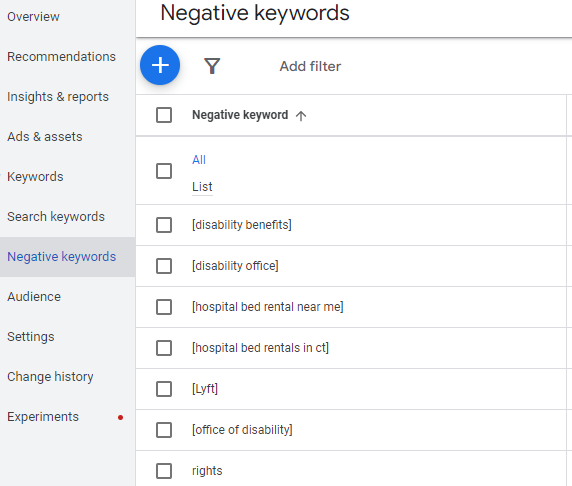
I’ve always made it a practice to review Google Ads search term reports regularly as part of monitoring how clients’ Google Ads campaigns are faring. Why? Because those reports show me what terms Google has actually served my clients’ ads up for during a particular timeframe. I make and take the time to scroll thru the terms that are generating the most impressions and clicks, and then, simply make any search terms for which Google Ads has served up the ads that I don’t believe are appropriate “negative.” Plus, reviewing the report often makes me think of similar search terms I should make negative. See example negative keyword list below and where to go to in Google Ads account to add negative keywords.
Concerned Your Google Ads Are Being Served Up To The Wrong Searchers?
Because one of the services my agency offers is PR — and we’ve had some decent success obtaining meaningful media coverage for some of our for-profit and non-profit clients (as documented in our Public Relations Portfolio) — of course, we reached out to The Patriot Ledger to see if they wanted to do a “then and now” story about our South Shore organization since they covered our story nine years back. We’re still awaiting news, literally and figuratively on that one, but we figured why not go ahead and share a similar version of that story on our blog using the highlights we shared with them? So, here goes…
I prefer to refer to my business as a digital marketing agency vs. a marketing consultancy because we do as much as hands-on work as we do developing & recommending marketing strategies.
Our story actually began with me launching my own WordPress website without the help of anyone else, and my officially hanging my digital marketing agency’s shingle via that site. And, if I knew as much as I know about WordPress and website development now as I knew then, I would have originally launched my site with WordPress.org (the platform that it’s on now) vs. WordPress.org, so I could use the many great WordPress plug-ins from the get-go! Or, I might also have considered Joomla instead, but owning a business and getting it right is all about the journey. And, you can’t learn what you need to learn without making a few mistakes and getting your hands dirty, right?
What’s been particularly challenging as an organization who helps others with their own marketing is, sometimes, as I’ve been known to share, “the cobbler’s kids have no shoes.” That means often we are so busy helping our clients with their marketing, we don’t have time for our own. The aforementioned said, we make every effort to have our firm’s own marketing activities (such as our website and social media profiles) serve as a shining example of how to maintain a strong online presence, and it’s great that we’ve been able to use our own business to test and try out various marketing activities — therefore, serve as a bit of a guinea pig — before we test or try something brand new with clients.
I believe and hope my story can motivate and inspire others considering opening their own business. Before, or right after I launched my business, I was told by one individual who works with entrepreneurs that 80% of female marketing consultants fail. I refused to be a statistic, and regularly told myself that during the first 5 years, which were the hardest. It takes a good five years to get the word out there and have business come to you organically/naturally thru referrals, leads, and recommendations from others — made by former co-workers and clients, existing clients, other marketing consultants and agencies, and other organizations who serve the same vertical/target audiences whom you serve.
My philosophy and dreams when I started my business have remained pretty constant and I’m pleased to report I’ve followed them. I’m particularly proud that I’ve been able to continue to offer what I believe, based on research, are very reasonable rates to small for-profit and non-profit organizations. Due to my years of experience and expertise, clients have access to the same level of knowledge and skills that they’d have access to via a larger marketing agency, but at much lower rates than what a larger agency might offer. And, because we have significant experience in both traditional marketing AND digital marketing, we can offer the majority of services a larger, full-service agency can.
The biggest lesson I’ve learned that I’d love to share with others starting a business is this: don’t think of others in your space as competitors. Think of them as collaborators – people who serve the same target audiences who may need your services.
Our Impact: Local (South Shore of Boston), National, and International
I’ve helped a number of young adults who grew up on the South Shore, or elsewhere in MA, get hands-on experience that they were able to parlay into a post-graduation job elsewhere.
Related to the above, I’ve had the great fun and pleasure of working with my nephews, my brother, my brother-in-law, and my late sister-in-law on various client projects.
I’ve also met with a number of college or graduate school students looking to pick my brain about careers in marketing and learn from me – including one in my neighborhood who found me thru a Google search! Yes, because early on I recognized I needed to create a Google My Business Profile for my own business to be found by local, relevant searchers and this is something I regularly help my clients with now!
I’ve given a large number of pro bono hours to nonprofits as part of a totally free consulting/volunteer situation or discussion, or as part of their paid arrangement with me. I’ve had a number of very interesting local nonprofit clients, including ones in the faith-based space, arts and music space, ones serving vulnerable populations, ones serving individuals with special needs, and one providing financially challenged teens the opportunity to serve vulnerable teens abroad, and more! Some have an international impact.
One of my specialties is helping nonprofits apply for a Google Nonprofit Ad Grant. I, then, often stay on and manage the Grant for them – $120,000 in free Google Search advertising annually. I can explain more.
I also have a number of for-profit clients on the South Shore, but my client base is national and I have had clients in New Orleans, CA, Texas, and more!
I’ve served over 120 for-profit and non-profit organizations in the 10 years I’ve been running my digital marketing agency/SEO company.
I had no idea when I launched my business that I would become an expert in something that I only had very little knowledge of at the time when I launched my business – search engine optimization (SEO). Many of my referrals for or sub-contracted work come from other agencies, marketing consultants, and website designers who need to pull someone into their client work/project who knows how to get websites and Google My Business Profiles ranking well in Google via organic and paid search (Google Ads) SEO activities. I’ve become a self-taught SEO expert and very proud of it. I just read and watched everything I could get my hands on, took Google Ads certification classes, and attended free webinars. I still do that daily as Google’s Search Engine will be switching to an AI one, and I’m already helping my clients be proactive about that and prep for it (Google SGE).
As indicated above, while I do sub-contracted or referred work for other agencies, marketing consultants, and website designers, many of my clients are my own clients, and I usually have a plate of about 12 – 15 clients for whom I’m doing ongoing, digital marketing work for on a monthly basis, plus also juggling several one-off/one-time clients at the same time. At any given point in time, I’m normally doing work for about 17 – 25 clients with the help of some fabulous interns and associates, as they were/are available.
I’ve given a number of free workshops for SCORE and other organizations serving entrepreneurs, and I’m a SCORE volunteer and have provided tons of free advice to entrepreneurs by meeting with them on a complimentary basis. And, related to all of this, I’ve had a blast partnering with fellow marketing experts to give presentations that address multiple marketing areas of expertise! Thank you! You know who you are!
I’m a data geek and SEO geek and proud of it. I’m a huge data slicer and dicer and that’s what separates me from a lot of others in my space. I always say I won’t encourage clients to start or continue with marketing activities that don’t make sense for them based on what data is showing. I consider myself to be my clients’ accountability partner, and I’m not afraid to give tough love when I need to. I’m not afraid to voice a different opinion than other marketers. If I think something isn’t going to work, or isn’t working, I speak up.
I’m also proud that my marketing agency survived our recent COVID-19 pandemic and was extremely proactive about providing helpful insights from the very start of the pandemic for marketers to appropriately respond to the pandemic/pivot, such as these blog posts about using paid ads during the pandemic and how to make sure your social media presence wasn’t offensive and was relevant.
I give back significantly to the community. I was involved with the Braintree Relay For Life Committee for a while, and now, I do a number of charity walks in addition to all the other beneficial work I mentioned above.
Our Focus On Health & Wellness
If you’re a regular reader of our blog, you’ll know that I’ll throw in a good blog post about walking once in a while. You can use the categories search tool/drop-down menu to search on “walking” to see the various walking topics about which I’ve written.
Since my corporate marketing days, I’ve always loved to share health & wellness tips — whether they be with fellow employees as part of an internal communications role, or with members of a health plan I worked for, and from the get-go with Results Communications & Research, I’ve aimed to inspire those with health (and other challenges) to never give up, and keep fighting via my “Keep Up The Fight” website page. And, I recently put up a new blog post about an invisible disease with which many health warriors who have battled or are battling other forms of illness have to contend.
Our Thank You
My digital marketing agency/SEO company and I would have never made it this far without all the help of great collaborators, cheerleaders (friends, family, my husband Jay, and other fellow small business owners), and most importantly, our clients who looked to us for expert marketing guidance and assistance. We have many clients with whom we’ve served as an outsourced marketing department for years, and we thank you for your faith in us! We’ve so enjoyed being a part of your business family! We also thank those who we haven’t had the opportunity to work with for as long as some of our long-term clients, but have enjoyed or are enjoying being a part of your organization’s success story.
What’s Next
I don’t know what the future holds for Results Communications & Research, but I’m excited about what’s to come! And, I know I will continue to try to give back as much as possible with the platform that this fun, educational, and interesting business provides!
Want To Benefit From The Marketing Services Of A Digital Marketing Agency/SEO With A Long Tenure And Who Gives Back?