AEO, AI Search, Being Found On Bing, Being Found on Google, Blog, Blogging, keeping up with trends, marketing best practices, meta tags, organic SEO, pull marketing, Search Engine Optimization, SEO, SEO tags, website

Why Meta Description Tags Still Matter, And May Matter More, When It Comes To Being Found Online

Prior to the introduction of AI search engines, we always advised our clients to be sure to complete both their SEO page/post title tags and their SEO meta description tags for any page or blog post on their website. Both tags are known as “meta tags” and both support websites being found online in relevant geographies by relevant searchers.

The History Of Meta Description Tags And Their Role Related To SEO

It used to be that, instead of creating and serving up their own description with a link to an organization’s website in search results, traditional search engines (like Google and Bing) would rely on the meta description tag associated with an organization’s website page or blog post, and therefore, automatically serve the content’s tag up along with a link to the website blog post or page in-question. This gave website owners control over what content was shared with a link to their website by search engines.

We don’t know the exact timing, but estimate the above scenario changed five or more years ago when search engines discontinued defaulting to the meta description tag provided by the content owner and starting creating their own “blurbs” to serve up with website content created by various website owners. This meant website owners never knew, and no longer had control over, what content was served up in search results with a link to one of their website pages or blog posts. Regardless, we still continued to encourage clients to fill in meta description tags using whatever fields their website platform/content management system (CMS) provided, or a website plugin used with their website provided, so that traditional search engines could serve up meta description content in search results listings if they chose to do so.

Image shows All In One (AIO) SEO plug-in used with WordPress to house a meta description tag. The meta description tag reads "Learn why meta description tags may matter more related to being found on AI vs. traditional search engines and how & why to complete and structure these tags.
Image of AIO (All In One) SEO WordPress Plug-in Field For Entering Meta Description Tag

In the days before AI search engines, we always said to our clients that, “while meta descriptions weren’t used by traditional search engines to figure out what a page or post was about and, therefore, what to index a website page or website post for (the way that SEO page and post title tags were and currently are used), they indirectly influence SEO (search engine optimization and being found online) since, if they are well-written and served up in search results listings, they may encourage a searcher to visit your website and that leads to more website traffic. And, more website traffic leads to search engines thinking your website is creditable/reputable and makes the engines more comfortable serving up your website in relevant search queries in relevant geographies.”

Use Of Meta Descriptions By AI Search Engines

We recently heard at an SEO conference and read online in an SEO expert’s website content that meta descriptions were making a comeback with AI-search engine/answer-engine optimization (AEO). Why? Because AI/answer engines are reading meta description tags, and sometimes, serving that content up in the answers they provide to questions posed to them by tool users.

How To Write An Effective Meta Description Tag To Support Being Found By Target Audiences

Here’s how to write an effective meta description related to use by both traditional and AI search engines:

  • Keep your meta description tag to 160 characters or less (including spaces).
  • Spell out what visitors will learn and/or the information they’ll have access to if they visit your website post or page — therefore, what answers will they get or actions will they be able to take by visiting your post or page
  • Don’t use “internal speak” or acronyms in your tag that your target audience/laypeople wouldn’t understand or use
  • Walk in your target audience’s shoes
  • Do use call-to-actions in your meta description tag, like:
    • Learn how
    • Read about
    • Get answers to
    • See how
    • Read how
    • Check out
  • Never use the same meta description tag (and for that matter, SEO/meta title tag) for more than one page and/or post on your website. That will just confuse search engines and make them less likely to serve up/share your website content!

Meta Description Tag Examples

Some examples of meta description tags include:

“Learn about products offered by our durable medical equipment company that provide greater mobility and independence to those challenged by disability and aging”

“Read about tactics to implement on your website to support it being found by relevant searchers in relevant geographies, including in AI search results”

“Learn how our estate planning law firm creates estate plans that include the documents you’ll need in case of serious illness and ensure last wishes are honored”

Need Help Writing New Meta Description Tags Or Rewriting Old Ones?

Use our calendar app to schedule a complimentary SEO/AEO discussion today with an SEO expert to discuss your particular marketing opportunities and challenges. Or, check out our list of SEO/AEO services!

AEO, AI Search, Being Found On Bing, Being Found on Google, keeping up with trends, online presence, organic SEO, pull marketing, Search Engine Optimization, SEO, staying current, Understanding Your Environment

Understanding AI Search Engine Terminology

June 2026 Update:

It’s been a full year since we originally published this blog post dedicated to understanding AI Search Engine Terminology. Since this area continues to evolve rapidly, we felt it was time for an update! Any Text in GREEN below reflects information that was added to the post since we first wrote it.

A big challenge to all marketers today is the number of different terms that are being thrown around related to the use of AI search engines, or what can be called “answer engines.” These are also referred to as LLMs or LLM engines since they are powered on large language models. In addition, these terms aren’t always used consistently and mean different things to different organizations and marketers. To inform our readers about the current AI search engine landscape and help them understand what certain terms truly mean, we’ve put together the below glossary of AI search terms.

AI Search Glossary

  • AEO – while this acronym is also used for non-marketing and non-search-engine-related topics, when applied to search engine optimization (SEO), it’s related to one of the two broad branches of search tools (answer engines) that are available for use by searchers today, and stands for “Answer Engine Optimization.” Explained in this outstanding Better Business Bureau blog post about AEO, AEO practices and tactics focus on creating and sharing content that provides a “direct, informative, and well-structured answer” to a question that a searcher enters into a generative AI interactive, conversational (chat) tool, such as Perplexity, ChatGPT, and Google AI Mode. As we explained in our blog post about generative AI, the whole premise behind AEO is to answer questions searchers have via the online content your organization produces and shares. Don’t lose site of the variety of content AI search engines may pull and provide to question askers — check out our comprehensive list!
  • Answer Engines – as alluded to above, “answer engine” is a term used to describe interactive, conversational tools like Perplexity, ChatGPT, Google AI Mode, and Google Gemini. In lieu of spitting back a long list of links to websites and other online/digital properties (known as SERPs), these answer engines tend to provide content blocks — often without links — that synthesize data from a number of websites to answer the searcher’s question. This can mean that your organization or your content may be mentioned/included in response to an appropriate “prompt,” but a link back to your website, known as a citation won’t always be included.
  • Agentic AI – it’s not yet known what the implications are related to traditional search engines and answer engines, but in the words of Nvidia, agentic AI refers to AI that “uses sophisticated reasoning and iterative planning to autonomously solve complex, multi-step problems. And it’s set to enhance productivity and operations across industries.” As of the date of the revisions to the blog post, many SEO experts are using this term to pertain to a tool that individuals sign up to use that allows the tool to choose and/or buy a product or service on behalf of the tool user.
  • AI Search – this is one of the terms that we were thinking of when we mentioned that different organizations and marketers are using this term differently since AI search can refer to the use of an answer engine like the ones we discussed above to identify external resources and external data related to a particular question, or it can be used to describe searches of organization-owned/internal data (this data may extend to data that the organization shares publicly or enters into digital tools or apps or technology, but ultimately, it’s information owned by or generated by the organization.) An example of this latter case is discussed in this guest blog post by Medullar who offers an AI productivity and collaboration tool for SMBs, and particularly consulting firms and professional-services firms.
  • Chat Search Engine/Chatbot Search Engine – chat search engines/chatbot search engines really are the same thing as answer engines (described above).  They employ the conversational, interactive capability of chatbots, but also the capabilities of providing answers to questions from data they collect/gather across the internet the way that traditional search engines like Google, Bing, Yahoo, and DuckDuckGo do. It’s basically a search engine that users chatbot functionality to interact with individuals asking questions vs. just searching using a statement, term, or topic.
  • Chatbot – technology that provides an interface for humans to communicate with that interface via voice commands, text (typed commands) or both. It is considered a form of AI and is employed in online messaging or online chat services used by organizations to answer customer or prospective customer questions like LiveChat ones.
  • Generative AI – generative AI is technology that pulls data/content from a variety of sources and produces (generates!) new content based on what it’s learned. The content can be viewed as a summary or synthesis of information collected by the technology.
  • GEO (Generative AI Optimization) – employing best practices and tactics so that your organization appears in generative AI results; basically, same as AEO with the nuance that instead of answer/AI search engines serving up verbatim the answer that you provide to a question, answer/AI search engines are “citing” your organization because they view you as an expert and are providing a link back to your website as part of their results to a relevant “prompt.”
  • Large Language Models (LLMs) – if you really want to get into the nitty-gritty of understanding how LLMs work, Search Engine Land explains it well. Most organizations/lay people simply need to have a general understanding of this term because it’s often used in regards to answer engines/chatbot engines/generative AI engines because it’s the LLM technology/capability that lets the engines service engine users the way they do. As Search Engine Land states, “The core functionality of LLMs in search is to process queries and produce natural language summaries. Instead of just extracting information from existing documents, these models can generate comprehensive answers while maintaining accuracy and relevance. This is achieved through a unified framework that treats all (search-related) tasks as text generation problems. What makes this approach particularly powerful is its ability to customize answers through natural language prompts. The system first generates an initial set of query results, which the LLM refines and improves.”
  • Mention – this is when the name of your organization gets served up in AI search engine results. This may happen with or without the engine including a link back to your website (citation).
  • Prompt – this is what a user of an answer engine/AI search engine like ChatGPT or Google Gemini enters into the tool to get an answer/results/help/advice, etc. Check out this blog post about why appearing in AI search prompt results may help your organization.
  • RAG (Retrieval-Augmented Generation) – refers to a content-generation method that takes advantage of both information information retrieval and LLM. It’s about producing content that’s both relevant and accurate by combining external data with generative AI capabilities.

Continue to Check Back For AI Search Engine Terminology Updates

We read, listen to, watch everything we can get our hands on these days related to changes in the world of search engine optimization and answer engine optimization. In keeping with the aforementioned, we will continue to update our terminology list, so please continue to check back!

Need Help Understanding The Impacts Of AI Search Engines And How To Respond To Them?

Reach out today for a complimentary discussion of how to respond to the growth in use of AI Search Engines! Or, about how to advertise on ChatGPT!

Acceptance of Circumstances, Being Found On Bing, Being Found on Google, competitive advantage, keywords, marketing best practices, organic SEO, Search Engine Optimization, search terms, SEO, website

When You’ve Exhausted Your Starters, Let Your SEO Bench Step In

Anyone who’s interacted with me in a lot in the last five years knows that I’m a huge Boston Celtics fan. I started watching them during the pandemic and while they were playing in the “bubble.” I got hooked pretty quickly, and the rest is history. By the way, I also like the Boston Bruins and the Boston Red Sox , and have enjoyed watching both of the aforementioned teams for many years.

In fact, the Red Sox had my sports heart way before the Celtics did. But, since it’s still 2025 NBA playoff season, and my beloved Celtics recently endured a lot of hardship in the form of injured/ill players (which definitely played a role in their NBA Championship journey ending far sooner than fans hoped or expected), my sports-related analogy will be basketball-related vs. hockey- or baseball-related.

When To Bring In the SEO Back-ups: H2, H3, and Other Sub-headers

Anyone who knows SEO best practices and commonly accepted SEO wisdom knows it just makes good SEO sense to include high-volume keywords and questions in your public-facing website page and post titles, which usually take the form of what’s known as an “H1 header.” An H1 header is the first heading that appears in any website post or page. In the case of this blog post our H1 header is “When You’ve Exhausted Your Starters, Let Your SEO Bench Step In.”

Let’s say you’ve employed the above SEO tactic already, along with these other commonly known and respected SEO best practices, such as:

And, the above aren’t taking your site to where you want and need it to be, i.e., higher up in search-engine results for search terms and questions regularly entered into search engines by target audiences. Maybe, it’s time to give the players who get less play time, more play time! Call them what you will — the bench, the scrubs, the B team, etc. — these non-starters might be exactly what you need to help you score some SEO baskets, including 3 pointers!

This image was taken from Loge seats at a Boston Celtics game and shows the TD North Bank stadium packed with fans, but also the Celtics' players out on the court and the jumbotron.
Last Regular Season Celtics Game At TD Bank Garden, Boston

What Is An H2, H3, H4, etc. Header?

At Results Communications & Research, we like to refer to any headings that are used on a website page or in a blog post and aren’t the first/main header on the page as sub-headers. These are headers that appear below the primary header on the page, tend to be smaller in font size than the main header, are formatted as an H2, H3, H4, etc. header and are often used to break up and/or introduce content — making it easier for both readers and search-engines to consume/absorb the content that appears below the sub-header. The “What Is…” header directly above is formatted as an H3 header, and the “When To” header above that as an H2 header.

As the creator of any blog post or website page content, you will have to decide when to use H2 headers vs. H3 headers, etc. If a sub-header feels more like a sub-header of another sub-header, then it should use a header format that is lower in the header hierarchy (with H1 being 1st in the hierarchy).

Why Use H2, H3, H4 Sub-headers?

The reason to let the sub-headers take a chance at improving SEO game results is because they provide additional and new headings/headers for search engines like Google to crawl. This means they provide more detail and/or more opportunities for you to re-share previous information with search engines so they know what a website post or page is all about and when to serve it up in search results. It’s just one more way to make it easier for search engines to quickly and easily identify and understand when it should serve up a particular website post and page in response to a particular search query.

We’ll Always Bring Our A Team To Any Clients’ SEO Game

Regardless of encouraging you to clear your SEO header bench, we’ll always bring our A team, i.e., our starters, to any SEO discussion or engagement with you, so schedule a complimentary discussion of your marketing challenges and opportunities with us today!

Acceptance of Circumstances, AI Search, Being Found On Bing, Being Found on Google, Blog, Blogging, keeping up with trends, lead generation, online presence, pull marketing, Search Engine Optimization, staying current, target audiences, website

Being Found On AI Search Engines And Do You Need To Be?

Since the “AI search engine” questions outlined below come up regularly with existing and prospective clients, it made sense to address them in a blog post that can be shared as needed, and that can be found by searchers looking for answers to them.

Common Questions SEO Experts Get Asked About AI Search Engines, Like ChatGPT (Owned by OpenAI)

  1. How will my organization benefit from appearing in search results served up by ChatGPT or other AI search engines in response to relevant searches?
  2. What can I do to ensure my organization’s name and/or link to website appears in ChatGPT or in other AI search engine results?

Benefits To Appearing In ChatGPT Or Other AI Search Engines

Let’s start with question #1 above. Jumping on the latest marketing “toy” can, often, be a huge waste of time and energy. And, because of my organization’s tagline, “Maximizing Results Thru Research-Supported Marketing,” I’m the first one to speak out if data doesn’t support using that “toy” just because everyone else is jumping on the bandwagon. As you’ll see, I’ve done so related to social media – for many organizations it just doesn’t move the awareness, inquiry, or sales needle, even though there are certainly organizations for whom it does – and related to paid search/Google Ads (in this latter case, this is often an effective marketing tool for organizations, but it’s not effective for ALL organizations).

Sure, AI search engines that search the internet for you to provide answers to your question sound cool, fun, and interesting, but per this March 2025 article by Search Engine Land about search engine use in 2025, the majority of searchers are still using the traditional Google search engine to conduct internet-wide searches, and even if they weren’t, SEO best practices that apply to being found on traditional search engines, like Google and Bing, still make great sense related to being found in AI search engine results. Ultimately, it’s all about putting up helpful, consumable content that’s valued by your target audiences. And, that holds true for both traditional and AI search engine success, as we outlined in these two previous blog posts:

As you’ll see from reading the linked Search Engine Land article above, only about 1% of searchers use ChatGPT! Let’s move beyond the far-smaller-than-Google number of users who use ChatGPT, even though that will obviously impact your organization’s chances of being found by relevant searchers in relevant geographies, and tackle the question “would your organization benefit if someone conducted a relevant search in ChatGPT?” Your organization would likely only benefit and/or benefit most from appearing in AI search results if:

  • The mention of your organization in the results spit back included a link to your website.
  • The searcher originally included some kind of geographic mention when they conducted the search, so that your organization is appearing in search results in a geography you serve.

As you’ll see from the below print screen, our digital marketing agency and SEO company appears at the top of ChatGPT’s list when someone enters the relevant search shown in a relevant geography. Did we do anything beyond adhering to long-standing SEO best practices to ensure we appeared there? Nope.

This image shows results that appear in ChatGPT when the "ask anything" command is used and we asked "who are the best SEO experts on Boston's South Shore?" At the top of the results is our SEO company, Results Communications & Research.

For a geographic-neutral search, i.e., one where the searcher didn’t enter a specific location as part of their search, we don’t appear. But, we wouldn’t expect to, as our organization is literally competing with 1000s and 1000s of other SEO companies and digital marketing agencies across the entire country, and maybe the world. We’re not even slightly upset or disappointed by this, as we find many people still want to hire an SEO company or digital marketing agency that’s in the same state or at least same region (in our case, New England) as them. So, we aren’t concerned that our organization’s name and/or a link to our website isn’t being served up to someone who may be searching from as far away as California.

This image shows the results generated by ChatGPT when we used the "ask anything" command to answer the question "who are the best SEO experts. The list includes Neil Patel and other well-know national and international SEO experts.

And, as you’ll see from the below image, when people search more broadly/generally about SEO services, the names of organizations who offer such services aren’t even mentioned, and links to such organizations websites, therefore, don’t appear. So, it doesn’t seem there is a lost/missed opportunity there…

This image shows the results generated by ChatGPT when we used the "ask anything" command and searched on "what types of companies offer SEO services?" It spit back a list tht includes, but is not limited to SEO Agencies, and Digital Marketing Agencies.

A more indirect SEO benefit to appearing in AI search engine results is related to this longstanding SEO basic tenet: unless you’re getting a lot of website traffic from spammy referral sites, the more traffic your website gets, the more creditable/reputable search engines will view your site to be, and the more likely they will serve it up in search results. That said, most of our clients are only getting 1-5 visitors, at most, a month to their websites, so focusing heavily on trying to appear in AI search results, just to get additional traffic, doesn’t seem worth an organization’s efforts.

What makes appearing on ChatGPT even more complicated is that individuals who have signed up to use the tool at https://chatgpt.com, can either “ask anything,” and automatically put the type of “search” statement/question into it that they would put into Google or Bing, or they can click on the “search” (world) icon underneath the “ask anything” command/feature.

In full disclosure, we used the “ask anything” command vs. the “search” command to generate the search results we’ve shared in this post, but we don’t think the average person knows or thinks about when to use one command or feature vs. the other. We did see that when we used the “search” command/feature that different results than what were generated for “ask anything” were spit back. Regardless, our thinking is the same regarding time and energy spent to be found on ChatGPT. Unless someone completes a search (using either of the two commands/features that includes a geography, there’s probably neither a large chance that your organization will be served up nor a large chance that the person searching is going to engage you for your services or buy your products.

How To Appear In AI Search Results, Including Those Generated By ChatGPT

Moving on to question #2 above — which we’ve already addressed to a decent degree as part of answering question #1 – if you want to appear in AI search engine results, including ones generated by ChatGPT, continue to put out fresh, and easy-to-understand content that is of importance to your target audiences. The content may or may not be directly related to your products or services. The important thing is to be helpful and to try to drive appropriate traffic to your website thru content that is either directly related to the products and services you offer, or only very tangentially related. An example would be a roofing company. You don’t always want or need to put up content about roofing. Since your clients would tend to be local, you could post content about community events going on in your area/the towns you serve and/or share information about non-roof home improvements. And, be sure the content provides enough detail that if the reader wants to take a next step/action, they know what that step or action is.

Our Conclusions About Appearing on ChatGPT and AI Search Engines, In General

To quote Shakespeare, right now all the frenzy and energy spent around AI search engines that search the internet feels like “much ado about nothing.” At least for now/the immediate future. But, of course, as SEO experts, we will continue to keep our eyes on things, test and use AI search engines, attend relevant courses, and read relevant information.

Need Help Understanding The Pros and Cons Of Putting Time & Energy Into Being Found On AI Search Engines

Reach out today to schedule a complimentary consultation with an SEO Expert.

advertising agency, AI Search, Being Found on Google, blog, Blog, Blogging, Consulting, content marketing, digital marketing agency, diverse experience, Google Ads, lead generation, marketing agency, marketing consultant, online advertising, paid search, pull marketing, push marketing, Search Engine Optimization, SEM, SEO, target audiences, Target Marketing, traditional marketing, website

11 Years and Close To 150 Customers Later…

We can’t believe it either, but today (April 1, 2025) marks 11 years of Results Communications & Research (Results C & R) being in the marketing agency and SEO company business.

As we always have been, we are very grateful to the many talented marketing consultants, marketing agencies and their staff, and other marketing professionals we’ve had the pleasure to collaborate with, and to learn from. We mention a few of those marketing collaborators on our Our Team page, but the list is so long, it’s hard to give a shout-out to everyone we’ve enjoyed meeting, knowing and working with the last 11 years!

And, we are incredibly grateful to the close to 150 client organizations — both for-profit and non-profit — with whom we’ve brainstormed and strategized to achieve the best possible level of awareness, sales leads, and actual sales (both product and service sales). Many of our current clients have been with us a number of years. You can access a list of our past and current clients to see examples of industries we’ve served by visiting the Clients page of our website.

Lastly, we’d be very remiss if we didn’t give a huge shout-out to the various students or recent-college- or recent-graduate-school graduates who worked for us over the years, and to our Principal’s late sister-in-law who greatly supported our mission, contributed to our success, and believed in us. All of the aforementioned individuals will always be a part of Results C & R’s rich history!

What’s Next For Our SEO Company and Marketing Agency?

In general, it’s full speed ahead with serving the same type of customers we’ve always loved serving — small to mid-sized for-profit and non-profit organizations. But, right now, we are enjoying spending more time getting up-to-speed on anything new and different going on in the Google Ads space. We love helping clients create awareness, sales, and leads with Google Ads and always have, so we are refreshing our Google Ads skillsets (even though we’ve taken and passed a number of Google certification exams in the past), particularly, Google Performance Max ones, so that we are not missing out on any opportunities to maximize our clients’ Google Search, Google Display, and Google Performance Max campaigns. Think of this latter campaign type as of a hybrid of the two former Google Ads types of campaign, and one with an AI component, like Google Display.

AI Is Not New To Google Ads/Google Ads Is Not New To AI

Related to our above desire to continue to grow our Google Ads skills, we want to remind our readers that AI is not new to Google Ads and Google Ads is not new to AI. For years, Google Ads has been able to offer “display” ad campaigns that are targeted to individuals who show affinity to certain products or services because of past buying or researching of them, having interests related to them, visiting websites focused on them, or reading about them on a variety of diverse websites.

AI and Writing Website Content, Particularly Blog Posts

And, speaking of AI, another area in which we hope to do more client work in the coming year is blog writing for clients. We’ve offered blog-writing services for years — and a number of clients have taken us up on it — but because we really enjoy writing, we hope to do more of this work for clients.

We don’t think AI search-engine/tools like ChatGPT will, or should ever, replace humans when it comes to website content and blog post writing. There’s great evidence that, at least some of what is spit back by AI search engines is not accurate. Plus, we don’t think an AI tool can ever bring the behinds-the-scenes knowledge or heart ‘n soul of an organization to website content writing or blogging. Only the organizations, themselves, truly understand what challenges their target audiences face — what their pain points are — and what they most need help with and how the organization’s products and services make a difference in their client’s/customer’s lives.

Traditional Marketing Opportunities Are Often Missed Ones

And, we always enjoy — and hope to do more of this in the coming year — helping our clients out with traditional marketing opportunities like print, radio, and TV/cable/streaming advertising, transit advertising, outdoors (billboard advertising) and more. We’ve got years and years of experience related to it and can help you gather information on possible traditional marketing opportunities and evaluate them! By dismissing traditional opportunities because they aren’t online/digital ones, organizations can also miss out on reaching target audiences who don’t spend a lot of time on the internet!

An image of our digital marketing agency's Founder and Principal, Gail Snow Moraski who is wearing glasses and who has shoulder-length blonde hair and who is weraing a red dress, a black cardigan and a sliver necklace.
Our Principal, Gail Snow Moraski, in a photo from around 2014, the year she founded Results C & R

Many Thanks and Let’s Catch Up!

Many thanks to the clients and marketing professionals we continue to collaborate with!

If you’re a past client, a prospective client we spoke with, or a fellow marketing professional with whom we collaborated in the past, or if you’ve interned with us in the past, let’s catch up. Schedule a time to do so today!

Acceptance of Circumstances, AI Search, Being Found On Bing, Being Found on Google, Google Ads, keeping up with trends, marketing best practices, Marketing Planning, Objectives Setting, paid search, pull marketing, push marketing, Search Engine Optimization, search terms, SEM, SEO, SEO tags, strategic planning, target audiences, Target Marketing, Understanding Your Environment, website

Like SEO, Keyword Research Is Not Dead

Some SEO experts are saying identifying and focusing on ranking for keywords, i.e., high-volume appropriate search terms your organization wants to be found for in search engines in relevant geographies, isn’t as critical to SEO success as it used to be. In keeping with our recent blog post about SEO (search engine optimization) still being relevant, keyword research is still quite relevant to both for-profits’ and non-profits’ success.

Here at Results Communications & Research, we still believe and see evidence from the SEO rankings audits of clients’ websites that we conduct, that understanding the search terms that target audiences are entering into Google, Bing, and other search engines and capitalizing on them (as explained in this previous blog post about how to interpret and use keyword research) is still an important SEO tactic and one that moves the SEO needle.

We don’t see the day coming (for a long time, if ever) on the SEO front where clients aren’t going to want and need to remove their blinders and not rely on internal speak and internal knowledge to inform both their SEO and their overall business strategy. Keyword research allows them to take those blinders off.

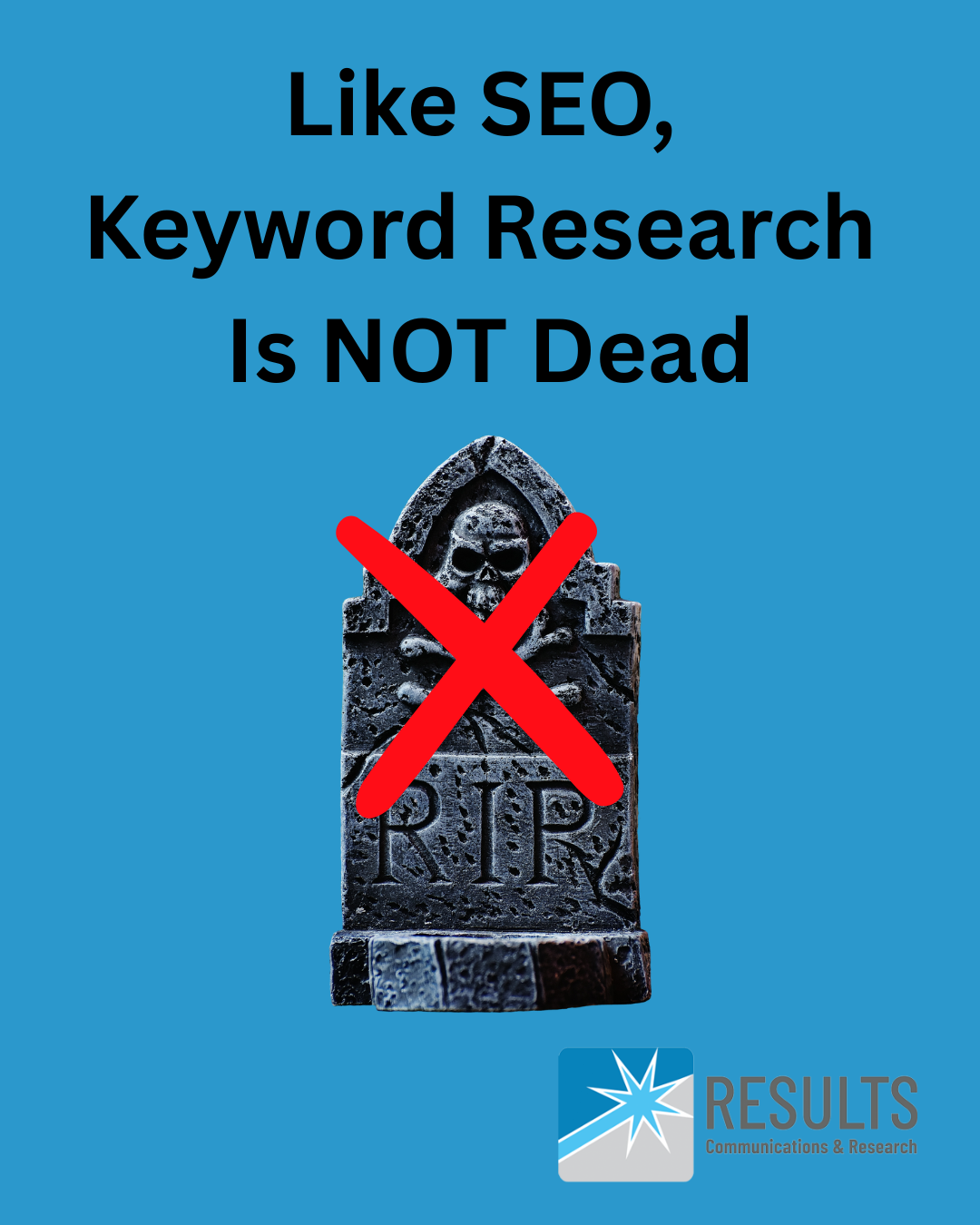
This is a blue square image that reads in black font, "like SEO, keyword research is not dead," and that contains the picture of a tombstone that says "RIP" on it, and the tombstone has a red X over it/crossing it out. The image also contains the logo of our SEO consulting firm, Results Communications and Research

Non-SEO Benefits Of Keyword Research

Keyword Research Is Not All About SEO, It’s Also About Your Marketing and Business Strategy

Even if keywords were no longer important to SEO, keyword research still allows you to determine:

  • What products and services target audiences are searching on which can help an organization to decide to eliminate products or services or add new ones
  • The volume of individuals who are searching in an organization’s market area (geography) to help inform whether push or pull marketing is warranted

Read our blog post about why keyword research informs more than an SEO strategy.

Need Help Conducting Keyword Research?

Our team regularly conducts keyword research to inform our clients’ marketing and SEO strategies. Reach out today to schedule a complimentary discussion about our keyword research services.

Being Found on Google, competitive advantage, Google My Business Profile, keywords, marketing best practices, online presence, organic SEO, pull marketing, Search Engine Optimization, search terms, SEO

Are You Making These 3 Mistakes Related To Your Google My Business Profile?

As part of our organization’s organic SEO (search engine optimization) services, we ask to have access to a client’s Google My Business Profile, or at least have a chance to review the behind-the-scenes information/set-up with our SEO clients via a Zoom call where they access and share their Google My Business Profile dashboard.

Whether you want to think of it as a mistake or a missed opportunity, here’s three Google My Business capabilities you may be missing out on to get your organization ranking better locally on Google (remember, Google is more likely to serve up your Google My Business Profile vs. your website) for “near me” or “city/town” terms) :

  1. Providing Google with 20 services areas. Make sure you capitalize on these. And, remember, the further out your business is physically from the geography in which a searcher is searching on relevant terms, the less likely Google is to serve up your Profile, so keep any service areas you add to your Profile within a two-hour drive of your physical office, and ideally far less than two-hours.
  2. Identifying up to 10 business categories. You need to pick a primary category — a category of business that best describes your products and services, but you can pick 9 additional “secondary” categories. Right now, there are over 4,000 business categories in Google My Business from which you can select. And, Google keeps adding to the list, so even if you don’t see a category that fits a particular product or service you offer now, you should revisit your Profile information every 3 months or so to see if there are any new categories you can select that are appropriate to your business.
  3. Providing specific product or service lists underneath your various business categories that employ keywords (search terms) on which your target audience(s) may be searching. See example below where we listed our SEM (paid SEO/Google and Bing Ads) and organic SEO services under our primary business category.
This image shows information you can see within your Google My Business Profile dashboard. It shows an example of service listings that have been added under a primary business category in Google My Business. The primary business category says "Marketing agency" and underneath it there are service listings for "Local and Global (Organic) SEO and "SEM/Paid Search."

We Can Help You Optimize Your Google My Business Profile

Reach out today to learn more about our local SEO services! And, learn about another Google My Business best practice!

Google Analytics, lead generation, Marketing Planning, online presence, organic SEO, pull marketing, Results Analysis, Search Engine Optimization, SEO, Understanding Your Environment, website

Why Looking At Your “Organic Search” Traffic Volume In Google Analytics No Longer Tells The Whole Picture About Your Site Being Found On Search Engines

As I’ve been reviewing both my own website’s Google Analytics data, as well as that of my clients’ websites in recent months to see how much traffic they are getting from “organic search,” therefore, search engines, it’s become quite clear to me that an organization should no longer just rely on the results shown under the traffic acquisition and user acquisition reports, and specifically the results listed for defined traffic channel “organic search,” to assess how the site is faring from an SEO (search engine optimization standpoint).

Why? Because AI search engines are being used more and more by searchers and Google Analytics (GA4 Analytics) does not yet account for traffic coming from AI search engines like ChatGPT and Perplexity and does not incorporate such traffic in the “organic search” volume total. Instead, that type of traffic shows up under the Google Analytics defined channel of “Referral” traffic.

How To See If Your Website Is Being Served Up In AI Search Engines

So, in addition to checking your “Organic Search” (search-engine) traffic volume, you will need to look at your referral traffic to see if any AI search engines are “referring” traffic to your site. You can do so by adding the “source/medium” dimension to your user or traffic acquisition report as shown in the print screens below related to our own website.

This is a print screen of the user acquisition report from Google Analytics for our SEO consulting firm, Results Communications and Research that shows the various marketing channels that are driving traffic to our website.

Click the “+” sign in the top left side of the report shown above to add another dimension to your Google Analytics report.

This is a print screen of the user acquisition report from Google Analytics for our SEO consulting firm, Results Communications and Research that shows the various marketing channels that are driving traffic to our website, but it also shows how to add dimensions to your user acquisition report so that you can see more detail about the various sub-marketing categories from which website traffic is coming from.
This is a print screen of a report run for our SEO consulting firm in Google Analytics to be able to see where all our website "referral" traffic is coming from, i.e., from what external websites are we receiving traffic.

Look thru the immediately-above report for referral traffic coming from AI search engines like ChatGPT and Perplexity.

Need Help Figuring Out How To Rank Better In AI Search Engines? Reach Out Today To Speak With An SEO Consultant.

Reach out today for a complimentary discussion about the type of online content your organization needs to regularly produce and publish to rank well on all search engines, not just AI-search ones!

AI Search, Being Found On Bing, Being Found on Google, Bing Ads, competitive advantage, digital marketing agency, Google Ads, Google My Business Profile, keeping up with trends, marketing best practices, Marketing Planning, Microsoft Ads, organic SEO, Post-COVID-19 Marketing, post-pandemic marketing, pull marketing, Search Engine Optimization, SEM, SEO, social media, social media strategy, social media voice, strategic planning, Understanding Your Environment, website

Does SEO (Search Engine Optimization) Still Work?

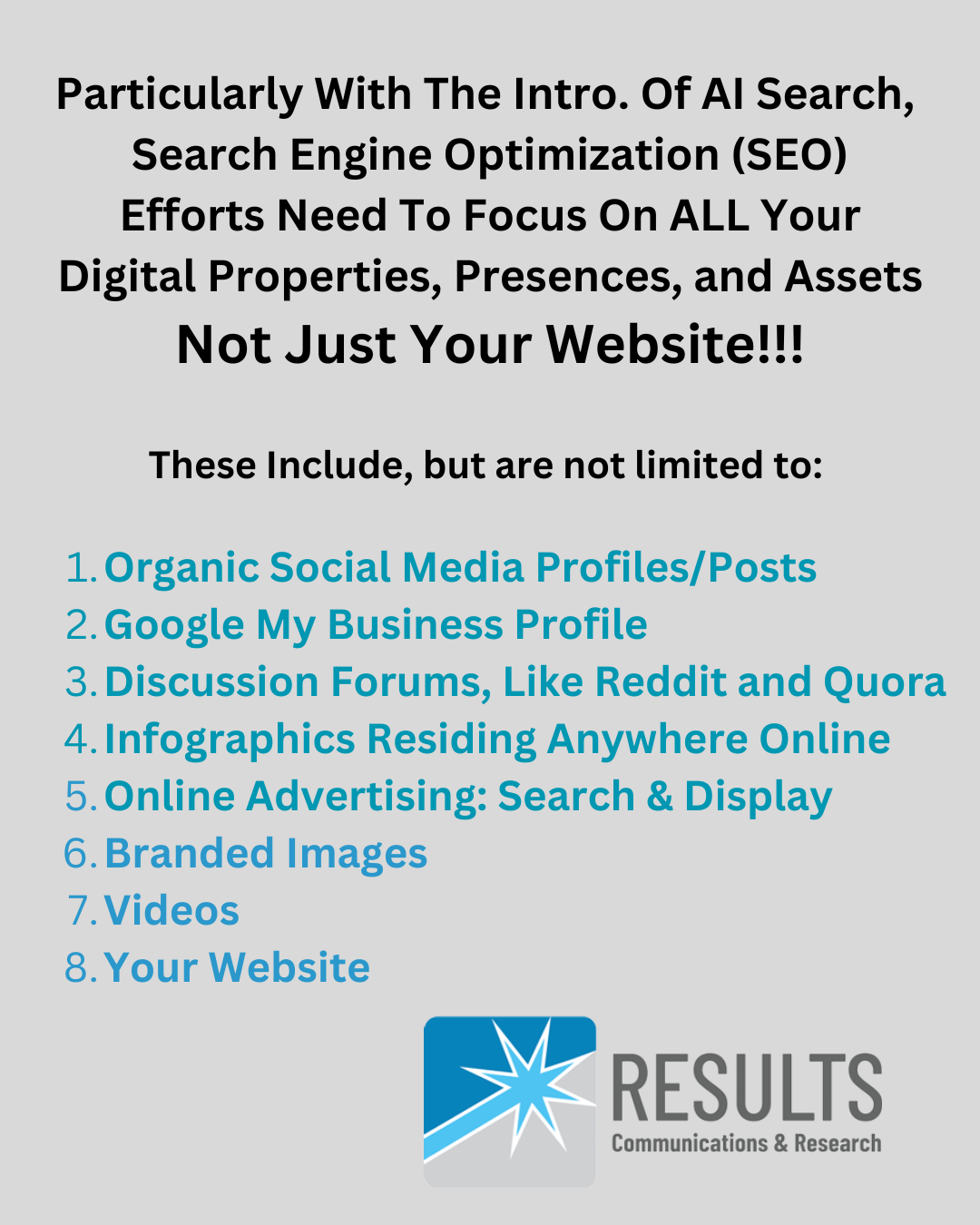
As we’ve explained in numerous spots throughout our website, SEO (Search Engine Optimization) is the practice of ensuring your organization is found online for relevant search-engines searches in relevant geographies. But a huge mistake in 2025, and beyond, would be to only focus on your website and Google My Business Profile being optimized to be found by appropriate searchers/target audiences, as shown in the image below.

Gray image with turquoise lettering that reads "Particularly With The Intro. Of AI Search, 
Search Engine Optimization (SEO)
 Efforts Need To Focus On ALL Your 
Digital Properties, Presences, and Assets
Not Just Your Website!!! These Include, but are not limited to: 
Organic Social Media, Profiles/Posts
Google My Business Profile
Discussion Forums, Like Reddit and Quora
Infographics Residing Anywhere Online
Online Advertising: Search & Display
Branded Images
Videos
Your Website." The image also contains the logo of our SEO consulting and digital marketing agency, Results Communications & Research.

If you’ve been regularly reading our blog or, simply, just reading whatever you can get your hands on related to SEO, you know that search engines’ focus since the 2020 pandemic has been on answering (by providing other organizations’ answers to) questions that searchers have related to a particular topic, product, service, or solution. Search engines care less and less about the source and format of that content, and they’ll snag content from just about anywhere on the internet if it answers a question in a manner that is easily understood/is absorbable, and that allows readers to take action/the next step.

Is SEO Dead? Does SEO Still Matter?

The answer to the above is “no way!” In fact, just the opposite, although some digital marketing experts are saying it is, or are reluctant to use/expand the SEO acronym or search engine optimization phrase to describe maximizing your opportunities for all and any digital assets, presences, or properties to be served up in search-engine results vs. just an organization’s website, Google My Business Profile, and paid search/search-engine ads (think Google and Bing ads).

Hey, right now in this time of constant change on the SEO front, no-one really is the one true expert or SEO guru, so we’re going to take our stand vs. following the crowd or one expert, and say that Search Engine Optimization (SEO) is about making sure all your digital assets, presences (think social media posts and presences and discussion forum presences) and properties serve you well related to being found online for the right search terms, questions, and topics in relevant geographies.

Let’s Chat About What SEO Means In This New Era And How Your Organization Can Plan and Respond To It!

We always love a complimentary discussion of for-profit and nonprofit organization’s digital marketing challenges, so schedule a discussion with our SEO consulting firm today!

Acceptance of Circumstances, Being Found On Bing, Being Found on Google, digital marketing agency, Enjoying What You Do, marketing agency, online advertising, pull marketing, Search Engine Optimization, SEM, SEO, staying current, Understanding Your Environment, website

Who’d Have Thought In The 1980’s I’d End Up As An SEO Consultant?

As shown in the image below, my husband, Jay, and I had the good fortune of attending a women’s basketball game this past Sunday, at my undergraduate alma mater, University of Connecticut (better known as UCONN). If you’re a fan of college basketball and/or of March Madness, you know that UCONN has had a very strong women’s basketball team for years, and in recent years, the men’s basketball team has played quite well and won the NCAA championship for the last two years! I share all of this because their great success means it’s very hard to land tickets to watch either of the two teams play. Fortunately, we were gifted some tickets from our nephew for Christmas!

Being back on UCONN’s main campus in Storrs, CT brought back so many wonderful memories of my three years spent there (I spent my entire senior year abroad in France as a participant in their JYA (junior year abroad, although as previously stated I went my senior year) program in Rouen, Normandy.

A French Major To An SEO Expert

As a French major back in the 1980’s, I never would have imagined that I would eventually become a marketing professional nor that such a powerful networking enterprise/system/solution (I really don’t know the best way to refer to something that impacts our daily lives to the degree it does) like the internet would ever exist. Heck, PCs (personal computers) didn’t exist when I was at UCONN. The only computer courses that students had access to were ones where you created punch cards that fed some crazy big computer contraption (I think it was called a mainframe computer, but maybe someone will correct me?). Of course, that meant there were no knowledge or dreams of e-mail, social media, or search engines back then!

But, after working at financial services companies post-college-graduation for a few years, I went back to school part-time, and then full-time, to get my Master’s in Business Administration (M.B.A.) at Boston University (B.U.). Post graduate-school, I worked in many a corporate marketing role, and lead various marketing teams, at healthcare and financial institutions. And then, in 2014, I hung the shield for my digital marketing agency, Results Communications and Research, where I greatly enhanced my knowledge of search engine optimization (SEO) and eventually began to specialize in it because I was so passionate about it!

If I had told my 17 – 21-year-old under-graduate self that, one day, many hours of my work day would be spent helping for-profit businesses and nonprofit organizations be found on search engines for relevant terms in relevant geographies, and be found on the internet, in general, I’m sure she and my UCONN friends would have laughed.

But, here I find myself in 2025 and I’m loving every minute of it!