Being Found on Google, Google My Business Profile, local search, organic SEO, pull marketing, SEO, social media

Why Posting To Your Google My Business Profile Just Got Easier

We’ll keep this blog post short & sweet, since we just wanted to share the great news that a key wish of every digital marketer and social media expert came true in November 2025 when Google implemented the capability of being able to schedule updates/posts to your Google My Business vs. solely post them in real time.

Google also now lets you post to more than one Google My Business Profile that you own or manage. So, if your organization has several Profiles, based on various locations out of which you operate, and you want to share the same post/update to more than one profile you can do this all at once while being logged into one Profile and using the multi-location scheduling functionality.

To see what the new Google My Business posting functionality looks like, check out Attorney Marketing Network’s blog post that details 2025 updates to Google My Business posting capabilities.

This image is a print screen of the posting/updates section of our digital marketing agency's Google My Business Profile. It shows our logo at the top and then example of two text posts that link to recent blog posts we put up on our website.

But, Do I Need To Post To My Google My Business Profile?

Yes, you very much do. As we called out in our blog post about whether or not social media is worth the time & energy, organizations need to think of their Google My Business Profile as another form of social media and keep content shared on their fresh/current — this not only helps from an SEO perspective, since search tools reward for fresh content, but also helps from a marketing standpoint, as prospective clients and clients will see you are attending well to your shop.

In Addition To Sharing Updates, What Are Some Other Google My Business Profile Best Practices?

Check out these blog posts we’ve written about optimizing your Google My Business Profile that provide information on other tactics you can implement to make sure your Google My Business Profile has the best possible chance of being served up in relevant Google “near me” searches!

Need Help Related To Optimizing Your Google My Business Profile, So You’re Found Online For Local Searches?

Reach out today to schedule a free, no-obligation discussion about your Google My Business Profile and how you can optimize it!

Acceptance of Circumstances, AEO, AI Search, Being Found On Bing, Being Found on Google, organic SEO, pull marketing, Search Engine Optimization, SEO, website

The Kind Of Citation Your Organization Wants To Get

Often when we think of the term “citation,” whether it pertains to our personal life or our business, we think of something bad or negative. Per Findlaw.com’s definition of “citation,” when someone hears the word “citation,” their mind may immediately go to thoughts of having to appear in court and/or being charged for some kind of minor offense.

But in the world of being found online (SEO, GEO, AEO), particularly in the results spit back by AI search tools like ChatGPT, being awarded a citation is a positive thing. It means the AI search engine in-question has included a link back to your organization’s digital property or assets or an external organization’s digital content that mentions you (often your or an external party’s website, but it could be a social media or discussion-forum presence or post).

Two Types Of Citations You’ll Want And Need To Be Found Online

As we outlined in great detail in our blog post about how to ensure AI search tools view your organization as trustworthy, you are going to want and need these two types of citations to succeed in being found online in AI search tool results:

  • Citations from AI search tools themselves where they are sharing a link to content that you own or that mentions you
  • Citations from non-search-tool, external organizations who provide links on their digital properties/assets back to your digital properties and assets

You’ll really want and need both of the above in order to drive traffic directly from AI search tools to your website because, as pointed out in the previous blog post whose link we shared above, an AI search tool is less likely to provide a citation (backlink) to your website if you aren’t receiving citations from other creditable external organizations on the internet.

This is a rectangular-shaped image that runs vertically with a gray background that reads in turquoise or dark gray letters: "Two citations you'll want and need for your organization to be found online: backlinks from AI search tools/engines themselves that appear in the content they spit back in response to a query and backlinks from other external organizations that indicate to AI Search Engines Your Organization is Trustworthy!!!"

Need Help Identifying Opportunities For Positive Online Citations?

Reach out today to schedule a complimentary discussion about how you can support your organization being found online via external citations from search tools and other organizations.

Acceptance of Circumstances, AEO, AI Search, Being Found On Bing, Being Found on Google, organic SEO, Search Engine Optimization, SEO, website

How To Let AI Search Tools Know You’re Trustworthy

As has happened very often over the last 11.5 years, recently, there’s been a lot of commonality in questions I’ve been getting from clients or in the challenges they are facing. Writing a blog post that I can share with them, seems like the perfect way to document my thoughts for both them and any other for-profit or non-profit organizations with the same question or concern.

Because of the uptick in use of AI search tools (by both businesses and consumers), more and more organizations want and need to understand exactly what goes into making sure AI search engines think your organization is a credible one. Why? Because how trustworthy your organization is believed to be by search engines plays greatly into their decisions about whether to mention your organization in the content they spit back in response to a query. And, particularly, into whether or not they will serve up a link to your website (known as a citation) in their results.

As pointed out in this outstanding piece about AI Search Trust Signals by SEMRush, there are a number of factors that influence how search engines/tools view your organization’s creditability, but the focus of this post is going to be on the less technical and website development tactics, and on what SEMRush labeled “Evidence and Citations.” We love how they described such factors/tactics as online evidence and content that “shows that credible third parties vouch for you.”

This is the rectangular image of Scrabble game letters standing up and spelling "Trust" and includes some blue flowers surrounding the letters that appear on a white background.

Evidence and Citations That Indicate To AI Search Tools Your Organization Is A Creditable Expert

The following ongoing online/digital activities indicate to search tools that your organization is trustworthy:

  • Other creditable sites are willing to share links back to your site (known as backlinks or citations) from their digital properties. The sharing of such links could be related to the following:
    • The external organization sharing your information wrote and published a story about you, i.e., you received a publicity/PR mention/coverage from a general news outlet or a publication specific to your industry.
    • Your organization is a member of their organization or part of their business directory — think trade/industry association or Chamber of Commerce or other business networking organization.
    • Your organization has completed various exams or other tasks required to become certified with or accredited by the external organization.
    • Your organization is simply considered an expert in your industry by other organizations and they look to share your thought-leader content. AI search tools give bonus points for mention or links from .edu or .gov sites because of those sites’ creditability.
  • You are being proactive about sharing links to external experts, and therefore, you have links to external sites that are current vs. old and out-dated. The sharing of such links could be related to the following:
    • You received a certification or accreditation badge (in the form of artwork you can use on digital properties) and you make that badge clickable/linkable, so that when someone clicks on it, it takes them to the external organization’s website.
    • If you are a business-to-business (B2B) organization and have your clients’ permission to do so, you share links back to the clients’ digital properties.
    • You are aware of who the experts are in your particularly field/industry and share links to their digital content (such as I did above related to SEMRush, since they are a widely respected leader in the field of SEO) since you don’t want or need to recreate the wheel by covering topics on which they can provide more detail and may be more knowledgeable.
    • You are a distributor or sales representative for a particular external organization’s products or services and share links to their website.
  • You actively solicit from customers the following types of reviews and testimonials:
    • Google reviews that appear on your Google My Business Profile
    • Reviews that appear on social media platforms like Yelp, Facebook and Nextdoor.com or recommendations or mentions that appear on discussion forums like Reddit and Quora, and particularly on any relevant sites that provide reviews of organizations belonging to a particular industry, such as private primary education.
      • Links emanating discussion-forum sites are priceless because AI search engines love sharing Reddit and Quora content that answers the question posed in a query by the engine’s user. But, be forewarned that discussion forums don’t support organizations who toot their own horn, so ideally, any links from sites like Reddit and Quora to your site would be posted on there by a happy customer or collaborator vs. your own organization.
    • Testimonials that you can post on your website or on other digital presences like social media.
  • You take the time to respond to reviews, i.e., publicly thank those who wrote them and reinforce how you love serving your target audiences and how you serve them; plus, acknowledge professionally address bad reviews — this shows you care and are committed to excellence!

Related to the last bullet above, as Dream Local Digital pointed out in their blog post about how positive reviews (mentions or backlinks) influence AI search presence, organizations need to be aware that AI search engines may use reviews to make decisions like what organization’s name and/or content to serve up related to queries like “who’s the best…” And, as part of serving up your organization as a “best…” it might include a piece or all of a review someone wrote and published anywhere on the digisphere. For example, AI search tools might indicate my agency, Results Communications & Research is one of the best digital marketing agencies in the Greater Boston area because their Principal is an “SEO guru and definitely knows her stuff! Every interaction with Gail has been a standout experience. She is remarkably patient and very experienced, dedicating significant time to analyzing data, reviewing metrics, and devising tailored plans to enhance my company’s SEO performance. Her depth of knowledge in the field is evident, and her insights have been invaluable.” (note that what appears in quotations in the previously statement comes from a Google Review written by one of our clients.)

Want to write a review because of your experience with Results C & R? We welcome and appreciate that! https://g.page/r/CblxOCik2bHfEBM/review

Get Help Ensuring Your Organization Is Viewed As Trustworthy By AI Search Tools

I recognize there’s a lot here to digest and unpack related to making sure your organization is viewed as trustworthy by search engines. Need help developing an AI search trustworthiness strategy and what to tackle first? Reach out for a complimentary consultation about ensuring your organization is viewed as trustworthy today!

Acceptance of Circumstances, AEO, AI Search, Being Found On Bing, Being Found on Google, competitive advantage, keeping up with trends, nextdoor, online presence, organic SEO, Reddit, reputation management, Search Engine Optimization, SEO, social media, staying current

What Does Crowdsourcing Have To Do With Being Found Online and SEO? A Real Lot.

When someone “crowdsources,” their objective for doing so could be to obtain knowledge, services, or goods from a large group of people (often strangers). But, for the purposes of this blog post about being found online and SEO (search engine optimization), we’ll be focusing on the seeking out of opinions and experiences (knowledge) of others to reach a decision about something. The decision one may be trying to make might be similar to one of the following, or something all together different:

  • What type of sneakers should I buy if I plan to train for a marathon?
  • I’m thinking I’m going to buy this particular brand type of sneakers. Am I making a good/the right choice?
  • What local roofing company should I hire to replace my old roof?
  • What local estate planning lawyer should I engage to help me execute a comprehensive estate plan?
  • What stretches or exercises work best for improving a bad hip?
  • What’s a good recipe to make if you need to feed a large crowd?
  • What’s the best private elementary school near me?
  • I’m planning on holding an event at this particular venue. What are both the good and bad things I should know about it?
  • Where should I take my out-of-town guests to dinner in Boston’s North End?
  • Should I take this job offer or job interview with this particular employer?

We’ll also be focusing on knowledge crowdsourcing platforms vs. the knowledge crowdsourcing that one may conduct, or believe they are conducting (since information spit back by AI search tools is not always accurate), by simply posing a question like “who is the best family lawyer in Boston?” to an AI/answer engine like ChatGPT or Google AI Mode.

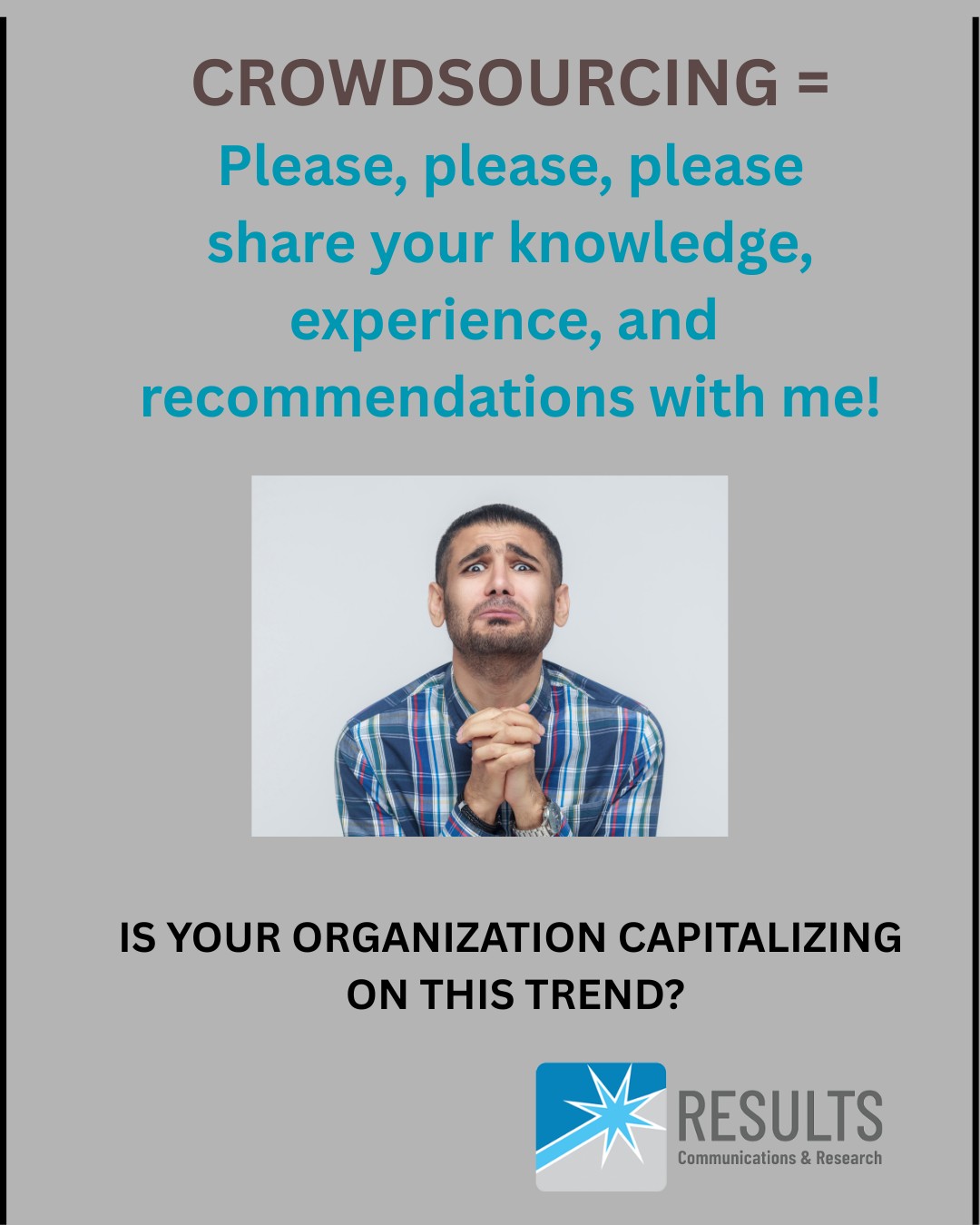
This is a rectangular image that runs vertically that has a gray background and reads in dark turquoise letters "Crowdsourcing = please, please, please share your knowledge, experience, and recommendations with me!" and includes our digital marketing agency's logo, plus the image of a young man wearing a plaid shirt and who has short dark hair and wide eyes and who is holding his hands together with a sad mouth as if he is pleading, plus the image says at the bottom, "is your organization capitalizing on this trend?"

Knowledge Crowdsourcing Platforms and SEO

As SEO experts, we keep hearing and reading over and over again that, when making a decision about which organizations’ online content to serve back in response to a searcher’s query, AI search engines/answer engines/chatbot engines are looking for signals that an organization is creditable and reputable, and where do they get those signals from, in addition to testimonials and other signs of credibility that are on the organizations’ own websites (think badges of associations your organization belongs to, certifications you’ve achieved, and backlinks from other organizations, including press/media/PR backlinks)? From platforms where people post recommendations in areas of the platform specifically designed for sharing recommendations and/or in the comments section in response to other users’ posts requesting recommendations from or posing questions to other users.

You can learn more about what’s been deemed “E-E-A-T” and how AI search engines look for signs of “Experience-Expertise-Authoritativeness-Trustworthiness in this “The Role Of E-E-A-T In AI Narratives: Building Brand Authority For Search Success” blog post from Search Engine Land.

Examples Of Crowdsourcing Platforms

  • Yelp – reviews of restaurant and other local business — such as contractors and personal services (think nail and hair salons)
  • Nextdoor – neighborhood social media platform
  • Reddit – discussion forum
  • Quora – discussion forum
  • Google My Business Profile Of Specific Organization (Google Reviews section)

Implications Of Crowdsourcing For Your Business/Organization

So, what are the implications of crowdsourcing for your business or organization?

  • Since some individuals seeking knowledge to support a decision they want and need to make go directly to a crowdsourcing platform to get information, you’ll want to have a positive presence on as many of the larger crowdsourcing platforms mentioned above as possible, and as appropriate for your particular industry. For example, Yelp might not make sense for your particular type of business.
  • If there are particular platforms that individuals use to recommend/rate businesses in your particular industry, you will want to ensure a favorable presence there, as well.
  • And, implementing what’s outlined in the two bullets above should provide plenty of positive trust and authority signals to search engines to encourage them to share your organization’s online content.

How To Show Up Favorably/Positively On Crowdsourcing Platforms

We mentioned above that your organization should show up favorably/positively on crowdsourcing platforms, but unfortunately what that looks like depends on the nature of the platform itself and the industry within your organization operates, and that’s why we encourage you to set up a complimentary discussion with us about how to use the current crowdsourcing trend to your specific organization’s advantage. But a common, over-arching way that all organizations can show up favorably/positively on crowdsourcing platforms is simply to encourage their customers to share positive information about them in online locations beyond the Google reviews section of their Google My Business Profile, i.e., on Yelp, Reddit, Quora, nextdoor and relevant industry crowdsourcing platforms. And, ultimately, all of this is about reputation management!

AEO, AI Search, alt-tags, Being Found On Bing, Being Found on Google, Google Analytics, Google My Business Profile, keywords, marketing best practices, Marketing Planning, Objectives Setting, online presence, organic SEO, pull marketing, Quora, Reddit, Results Analysis, Search Engine Optimization, search terms, SEO, SEO tags, target audiences, Target Marketing, website

What Does An SEO Audit Reveal?

One of the services we offer our clients — on both a one-off/one-time and monthly/ongoing basis is conducting an SEO audit that, then, allows us to make recommendations for what our client might do differently on the SEO (search engine optimization) front to be better found online by target audiences for relevant keywords (search terms) in relevant geographies.

What Can You Learn From An SEO Audit?

As we explained in this previous blog post about the mistake most people make when they manually conduct an SEO audit, your organization is better off hiring an SEO expert to conduct an audit, so that the results you get are unbiased. For most businesses/organizations, i.e., ones that have both a website and a Google My Business Profile, an SEO audit will provide information related to both your website and your Google My Business Profile, since Google may serve up either in search results (and as of the date of this post, the traditional Google search engine is still the one most used by search tool users, followed by YouTube, and ChatGPT.)

This image shows two hands of an older adult male peeling the skin off the onion.
Peeling Back An Onion Skin To See What Lies Beneath

Listed below is the information you can glean from having an SEO company or digital marketing agency, like ours, conduct an SEO audit for you:

  • what external websites and certain other digital properties (not owned by your organization/business) have links on them to your website, and therefore, are providing “referral” traffic via backlinks to your site — these may include other websites or discussion-forums like Reddit
  • as of the date of this post, any website traffic coming from searcher clicks on links to your website that appear in AI/chat/answer engine content is reported as referral traffic in Google Analytics, and information on how much traffic you’re getting from AI engines such as ChatGPT and Perplexity are included in an SEO audit
  • does your website and/or Google My Business Profile rank differently in Google in a particular geography for a particular keyword (search term), based on the device used by the searcher, i.e., mobile phone vs. desktop/laptop
  • what keywords your website and Google My Business Profile are ranking best for on Google and in what geographies
  • whether your Google My Business Profile or your website is being served up higher in search results in certain geographies for certain search terms — this will help you determine whether or not you should be putting more energy into getting your Google My Business Profile ranking better (you always want that to be served up for “near me” searches) and/or your website ranking better (ideally this would rank better for non-near-me terms)
  • missed SEO opportunities — these include best practices which haven’t been implemented by your organization, such as writing and entering SEO page title and meta description tags on your website platform/CMS for every page and post on your website, and writing an entering image alt-tags
  • mistakes/issues/challenges with your website that are likely causing it to be served up less than it could/should be in relevant geographies for relevant search terms, such as slow site load speed or broken links on your website
  • how much organic/search-engine traffic your website is getting from traditional search engines like Google, and how much website traffic you’re getting from AI search engines, and what traditional and/or AI search engines drove the most traffic to your website during the audit timeframe
  • what are the top 10-20 search keywords that Google is serving your website up most for
  • how many individuals are clicking on a link in your Google My Business Profile to arrive at your website
  • what are the most-viewed pages of your website
  • what pages of your website are being served up the highest in search results by Google
  • what marketing activities/vehicles are driving website traffic and what percentage of your overall website traffic is coming from AI or traditional search tools
  • what geographies/locations are your website visitors coming from
  • what devices do people use most to access your website, i.e., laptop/desktop vs. mobile

Hire An SEO Expert To Conduct Your SEO Audit

Want to learn more about our SEO audit services or ready to have us conduct an SEO Audit for you and to provide recommendations on SEO steps to take next, based on what the audit reveals? Reach out today to schedule a complimentary discussion about SEO audits.

Acceptance of Circumstances, accountability, AEO, AI Search, Being Found on Google, competitive advantage, Discussion Forums, Google Analytics, Google My Business Profile, Importance of taking break, keeping a balance, keeping up with trends, making time for things you value, Marketing Planning, Objectives Setting, online presence, organic SEO, Quora, Reddit, Results Analysis, Search Engine Optimization, SEO, staying current, strategic planning, walking, website

September Strong: A Second Chance To Set & Achieve Goals For The Year

If my memory serves me correctly, I’ve written about the second “new beginning” that September offers each of us each year on my own blog or that of a client. I love the fact that September provides a second start to any year and a chance to begin any kind of project you’d been hoping to get to earlier in the year, and to revisit goals — whether they be personal- or work-related ones. There’s still four full months to accomplish something you’ve always wanted to, or at least make a lot of headway toward achieving that accomplishment, so let’s agree to not start thinking another year is already behind us!

Since I own and run a digital marketing agency, the fall and early winter work goals I’m going to discuss below are marketing-related, but obviously, your work goals could pertain to any area of your organization, such as employee satisfaction and retention, new technology implementation, or expense reduction.

Marketing Goals For Q3 & Q4

Here’s some marketing goals you might want to complete in September, October, November, or December:

Personal (Health) Goals For Q3 & Q4

Since everything one does in life ends up positively or negatively impacting their mental and/or physical health, every personal goal ultimately is a wellbeing/wellness/health goal. For example, if you enroll in a class this fall or winter, it may cause you to gain knowledge to support a professional goal, but it also will likely make you feel more optimistic and improve your emotional wellbeing.

As I shared in this blog post about why I’ll always feel like a cancer (sarcoma) patient, I deal with chronic digestive issues on a daily basis because of past cancer treatment. I also have had chronic neck muscle mobility and pain issues since my late 20’s. Unfortunately, the neck trouble all started when I was working as a research associate at Fidelity Investments and going to graduate school at Boston University at night. I used to regularly carry a heavy bookbag of notebooks and books on the T (subway) to and from the University for many years. Post graduation, and ever since then, I’ve suffered from neck troubles.

I’ve already taken steps this summer, and plan to continue them thru the rest of Q3 & Q4, to improve the above two situations by:

This is the image of a small bronze colored Degas ballerina statue who has her shoulders back and arms behind her and who is wearing a ballet tutu and ballet slippers.
Degas Ballerina Statue That Provides Reminder About The Need to Maintain Good Posture While On Computer!

In addition to the above, I’m using the hashtag #SeptemberStrong with friends and family to encourage them to stay well and for us to cheer each other on, and I’m identifying situations and people that are unnecessarily and excessively anxiety-producing (in some cases, toxic) and steering clear of them!

Reach Out For Help On Your Q2 & Q3 Goals!

Whether you want or need a free wellness cheerleader, or you need help with business/work goal setting and achievement — particularly marketing goals — I’m here to support you, so reach out today! I love being an accountability partner on both the work and wellness fronts! And, be sure to check out our Keep Up The Fight page to encourage you to keep on plugging related to your goals! We totally got this, right?

AEO, AI Search, Being Found On Bing, Being Found on Google, Blog, Blogging, keeping up with trends, marketing best practices, meta tags, organic SEO, pull marketing, Search Engine Optimization, SEO, SEO tags, website

Why Meta Description Tags Still Matter, And May Matter More, When It Comes To Being Found Online

Prior to the introduction of AI search engines, we always advised our clients to be sure to complete both their SEO page/post title tags and their SEO meta description tags for any page or blog post on their website. Both tags are known as “meta tags” and both support websites being found online in relevant geographies by relevant searchers.

The History Of Meta Description Tags And Their Role Related To SEO

It used to be that, instead of creating and serving up their own description with a link to an organization’s website in search results, traditional search engines (like Google and Bing) would rely on the meta description tag associated with an organization’s website page or blog post, and therefore, automatically serve the content’s tag up along with a link to the website blog post or page in-question. This gave website owners control over what content was shared with a link to their website by search engines.

We don’t know the exact timing, but estimate the above scenario changed five or more years ago when search engines discontinued defaulting to the meta description tag provided by the content owner and starting creating their own “blurbs” to serve up with website content created by various website owners. This meant website owners never knew, and no longer had control over, what content was served up in search results with a link to one of their website pages or blog posts. Regardless, we still continued to encourage clients to fill in meta description tags using whatever fields their website platform/content management system (CMS) provided, or a website plugin used with their website provided, so that traditional search engines could serve up meta description content in search results listings if they chose to do so.

Image shows All In One (AIO) SEO plug-in used with WordPress to house a meta description tag. The meta description tag reads "Learn why meta description tags may matter more related to being found on AI vs. traditional search engines and how & why to complete and structure these tags.
Image of AIO (All In One) SEO WordPress Plug-in Field For Entering Meta Description Tag

In the days before AI search engines, we always said to our clients that, “while meta descriptions weren’t used by traditional search engines to figure out what a page or post was about and, therefore, what to index a website page or website post for (the way that SEO page and post title tags were and currently are used), they indirectly influence SEO (search engine optimization and being found online) since, if they are well-written and served up in search results listings, they may encourage a searcher to visit your website and that leads to more website traffic. And, more website traffic leads to search engines thinking your website is creditable/reputable and makes the engines more comfortable serving up your website in relevant search queries in relevant geographies.”

Use Of Meta Descriptions By AI Search Engines

We recently heard at an SEO conference and read online in an SEO expert’s website content that meta descriptions were making a comeback with AI-search engine/answer-engine optimization (AEO). Why? Because AI/answer engines are reading meta description tags, and sometimes, serving that content up in the answers they provide to questions posed to them by tool users.

How To Write An Effective Meta Description Tag To Support Being Found By Target Audiences

Here’s how to write an effective meta description related to use by both traditional and AI search engines:

  • Keep your meta description tag to 160 characters or less (including spaces).
  • Spell out what visitors will learn and/or the information they’ll have access to if they visit your website post or page — therefore, what answers will they get or actions will they be able to take by visiting your post or page
  • Don’t use “internal speak” or acronyms in your tag that your target audience/laypeople wouldn’t understand or use
  • Walk in your target audience’s shoes
  • Do use call-to-actions in your meta description tag, like:
    • Learn how
    • Read about
    • Get answers to
    • See how
    • Read how
    • Check out
  • Never use the same meta description tag (and for that matter, SEO/meta title tag) for more than one page and/or post on your website. That will just confuse search engines and make them less likely to serve up/share your website content!

Meta Description Tag Examples

Some examples of meta description tags include:

“Learn about products offered by our durable medical equipment company that provide greater mobility and independence to those challenged by disability and aging”

“Read about tactics to implement on your website to support it being found by relevant searchers in relevant geographies, including in AI search results”

“Learn how our estate planning law firm creates estate plans that include the documents you’ll need in case of serious illness and ensure last wishes are honored”

Need Help Writing New Meta Description Tags Or Rewriting Old Ones?

Use our calendar app to schedule a complimentary SEO/AEO discussion today with an SEO expert to discuss your particular marketing opportunities and challenges. Or, check out our list of SEO/AEO services!

Acceptance of Circumstances, AEO, AI Search, Being Found On Bing, Being Found on Google, keeping up with trends, lead generation, Marketing Planning, online presence, organic SEO, pull marketing, SEO, Understanding Your Environment, website

You May Not Need A Wikipedia Page To Win At AEO, Could Be Your Website Pages Just Need To Think And Act Like One

Why Wikipedia?

Why Are SEO Experts, AEO Experts, and Digital Marketers Talking About Wikipedia So Much In 2025?

Two key factors for all the marketing and AEO hype related to Wikipedia include:

  • Tests and research completed by SEO and AEO (answer engine optimization) experts indicate that often content from a relevant Wikipedia page is more likely to be served up to individuals using AI, answer, and chat search engines than content from the brand-in-question’s, or company-in-question’s, own website.
  • When AI search engines like chat engines were initially taught to crawl and index information, they were trained to do so using Wikipedia content.

Wikipedia Company Page

How To Set Up A Wikipedia Page and Hurdles To Getting Approved For a Company Page

We’re not going to try to recreate the wheel on this one, since this AEO expert did an outstanding job of explaining the many hoops an organization will likely have to jump thru in order for Wikipedia to approve the posting of a company page on their platform.

How To Set Up A Website Page That Might Perform As Well As A Wikipedia Page When It Comes To Answer Engines

How Can I Set Up Website Pages On My Own Website To Mirror Wikipedia Pages?

If it ends up holding true, and honestly it’s far too early to tell, that structuring/setting up your website page to mirror attributes of a Wikipedia page will cause its content to appear more frequently in answers to relevant questions spit back by AI search/chat/answer engines, then the aforementioned set-up work will have been worth it. But, what does the work entail? To structure a website page so that it mirrors Wikipedia page content that AI search/chat/answer engines seem to adore, we advise the following:

  • Employ various levels of headers, as appropriate to break up, title, and segment/categorize various website page content blocks. Think H1, H2, and H3, as explained in this blog post about the importance of using sub-headers related to SEO and AEO.
  • Throughout website page content, include inner-page and inner-post links to relevant content, particularly content that provides additional information on a term or topic.
  • Reference/give credit to external resources used to inform website page content and link to reputable external sites that might answer additional questions that website page readers might have.

In case you hadn’t noticed, we tried to make this website page/blog post mirror a Wikipedia page to some degree, and since we recently had the good fortune of seeing the musical highlighted in this Wikipedia page at the Huntington Theater In Boston with a friend, we’ll use this page as an example. As you’ll see if you visit this hyperlinked page, the page is really easy to read. No paragraphs are crazy long. The page uses a lot of headers/sub-headers to break up and segment/categorize content. Through reference and external links at the bottom, the page also includes links to creditable resources that provide information on where facts and data contained on the page came from. And, throughout the page, hyperlinks are included to relevant Wikipedia or non-Wikipedia pages that contain further information/explanation on a particular topic/particular data included in the Wikipedia page.

This image is a print screen taken of a Wikipedia page for a musical called "The Light In the Piazza." It shows titles and sub-titles, regular text, bolded text, and hyperlinked text and includes an image with a lot of purple and light yellow in it that shows a young woman and young man on a piazza in Italy with a label on the image that reads "The Light In The Piazza."

How To Write Content That AI Search Engines Like To Crawl And Index

When Google first announced and began rolling out Google SGE, we published a blog post about how to write content for that particular AI search engine. You’ll see that the still appropriate advice provided there is very similar to what was provided above, keep your content clean and make it easily digested and understood by both humans and answer engines!

References and External Links

  1. https://www.semrush.com/blog/generative-engine-optimization/
  2. https://www.linkedin.com/pulse/wikipedia-one-platform-you-cant-seo-your-way-beutler-ink-fuwzc/?trackingId=GbMlvVt9SU2fswSkpkGT9g%3D%3D
  3. https://www.linkedin.com/posts/localseoguide_its-friday-so-lets-end-the-week-with-a-activity-7339426222956822528-DGjr?utm_source=share&utm_medium=member_desktop&rcm=ACoAAAFHYEQBT0lx6IRjrP6l3fXO7v_8lhVYZ7g
  4. https://www.linkedin.com/pulse/wikipedia-paradox-why-your-business-cant-control-its-most-crawford-axsze/?trackingId=CVy%2FLtPEQMOeLBsEq67cGA%3D%3D
  5. https://www.huntingtontheatre.org/whats-on/the-light-in-the-piazza/

Need Help Understanding How To Increase Your Organization’s Odds Of Being Found Online?

Schedule a complimentary appointment with an SEO expert/AEO expert today!

Acceptance of Circumstances, AEO, AI Search, Being Found On Bing, Being Found on Google, marketing best practices, organic SEO, pull marketing, Quora, Reddit, SEO, Understanding Your Environment

The Two Main Branches Of The Being-Found-Online Tree: SEO and AEO

June 2025 Update To Our Original Blog Post Below: As digital marketers and SEO experts scramble to learn and express all the changes happening in the “being found online” world because of AI, I’m seeing yet another acronym being used related to being found in content served up in AI search/chat/answer engines, and that is GEO.

What Is GEO And How Is It Different From SEO?

According to Google AI Overviews, “SEO (Search Engine Optimization) focuses on optimizing website content for traditional search engines like Google to improve rankings and visibility in search results. GEO (Generative Engine Optimization), on the other hand, focuses on optimizing content for AI-powered search engines and generative AI models like ChatGPT and Google AI Overviews. While both share the goal of increasing online visibility, their strategies and target search engines differ.”

For now, I think it’s safe to say that people are using the acronyms GEO and AEO pretty interchangeably. Read on to learn about AEO!

Original Blog Post:

Every since I learned that Google rolled out Google AI Mode to all of U.S. users of its search tool in late May 2025, I’ve been educating myself as much as possible about the impact. In fact, I just posted the following on LinkedIn:

“This is how I’m looking at the challenge to optimize your organization’s chances of being found online these days. I’m changing my tune a bit. I didn’t think it was so critical a few months back for organizations to optimize for #AIsearchengines #chatbotengines #chatengines #answerengines, or however else you want to refer to search tools that employ #GenerativeAI capabilities, but with the very recent introduction of #GoogleAIMode, I’m seeing more need and urgency to cater to both the aforementioned type of search engines and to #traditionalsearchengines, like your standard Google and Bing search engines. #seo #searchengineoptimization #beingfoundonline #aeo #answerengineoptimization.”

As indicated in our LinkedIn post (shown above), just a few months ago, we didn’t think we needed to be so concerned about how AI search engines might impact how an organization was found online. Why? Because we didn’t think a large enough percentage of “searchers” were using AI search engines (check out this glossary for the definition of AI search engines, and the numerous terms used for AI search engines). But given Google longstanding dominance in the search-engine landscape, we’re pretty sure searchers are going to start switching from the traditional Google search tool to the AI Mode tool, and all marketers and organizations have to be ready for it.

But, while we need to be ready for greater use of AI search engines by searchers, we can’t lose site that many individuals will continue to search using the former, traditional forms of search engines offered by Google, Bing, Yahoo, DuckDuckGo, etc. Hence the reason for our image below.

What Is The Overlap Between AEO and SEO?

So, where is the overlap between optimizing your online presence so that information and data you share appears in generative AI results (AEO), but also appears in traditional search results (SEO)?

We plan to write a much more detailed blog post about that, but for now we’ll simply say that the commonality between AEO and SEO is producing and sharing content that answers questions that your target audiences have, whether those questions be about:

  • The broader category/nature of products and services you offer vs. your organization’s specific products and services
  • The specific products and services your organization offers
  • Your organization
  • Challenges or issues that your target audiences have that are tangential (not directly related to your organization and your products and services) but very important to your clients.

And, whether they are answered via ongoing, fresh website blog posts or regularly updated Q & As housed in a website FAQ like ours, or via social media posts or discussion forums like Quora and Reddit, it’s critical to both AEO and SEO that the questions you answer are helpful to your target audiences and not too self-serving!

Need Help Developing And/Or Executing A Strategy To Be Found Online?

Reach out today for a complimentary discussion of your marketing challenges & opportunities.

AEO, AI Search, Being Found On Bing, Being Found on Google, keeping up with trends, online presence, organic SEO, pull marketing, Search Engine Optimization, SEO, staying current, Understanding Your Environment

Understanding AI Search Engine Terminology

June 2026 Update:

It’s been a full year since we originally published this blog post dedicated to understanding AI Search Engine Terminology. Since this area continues to evolve rapidly, we felt it was time for an update! Any Text in GREEN below reflects information that was added to the post since we first wrote it.

A big challenge to all marketers today is the number of different terms that are being thrown around related to the use of AI search engines, or what can be called “answer engines.” These are also referred to as LLMs or LLM engines since they are powered on large language models. In addition, these terms aren’t always used consistently and mean different things to different organizations and marketers. To inform our readers about the current AI search engine landscape and help them understand what certain terms truly mean, we’ve put together the below glossary of AI search terms.

AI Search Glossary

  • AEO – while this acronym is also used for non-marketing and non-search-engine-related topics, when applied to search engine optimization (SEO), it’s related to one of the two broad branches of search tools (answer engines) that are available for use by searchers today, and stands for “Answer Engine Optimization.” Explained in this outstanding Better Business Bureau blog post about AEO, AEO practices and tactics focus on creating and sharing content that provides a “direct, informative, and well-structured answer” to a question that a searcher enters into a generative AI interactive, conversational (chat) tool, such as Perplexity, ChatGPT, and Google AI Mode. As we explained in our blog post about generative AI, the whole premise behind AEO is to answer questions searchers have via the online content your organization produces and shares. Don’t lose site of the variety of content AI search engines may pull and provide to question askers — check out our comprehensive list!
  • Answer Engines – as alluded to above, “answer engine” is a term used to describe interactive, conversational tools like Perplexity, ChatGPT, Google AI Mode, and Google Gemini. In lieu of spitting back a long list of links to websites and other online/digital properties (known as SERPs), these answer engines tend to provide content blocks — often without links — that synthesize data from a number of websites to answer the searcher’s question. This can mean that your organization or your content may be mentioned/included in response to an appropriate “prompt,” but a link back to your website, known as a citation won’t always be included.
  • Agentic AI – it’s not yet known what the implications are related to traditional search engines and answer engines, but in the words of Nvidia, agentic AI refers to AI that “uses sophisticated reasoning and iterative planning to autonomously solve complex, multi-step problems. And it’s set to enhance productivity and operations across industries.” As of the date of the revisions to the blog post, many SEO experts are using this term to pertain to a tool that individuals sign up to use that allows the tool to choose and/or buy a product or service on behalf of the tool user.
  • AI Search – this is one of the terms that we were thinking of when we mentioned that different organizations and marketers are using this term differently since AI search can refer to the use of an answer engine like the ones we discussed above to identify external resources and external data related to a particular question, or it can be used to describe searches of organization-owned/internal data (this data may extend to data that the organization shares publicly or enters into digital tools or apps or technology, but ultimately, it’s information owned by or generated by the organization.) An example of this latter case is discussed in this guest blog post by Medullar who offers an AI productivity and collaboration tool for SMBs, and particularly consulting firms and professional-services firms.
  • Chat Search Engine/Chatbot Search Engine – chat search engines/chatbot search engines really are the same thing as answer engines (described above).  They employ the conversational, interactive capability of chatbots, but also the capabilities of providing answers to questions from data they collect/gather across the internet the way that traditional search engines like Google, Bing, Yahoo, and DuckDuckGo do. It’s basically a search engine that users chatbot functionality to interact with individuals asking questions vs. just searching using a statement, term, or topic.
  • Chatbot – technology that provides an interface for humans to communicate with that interface via voice commands, text (typed commands) or both. It is considered a form of AI and is employed in online messaging or online chat services used by organizations to answer customer or prospective customer questions like LiveChat ones.
  • Generative AI – generative AI is technology that pulls data/content from a variety of sources and produces (generates!) new content based on what it’s learned. The content can be viewed as a summary or synthesis of information collected by the technology.
  • GEO (Generative AI Optimization) – employing best practices and tactics so that your organization appears in generative AI results; basically, same as AEO with the nuance that instead of answer/AI search engines serving up verbatim the answer that you provide to a question, answer/AI search engines are “citing” your organization because they view you as an expert and are providing a link back to your website as part of their results to a relevant “prompt.”
  • Large Language Models (LLMs) – if you really want to get into the nitty-gritty of understanding how LLMs work, Search Engine Land explains it well. Most organizations/lay people simply need to have a general understanding of this term because it’s often used in regards to answer engines/chatbot engines/generative AI engines because it’s the LLM technology/capability that lets the engines service engine users the way they do. As Search Engine Land states, “The core functionality of LLMs in search is to process queries and produce natural language summaries. Instead of just extracting information from existing documents, these models can generate comprehensive answers while maintaining accuracy and relevance. This is achieved through a unified framework that treats all (search-related) tasks as text generation problems. What makes this approach particularly powerful is its ability to customize answers through natural language prompts. The system first generates an initial set of query results, which the LLM refines and improves.”
  • Mention – this is when the name of your organization gets served up in AI search engine results. This may happen with or without the engine including a link back to your website (citation).
  • Prompt – this is what a user of an answer engine/AI search engine like ChatGPT or Google Gemini enters into the tool to get an answer/results/help/advice, etc. Check out this blog post about why appearing in AI search prompt results may help your organization.
  • RAG (Retrieval-Augmented Generation) – refers to a content-generation method that takes advantage of both information information retrieval and LLM. It’s about producing content that’s both relevant and accurate by combining external data with generative AI capabilities.

Continue to Check Back For AI Search Engine Terminology Updates

We read, listen to, watch everything we can get our hands on these days related to changes in the world of search engine optimization and answer engine optimization. In keeping with the aforementioned, we will continue to update our terminology list, so please continue to check back!

Need Help Understanding The Impacts Of AI Search Engines And How To Respond To Them?

Reach out today for a complimentary discussion of how to respond to the growth in use of AI Search Engines! Or, about how to advertise on ChatGPT!