Some SEO experts are saying identifying and focusing on ranking for keywords, i.e., high-volume appropriate search terms your organization wants to be found for in search engines in relevant geographies, isn’t as critical to SEO success as it used to be. In keeping with our recent blog post about SEO (search engine optimization) still being relevant, keyword research is still quite relevant to both for-profits’ and non-profits’ success.
Keyword Research Is Not All About SEO, It’s Also About Your Marketing and Business Strategy
Even if keywords were no longer important to SEO, keyword research still allows you to determine:
What products and services target audiences are searching on which can help an organization to decide to eliminate products or services or add new ones
The volume of individuals who are searching in an organization’s market area (geography) to help inform whether push or pull marketing is warranted
As I’ve been reviewing both my own website’s Google Analytics data, as well as that of my clients’ websites in recent months to see how much traffic they are getting from “organic search,” therefore, search engines, it’s become quite clear to me that an organization should no longer just rely on the results shown under the traffic acquisition and user acquisition reports, and specifically the results listed for defined traffic channel “organic search,” to assess how the site is faring from an SEO (search engine optimization standpoint).
Why? Because AI search engines are being used more and more by searchers and Google Analytics (GA4 Analytics) does not yet account for traffic coming from AI search engines like ChatGPT and Perplexity and does not incorporate such traffic in the “organic search” volume total. Instead, that type of traffic shows up under the Google Analytics defined channel of “Referral” traffic.
How To See If Your Website Is Being Served Up In AI Search Engines
So, in addition to checking your “Organic Search” (search-engine) traffic volume, you will need to look at your referral traffic to see if any AI search engines are “referring” traffic to your site. You can do so by adding the “source/medium” dimension to your user or traffic acquisition report as shown in the print screens below related to our own website.
Click the “+” sign in the top left side of the report shown above to add another dimension to your Google Analytics report.
Look thru the immediately-above report for referral traffic coming from AI search engines like ChatGPT and Perplexity.
Need Help Figuring Out How To Rank Better In AI Search Engines? Reach Out Today To Speak With An SEO Consultant.
Reach out today for a complimentary discussion about the type of online content your organization needs to regularly produce and publish to rank well on all search engines, not just AI-search ones!
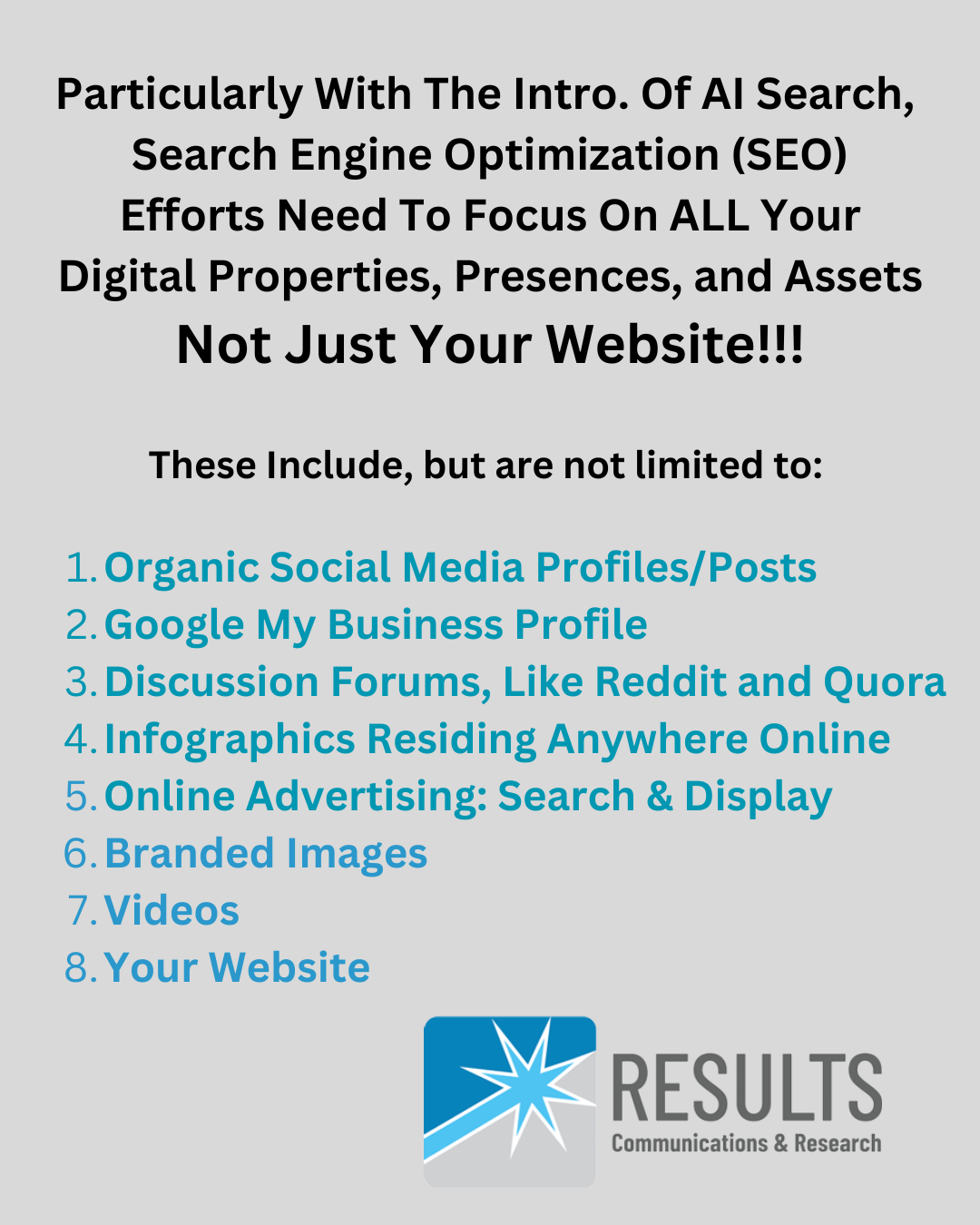
As we’ve explained in numerous spots throughout our website, SEO (Search Engine Optimization) is the practice of ensuring your organization is found online for relevant search-engines searches in relevant geographies. But a huge mistake in 2025, and beyond, would be to only focus on your website and Google My Business Profile being optimized to be found by appropriate searchers/target audiences, as shown in the image below.
The answer to the above is “no way!” In fact, just the opposite, although some digital marketing experts are saying it is, or are reluctant to use/expand the SEO acronym or search engine optimization phrase to describe maximizing your opportunities for all and any digital assets, presences, or properties to be served up in search-engine results vs. just an organization’s website, Google My Business Profile, and paid search/search-engine ads (think Google and Bing ads).
Hey, right now in this time of constant change on the SEO front, no-one really is the one true expert or SEO guru, so we’re going to take our stand vs. following the crowd or one expert, and say that Search Engine Optimization (SEO) is about making sure all your digital assets, presences (think social media posts and presences and discussion forum presences) and properties serve you well related to being found online for the right search terms, questions, and topics in relevant geographies.
Let’s Chat About What SEO Means In This New Era And How Your Organization Can Plan and Respond To It!
We’re going to keep this blog post short because, like most organizations during this time of year, we’ve got work to wrap up for the current year and tactics and plans to put in place for the new one — for both our client organizations and our own. Fortunately, we’ve already addressed many of the topics we’ll address in this blog post in a variety of previous blog posts, so we’re sharing those, as appropriate. So, what should all organizations be doing now to plan for the new year on the marketing front if they haven’t already done so? Read on…
How To Get Ready For A New Marketing Year, i.e., 2025!
It may feel pretty scary to do so, but be willing to cut back on the number of social media posts you put out there in the digisphere and/or the platforms you are on if and when social media isn’t worth the time and money. Often organizations rely too heavily on this particular form of marketing because they think of it as free, but it’s likely that all of your target audiences aren’t regularly online and you are missing out on opportunities available thru other marketing activities to reach them. Learn more about the aforementioned by reading our previous blog post that helps you figure out how large of a social media presence is warranted.
Related to the bullet directly above, start gathering information about some non-digital marketing/traditional marketing activities in which you might invest in 2025 — ask about pricing, of course, but also about circulation/impressions (# of people reached), demographics of audience reached, opportunities to include a QR code in your ad, frequency of distribution/publication, and are their volume discounts for purchasing a series of ads. Ask for sample success stories, and how and when circulation/impressions information was last updated, plus how advertisers are able to determine if their advertising is effective, i.e., about results tracking available via the medium on which you are purchasing advertising. Learn more about the perks of traditional marketing and how you can assess how ads on external websites are working for you.
Give some long and hard thought to whether push vs. pull marketing (or both) would serve you best in the new year.
To summarize, figure out what’s working well for you and keep it going and/or invest more in those marketing activities in 2025, remain open to and check out new marketing opportunities, and stop investing marketing $$ and time in activities that don’t work for you, simply because it gives you some unease not having such activities in place. Perhaps, only a small pivot will be necessary!
And, related to the above, figure out what marketing data is most important for you to track, so you don’t spend time gathering and documenting stats and KPIs (key performance indicators) that aren’t relevant and/or that you can’t influence in any way/move the needle on.
Our SEO Consulting Firm Helps Clients Figure Out Where To Invest Their Marketing $$ and Time And We Can Help You!
As I’ve expressed to fellow marketing consultants, many of my blog post topic ideas stem from being asked the same question by existing or prospective clients over a short period of time, or my need to address the same challenge for numerous clients over a short period of time. Certainly the aforementioned is the driver behind this particular blog post.
How A Common Mistake That Impacts Digital Marketing & Analytics Is Discovered
When new or existing clients engage me for organic SEO work, i.e., for help being found on Google, organic SEO best practices I may initially complete include, but are not limited to the following:
Reviewing clients’ Google My Business Profile presence looking for answers to questions related to Google My Business best practices, such as the following:
Is the Profile posted to regularly by client staff in the same fashion that they post to social media?
Has the client added any appropriate primary and secondary business categories that are available for selection via the “Info.” section of Google My Business?
Did the client provide a 750-character-or-less description of what their business is all about?
Has the client been receiving positive Google reviews on their Profile?
Has the client filled in their hours of operation?
Are the clients’ various social media profiles linked to from their Profile?
Analyzing data available within a client’s Google Analytics and Google Search Console accounts to assess the following:
On average, in what position on Google (in Google search-engine results), does a listing with a link back to the client’s site appear?
What is the average click-thru rate on listings that do appear on Google – therefore, what percentage of individuals to whom Google serves up a listing with a link to a website in its search-engine results, then, actually visit the organization in-question’s website by clicking on that link?
How many individuals visit the client’s website on a monthly basis due to a search-engine search (Google, Yahoo, Bing, DuckDuckGo, etc.)?
What percentage of all monthly website traffic does organic search/search-engine traffic represent?
Sounds pretty straightforward, right?
Unfortunately, I and my client often find ourselves in a situation where I can’t complete the above-mentioned reviews and analyses to inform other/future organic SEO work. Why? Because of one or several of the following:
While the client or an individual or agency engaged at one point by the firm set up one or all three of the above Google Accounts, i.e., Google Analytics, Google Search Console, and Google My Business, no-one has accessed them in quite some time and no-one knows what e-mail address and password are associated with the accounts. While I can easily share 3 distinct documents I’ve created with instructions on how to add me as a user to the 3 different types of Google Accounts (so I can complete my review and analysis), the instructions serve no purpose because the client doesn’t know how to access the accounts to add me as a user.
An internal individual (an employee) at the organization responsible for IT and/or marketing efforts, or an individual at an external organization, such as a marketing agency, has accessed the Google accounts in recent months, but they are no longer employed by the client organization or at the marketing agency, and no-one else at the organization knows what login or password was used to set up the various Google accounts.
An Ounce Of Password-Policy Prevention Is Worth A Pound Of Cure
I won’t use this blog post to talk about possible timely and cumbersome work-arounds should the above scenario exist. Instead, I want this blog post to serve as a warning and precaution for organizations that would benefit from ongoing use of, or reviews of data available in, the three types of Google accounts discussed above. Take measures now to avoid finding yourselves in the predicament described above! And, that’s where a proper login and password policy (known as a “password policy)” comes in – not just for large businesses/employers, but for any size for-profit or non-profit organization.
What Should A Password Policy Include?
We believe these five blog posts from different cybersecurity and corporate security organizations provide great food for thought on what an effective password policy should entail:
Sure, there’s always something else that you can allow to get in the way, but creating a corporate policy today can prevent a lot of digital-marketing heartache tomorrow!
After 30 years working in corporate roles, and many of them in marketing and marketing leadership, our Principal, Gail Snow Moraski, decided to launch a digital marketing agency that would allow small business owners and nonprofits the same breadth/depth of experience they’d get from a larger marketing or adverting agency, but at lower rates, and more personal attention.
From corporate roles, our Principal knew a decent amount about paid SEO (Google Ads) because of working with ad agencies (for whom she was a client) on various campaigns, but her knowledge of organic SEO (search engine optimization) was fairly limited. Since she’s always been a very technical and analytical person — characteristics that are required to really succeed at both paid SEO and organic SEO — needing to slice ‘n dice data and use technical skills really appealed to her. So she set out to better educate herself on both organic SEO (tactics that support ranking well in search engine results without paying for a media/advertising buy) and paid SEO (search engine marketing/SEM).
Gail’s first marketing job after completing her MBA with a marketing concentration at Boston University was at a market research firm where she oversaw market research studies for well-known consumer brands. She loves “peeling back the onion,” to see what the data reveals and that’s an exercise she does all day long related to all of the following activities (and many more!):
Employing website diagnostic and SEO ranking audit tools to access whether or not an organization’s Google My Business Profiles and/or website are ranking well in Google search results for relevant terms in desired geographies
Making and/or recommending organic SEO revisions to websites and Google My Business Profiles, or revisions to Google Ads campaigns, and assessing how those revisions impacted results
Plus, per our recent blog post, “Is Social Media Worth It?,” our Principal has always been a bit apprehensive about organizations relying too heavily on social media posts to move the marketing & sales needle. Based on years of analyzing Google Analytics website visitor data and behavior for a diverse mix of clients, our experience has been that social media posts, in most cases, do not generate sales, leads, or inquiries. There are exceptions to this, particularly when it comes to consumer goods and service organizations, but we’ve seen many an organization invest a very disproportionate amount of their marketing $$ and time in social media post creation and scheduling when very little, if any new business, is generated from it. Should all organizations maintain a social media presence of some sort? Sure. You want your organization to be viewed as “relevant,” and social media also creates awareness, the first step in the sales cycle, but don’t expect social media to move mountains.
Given the above, Our Principal wanted to focus our energy and time for clients on marketing activities that most move the sales needle and has always believed that, as long as your products, services, and solutions are ones that research shows individuals are searching to find, why not put a good chunk of your marketing $$ and time in being found by those individuals since they are “hot” leads?
Let Us Bring Our Passion For SEO To Helping Your Organization Be Found On Google (and other search engines, of course!)
We can regularly be seen on LinkedIn responding to SEO conversations, and we read everything we can get our hands on about SEO. We also passed a number of Google Ads certification exams. Plus, as mentioned above, we constantly test and evaluate ideas for getting our own Google My Business Profile and website, and well as those of our clients, ranking higher in relevant search results. Let us bring that passion, knowledge, and expertise to your organization’s SEO efforts. Reach out today to schedule a complimentary discussion with us about your marketing challenges and opportunities!
This may be one of our shortest, but most important blog posts. As a digital marketing agency who specializes in SEO services, we often see organizations back-burnering execution of business-critical initial or ongoing SEO tactics. We use the phrase “business-critical” because, for many organizations, neglecting implementing one-off and ongoing SEO best tactics means that they are missing out on what tends to be one of the highest sources of traffic to any website, i.e., search-engine traffic.
And, for many organizations with which we work, search-engine traffic “converts” better than any other source of website traffic, including paid search advertising (Google and Bing Ads), direct traffic (traffic from individuals who have bookmarked your site or type it directly into their browser), organic (unpaid social media posts), paid social media (Instagram and Facebook ads, etc.), and referral traffic (traffic stemming from links found on external sites, known as “backlinks.”)
Examples Of How Organizations Put Off Important SEO Work
Below are two examples of how/where/why SEO work stalls. Note that these aren’t the only reasons SEO work gets delayed, but these are the reasons/situations we witness most often in our work helping organizations rank better on Google or in other search engines. Delays could be due client capacity and staffing or just not prioritizing work properly.
One-Time/One-Off/Initial Organic Work
Not reviewing or using keyword research with which we provide our clients as part of an engagement to complete initial SEO tactics/deliverables. Often when our firm is first engaged to employ one-time/one-off SEO best tactics, our second step or first step (depending on whether we conduct an SEO audit rankings) is to provide our customers with lists of the highest-volume keywords (search terms) individuals are using to find an organization that offers the products, services, and solutions that the client does. As part of this research we employ a tool called “Answer The Public” to identify relevant questions that target audiences have. Before we can use those keywords and questions to implement other SEO best practices, we need our customers to provide feedback on which terms and questions feel appropriate and authentic to their business. But, unfortunately, often those reviews are stalled or delayed, which means other SEO work (that is dependent on the aforementioned work) can’t move forward.
Ongoing Organic SEO Work
Not making time to post to one or several Google My Business Profile(s) the way organizations post to social media platforms.
Not using the keyword research and Answer-The-Public question lists mentioned in the section above to inform and write new blog posts or new questions to be housed in an FAQ, and ultimately, posting that new content to the organization’s website.
Organic SEO Tactics Often Achieve More Than Advertising Campaigns
Per the beginning of our blog post and the header above, organic SEO tactics often deliver better results than any kind of online/digital and/or print or other form of advertising. So, we encourage those who keep putting off implementing initial SEO best practices and ongoing/monthly ones to reconsider their marketing and advertising priorities. We recommend the following:
Set a deadline for implementing initial/one-off SEO best practices. These include, but are not limited to:
making sure important keywords/search phrases used by your target audiences are incorporated in page content and in behind-the-scenes meta page/post title tags
embedding your Google My Business Profile on the contact page of your website
placing in the footer of your website a statement that indicates to Google the geography where your organization is located as well as the geography you serve
Schedule two 1/2 days a month where you will:
Write and post a new blog post using keyword research and questions research
Post updates to your Google My Business Profile — these updates could provide an intro. that links back to a blog post on your site
Because one of the services my agency offers is PR — and we’ve had some decent success obtaining meaningful media coverage for some of our for-profit and non-profit clients (as documented in our Public Relations Portfolio) — of course, we reached out to The Patriot Ledger to see if they wanted to do a “then and now” story about our South Shore organization since they covered our story nine years back. We’re still awaiting news, literally and figuratively on that one, but we figured why not go ahead and share a similar version of that story on our blog using the highlights we shared with them? So, here goes…
I prefer to refer to my business as a digital marketing agency vs. a marketing consultancy because we do as much as hands-on work as we do developing & recommending marketing strategies.
Our story actually began with me launching my own WordPress website without the help of anyone else, and my officially hanging my digital marketing agency’s shingle via that site. And, if I knew as much as I know about WordPress and website development now as I knew then, I would have originally launched my site with WordPress.org (the platform that it’s on now) vs. WordPress.org, so I could use the many great WordPress plug-ins from the get-go! Or, I might also have considered Joomla instead, but owning a business and getting it right is all about the journey. And, you can’t learn what you need to learn without making a few mistakes and getting your hands dirty, right?
What’s been particularly challenging as an organization who helps others with their own marketing is, sometimes, as I’ve been known to share, “the cobbler’s kids have no shoes.” That means often we are so busy helping our clients with their marketing, we don’t have time for our own. The aforementioned said, we make every effort to have our firm’s own marketing activities (such as our website and social media profiles) serve as a shining example of how to maintain a strong online presence, and it’s great that we’ve been able to use our own business to test and try out various marketing activities — therefore, serve as a bit of a guinea pig — before we test or try something brand new with clients.
I believe and hope my story can motivate and inspire others considering opening their own business. Before, or right after I launched my business, I was told by one individual who works with entrepreneurs that 80% of female marketing consultants fail. I refused to be a statistic, and regularly told myself that during the first 5 years, which were the hardest. It takes a good five years to get the word out there and have business come to you organically/naturally thru referrals, leads, and recommendations from others — made by former co-workers and clients, existing clients, other marketing consultants and agencies, and other organizations who serve the same vertical/target audiences whom you serve.
My philosophy and dreams when I started my business have remained pretty constant and I’m pleased to report I’ve followed them. I’m particularly proud that I’ve been able to continue to offer what I believe, based on research, are very reasonable rates to small for-profit and non-profit organizations. Due to my years of experience and expertise, clients have access to the same level of knowledge and skills that they’d have access to via a larger marketing agency, but at much lower rates than what a larger agency might offer. And, because we have significant experience in both traditional marketing AND digital marketing, we can offer the majority of services a larger, full-service agency can.
The biggest lesson I’ve learned that I’d love to share with others starting a business is this: don’t think of others in your space as competitors. Think of them as collaborators – people who serve the same target audiences who may need your services.
Our Impact: Local (South Shore of Boston), National, and International
I’ve helped a number of young adults who grew up on the South Shore, or elsewhere in MA, get hands-on experience that they were able to parlay into a post-graduation job elsewhere.
Related to the above, I’ve had the great fun and pleasure of working with my nephews, my brother, my brother-in-law, and my late sister-in-law on various client projects.
I’ve also met with a number of college or graduate school students looking to pick my brain about careers in marketing and learn from me – including one in my neighborhood who found me thru a Google search! Yes, because early on I recognized I needed to create a Google My Business Profile for my own business to be found by local, relevant searchers and this is something I regularly help my clients with now!
I’ve given a large number of pro bono hours to nonprofits as part of a totally free consulting/volunteer situation or discussion, or as part of their paid arrangement with me. I’ve had a number of very interesting local nonprofit clients, including ones in the faith-based space, arts and music space, ones serving vulnerable populations, ones serving individuals with special needs, and one providing financially challenged teens the opportunity to serve vulnerable teens abroad, and more! Some have an international impact.
One of my specialties is helping nonprofits apply for a Google Nonprofit Ad Grant. I, then, often stay on and manage the Grant for them – $120,000 in free Google Search advertising annually. I can explain more.
I also have a number of for-profit clients on the South Shore, but my client base is national and I have had clients in New Orleans, CA, Texas, and more!
I’ve served over 120 for-profit and non-profit organizations in the 10 years I’ve been running my digital marketing agency/SEO company.
I had no idea when I launched my business that I would become an expert in something that I only had very little knowledge of at the time when I launched my business – search engine optimization (SEO). Many of my referrals for or sub-contracted work come from other agencies, marketing consultants, and website designers who need to pull someone into their client work/project who knows how to get websites and Google My Business Profiles ranking well in Google via organic and paid search (Google Ads) SEO activities. I’ve become a self-taught SEO expert and very proud of it. I just read and watched everything I could get my hands on, took Google Ads certification classes, and attended free webinars. I still do that daily as Google’s Search Engine will be switching to an AI one, and I’m already helping my clients be proactive about that and prep for it (Google SGE).
As indicated above, while I do sub-contracted or referred work for other agencies, marketing consultants, and website designers, many of my clients are my own clients, and I usually have a plate of about 12 – 15 clients for whom I’m doing ongoing, digital marketing work for on a monthly basis, plus also juggling several one-off/one-time clients at the same time. At any given point in time, I’m normally doing work for about 17 – 25 clients with the help of some fabulous interns and associates, as they were/are available.
I’ve given a number of free workshops for SCORE and other organizations serving entrepreneurs, and I’m a SCORE volunteer and have provided tons of free advice to entrepreneurs by meeting with them on a complimentary basis. And, related to all of this, I’ve had a blast partnering with fellow marketing experts to give presentations that address multiple marketing areas of expertise! Thank you! You know who you are!
I’m a data geek and SEO geek and proud of it. I’m a huge data slicer and dicer and that’s what separates me from a lot of others in my space. I always say I won’t encourage clients to start or continue with marketing activities that don’t make sense for them based on what data is showing. I consider myself to be my clients’ accountability partner, and I’m not afraid to give tough love when I need to. I’m not afraid to voice a different opinion than other marketers. If I think something isn’t going to work, or isn’t working, I speak up.
I’m also proud that my marketing agency survived our recent COVID-19 pandemic and was extremely proactive about providing helpful insights from the very start of the pandemic for marketers to appropriately respond to the pandemic/pivot, such as these blog posts about using paid ads during the pandemic and how to make sure your social media presence wasn’t offensive and was relevant.
I give back significantly to the community. I was involved with the Braintree Relay For Life Committee for a while, and now, I do a number of charity walks in addition to all the other beneficial work I mentioned above.
Our Focus On Health & Wellness
If you’re a regular reader of our blog, you’ll know that I’ll throw in a good blog post about walking once in a while. You can use the categories search tool/drop-down menu to search on “walking” to see the various walking topics about which I’ve written.
Since my corporate marketing days, I’ve always loved to share health & wellness tips — whether they be with fellow employees as part of an internal communications role, or with members of a health plan I worked for, and from the get-go with Results Communications & Research, I’ve aimed to inspire those with health (and other challenges) to never give up, and keep fighting via my “Keep Up The Fight” website page. And, I recently put up a new blog post about an invisible disease with which many health warriors who have battled or are battling other forms of illness have to contend.
Our Thank You
My digital marketing agency/SEO company and I would have never made it this far without all the help of great collaborators, cheerleaders (friends, family, my husband Jay, and other fellow small business owners), and most importantly, our clients who looked to us for expert marketing guidance and assistance. We have many clients with whom we’ve served as an outsourced marketing department for years, and we thank you for your faith in us! We’ve so enjoyed being a part of your business family! We also thank those who we haven’t had the opportunity to work with for as long as some of our long-term clients, but have enjoyed or are enjoying being a part of your organization’s success story.
What’s Next
I don’t know what the future holds for Results Communications & Research, but I’m excited about what’s to come! And, I know I will continue to try to give back as much as possible with the platform that this fun, educational, and interesting business provides!
Want To Benefit From The Marketing Services Of A Digital Marketing Agency/SEO With A Long Tenure And Who Gives Back?
Note: Because executing, monitoring, tweaking, analyzing, and reporting on Google Ads campaigns is one of our SEO company’s specialties, we decided to write a number of blog posts on the topic this spring that are more granular, and therefore, provide more detail and really get into the Google Ads weeds! So, enjoy this second post in our Spring 2024 Google Ads series of posts!
Sometimes, it’s hard to hear or accept that there may be challenges with the features/characteristics of the products, services, and solutions you offer. But, if you’ve been checking the “Search Terms” report under Auction Insights in your Google Ads account (and made sure your Google Search ads are being served up to the right “searchers”), your ads are achieving a decent click-thru rate (2.5% or higher), and you’ve followed landing page best practices (outlined in our blog posts about ensuring ad clickers have a smooth landing and about making sure your landing page isn’t too-self serving), then there’s a high probability that website visitors who arrived on your website from online advertising ad clicks just aren’t that interested in your products, services, and solutions.
Obviously, before you reach the above conclusion — that there’s something about your products, services, and solutions that may be turning website visitors off — you need to give your ads appropriate time to “convert.” If there’s a high cost associated with your product, service, or solution, and/or it tends to be a purchase or engagement decision that’s not made lightly/overnight, then you need to wait one or several months to determine whether or not your ads eventually “convert,” and therefore, cause ad clickers to take desirable actions on your website like completing an inquiry form, or reaching out to you by clicking on a hyperlinked e-mail address or phone number.
Revisiting Product & Service Features and Characteristics
The below list is not meant to be all-inclusive since the number of different products, services, and solutions available to businesses and consumers throughout the world is immeasurable, and there are countless different industries offering products, services, and solutions — each requiring very different product and service specifications, having different features, and meeting very different needs.
Some common product and service features and characteristics that should be considered and revisited to determine if they may be the reason behind website visitors NOT purchasing a product or engaging you for your service — or at least reaching out to your organization to learn more include:
Ease of use – how difficult is to use or learn to use product or service?
Convenience – how convenient is it to use product or service? Can it only be used in certain places at certain times?
Appearance/Look/Feel – of course, opinions about whether or not something is attractive can vary, but, overall, is the product or service something appealing/attractive?
Price – does the value or benefit of the product or service warrant what is being charged for it? What are competitors charging for similar products and what makes yours stand out if you’re charging far more? Will prospective clients recognize the “value-add” and be willing to pay for it?
Ability to solve target audiences’ problem(s) – does the product or service solve a common problem, or among everyone whose problem it solves, will it accomplish what it needs to accomplish in all/most cases?
Portability – can the product or service be used outside your home, town, or state, etc.? Therefore, is it “portable?”
Uniqueness – is your product or service different enough from other similar products or services, and unique enough to make the purchaser feel “special?”
Durability/Lifespan – how long will the product or service or the effects of it last? Is current pricing warranted given the product or service lifespan?
Relevancy – is your product or service in step with current times and your current marketplace, or is it dated or out-of-touch? Have competitors entered your marketplace to offer a more modern or relevant product/service?
As a Greater Boston digital marketing agency and SEO company, we’ve implemented and executed countless online and traditional marketing activities to drive traffic to our clients’ websites, particularly online advertising campaigns that include Google Ads search advertising. Since we’ve already outlined in a former blog post what makes for an effective landing page (and what a landing page is to begin with), we won’t repeat that information here. Instead, we want to focus on why what we consider to be a “self-serving” landing page can hurt your organization.
Why You Shouldn’t Make Your Website Landing Page All About You
As we’ve explained in a number of past blog posts, in the marketing and marketing-activity-results-tracking world, a “conversion,” is a desired/desirable action that a website visitor takes on your website. A website visitor conversion could be:
Signing up for your e-newsletter
Clicking on social media icons that link to your various social media profiles to visit them
Completing an inquiry or contact form
Clicking on a hyperlinked e-mail address to send you an e-mail
Clicking on a hyperlinked phone number to call you
Downloading a white paper or a pdf housed on your website
Purchasing a product, service, or solution, including tickets to an event
Providing an e-mail address, via a gatekeeper type system, in order to download a document housed on your site, or to complete some other activity
We think you get the picture!
A mistake we often see marketers/advertisers make, though, is focusing too hard/much on the actions that THEY want visitors to take on their website, i.e., the actions THEY consider desirable vs. focusing on the actions that visitors may want to take and the tasks they hope and want to complete when they visit a website that offers the products, services, and solutions you do.
What The “Bounce Rate” Can Tell You About Your Landing Page
GA4 Google Analytics allows organizations to view the “engagement rate” for all your website pages and posts, including your landing pages (even if those are hidden from the navigation that the general public sees, and are only used in conjunction with specific marketing activities/campaigns). The inverse of a website page’s engagement rate is known as the “bounce rate,” and that can be calculated by subtracting the engagement rate from 100% (if a page’s engagement rate is 60%, then the bounce rate is 40%).
If a large percentage of visitors “bounce” from a website page or post, it means many prospective customers or customers left your website from that particular page or post without interacting in any way with the page or post (e.g., scrolling down on it, clicking on links/calls-to-actions/call-out buttons contained on it to visit other pages of the site, starting or completing a form contained on the page or post, etc.). The higher the bounce rate is, the less likely the page satisfies the needs of various visitors to complete desired tasks/take beneficial actions on your site — tasks and actions that are of importance to THEM vs. YOU.
How To Lower Your Landing Page Bounce Rate
Granted there will likely be some overlap between the actions A VISITOR might hope and want to take on your site and the ones YOU hope and want them to take on your site, but you and/or your team should go thru the following exercise to make sure your visitors’ needs are met more often than your own, and that they are a priority.
Make a grid, such as the one shown below, that lists all the tasks that you want visitors to complete on your site, as well as the tasks you believe visitors want to complete on your site. Really think hard and try to walk in target audiences’ shoes! Keep in mind that many individuals already receive e-mails from countless organizations on a daily basis, and many are reluctant to have their name added to another e-mail list. They know what will likely follow is a stream of e-mails to sell them the product, service, or solution they were investigating on your website, or ones asking for a donation, etc. Will you cause them to “bounce,” and lose them altogether as a potential customer because you kept certain content “gated,” or your marketing activity took them to a landing page that only allowed them to visit that particular page of your website vs. quickly/easily visit other pages of your site?
Review the grid you created and highlight those activities that you believe would be considered desirable/beneficial to both parties, i.e., your organization AND website visitors. Functionality should then be created/installed and included on your landing page to allow for completion of those tasks.
Then, review the activities which you believe are more valued by visitors (less preferable to your organization), and consider for which of those actions you’d be willing to provide functionality on your site for visitors to complete them. A great example, is requiring individuals to reach out to schedule an appointment to get pricing information. Even if your pricing is customer-specific/customized, many prospective clients may be reluctant to reach out, particularly if they aren’t in a financial position to invest in your product or service immediately. Think about what/how much downfall there would be to providing visitor functionality to get an estimate/access pricing information, and whether you’d be better off keeping visitors happy and on your website longer, or better off letting them bounce. Only you will know the answer to the aforementioned and the implications of trade-offs.
Ultimately, the more the scale swings in the favor of your website visitor vs. your organization when it comes to desirable action-taking, the more your organization will likely be to succeed at providing a great user experience, ranking better in search engines, and ultimately driving sales from satisfied visitors who were able to obtain the information, and complete the tasks they wanted, without being on the receiving end of what might be perceived as too “hard of a sell” by your organization or a too “self-serving” website.
Get Complimentary Advice On Landing Pages From Online Advertising Experts