June 2025 Update To OurOriginal Blog PostBelow: As digital marketers and SEO experts scramble to learn and express all the changes happening in the “being found online” world because of AI, I’m seeing yet another acronym being used related to being found in content served up in AI search/chat/answer engines, and that is GEO.
What Is GEO And How Is It Different From SEO?
According to Google AI Overviews, “SEO (Search Engine Optimization) focuses on optimizing website content for traditional search engines like Google to improve rankings and visibility in search results. GEO (Generative Engine Optimization), on the other hand, focuses on optimizing content for AI-powered search engines and generative AI models like ChatGPT and Google AI Overviews. While both share the goal of increasing online visibility, their strategies and target search engines differ.”
For now, I think it’s safe to say that people are using the acronyms GEO and AEO pretty interchangeably. Read on to learn about AEO!
Original Blog Post:
Every since I learned that Google rolled out Google AI Mode to all of U.S. users of its search tool in late May 2025, I’ve been educating myself as much as possible about the impact. In fact, I just posted the following on LinkedIn:
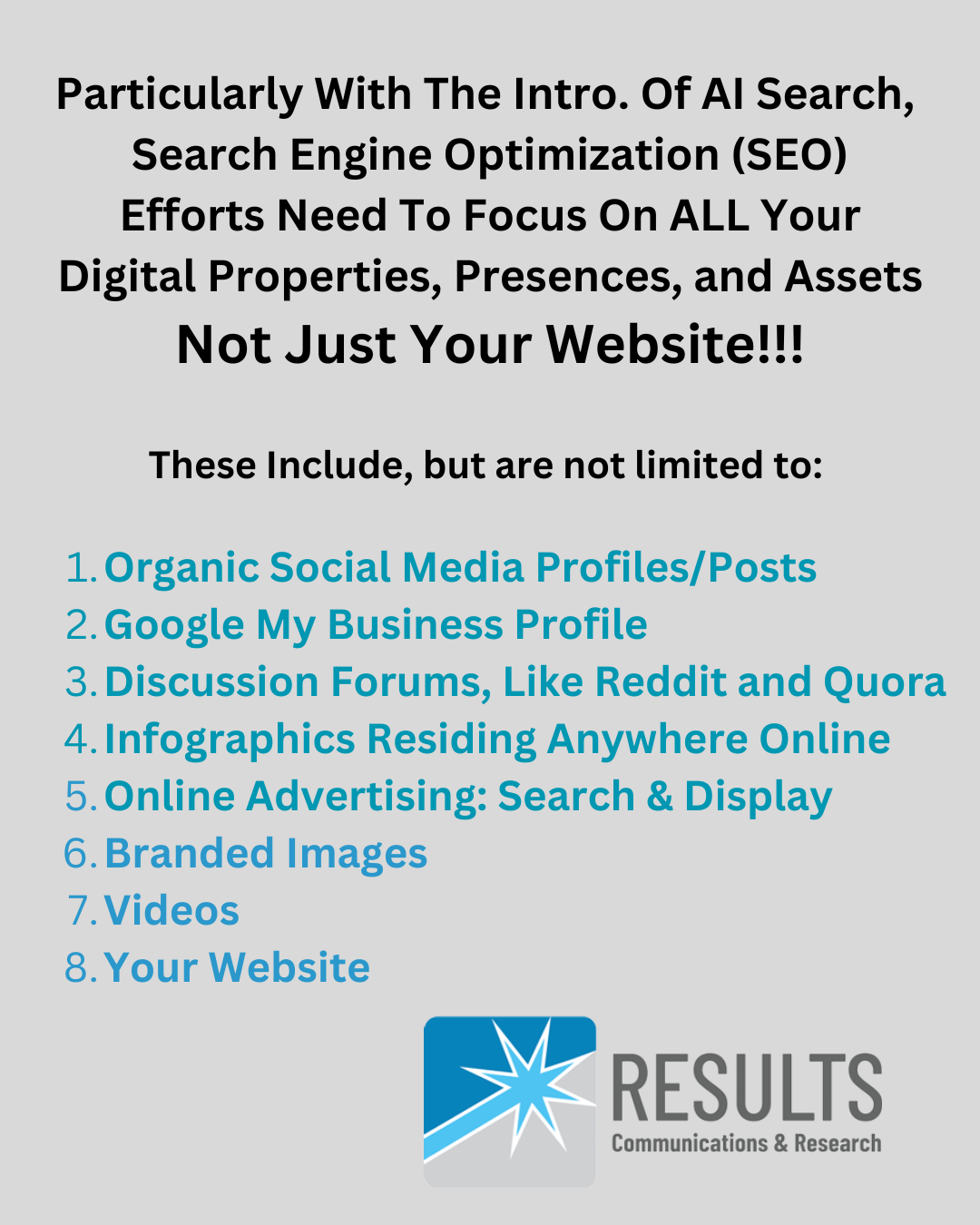
But, while we need to be ready for greater use of AI search engines by searchers, we can’t lose site that many individuals will continue to search using the former, traditional forms of search engines offered by Google, Bing, Yahoo, DuckDuckGo, etc. Hence the reason for our image below.
What Is The Overlap Between AEO and SEO?
So, where is the overlap between optimizing your online presence so that information and data you share appears in generative AI results (AEO), but also appears in traditional search results (SEO)?
We plan to write a much more detailed blog post about that, but for now we’ll simply say that the commonality between AEO and SEO is producing and sharing content that answers questions that your target audiences have, whether those questions be about:
The broader category/nature of products and services you offer vs. your organization’s specific products and services
The specific products and services your organization offers
Your organization
Challenges or issues that your target audiences have that are tangential (not directly related to your organization and your products and services) but very important to your clients.
And, whether they are answered via ongoing, fresh website blog posts or regularly updated Q & As housed in a website FAQ like ours, or via social media posts or discussion forums like Quora and Reddit, it’s critical to both AEO and SEO that the questions you answer are helpful to your target audiences and not too self-serving!
Need Help Developing And/Or Executing A Strategy To Be Found Online?
Anyone who’s interacted with me in a lot in the last five years knows that I’m a huge Boston Celtics fan. I started watching them during the pandemic and while they were playing in the “bubble.” I got hooked pretty quickly, and the rest is history. By the way, I also like the Boston Bruins and the Boston Red Sox , and have enjoyed watching both of the aforementioned teams for many years.
In fact, the Red Sox had my sports heart way before the Celtics did. But, since it’s still 2025 NBA playoff season, and my beloved Celtics recently endured a lot of hardship in the form of injured/ill players (which definitely played a role in their NBA Championship journey ending far sooner than fans hoped or expected), my sports-related analogy will be basketball-related vs. hockey- or baseball-related.
When To Bring In the SEO Back-ups: H2, H3, and Other Sub-headers
Anyone who knows SEO best practices and commonly accepted SEO wisdom knows it just makes good SEO sense to include high-volume keywords and questions in your public-facing website page and post titles, which usually take the form of what’s known as an “H1 header.” An H1 header is the first heading that appears in any website post or page. In the case of this blog post our H1 header is “When You’ve Exhausted Your Starters, Let Your SEO Bench Step In.”
Let’s say you’ve employed the above SEO tactic already, along with these other commonly known and respected SEO best practices, such as:
And, the above aren’t taking your site to where you want and need it to be, i.e., higher up in search-engine results for search terms and questions regularly entered into search engines by target audiences. Maybe, it’s time to give the players who get less play time, more play time! Call them what you will — the bench, the scrubs, the B team, etc. — these non-starters might be exactly what you need to help you score some SEO baskets, including 3 pointers!
Last Regular Season Celtics Game At TD Bank Garden, Boston
What Is An H2, H3, H4, etc. Header?
At Results Communications & Research, we like to refer to any headings that are used on a website page or in a blog post and aren’t the first/main header on the page as sub-headers. These are headers that appear below the primary header on the page, tend to be smaller in font size than the main header, are formatted as an H2, H3, H4, etc. header and are often used to break up and/or introduce content — making it easier for both readers and search-engines to consume/absorb the content that appears below the sub-header. The “What Is…” header directly above is formatted as an H3 header, and the “When To” header above that as an H2 header.
As the creator of any blog post or website page content, you will have to decide when to use H2 headers vs. H3 headers, etc. If a sub-header feels more like a sub-header of another sub-header, then it should use a header format that is lower in the header hierarchy (with H1 being 1st in the hierarchy).
Why Use H2, H3, H4 Sub-headers?
The reason to let the sub-headers take a chance at improving SEO game results is because they provide additional and new headings/headers for search engines like Google to crawl. This means they provide more detail and/or more opportunities for you to re-share previous information with search engines so they know what a website post or page is all about and when to serve it up in search results. It’s just one more way to make it easier for search engines to quickly and easily identify and understand when it should serve up a particular website post and page in response to a particular search query.
We’ll Always Bring Our A Team To Any Clients’ SEO Game
We agree with the wisdom of many marketing experts when it comes to whether or not businesses and organizations should spend less money and time on marketing during uncertain economic times — times when their customers want or need to spend less. And, that wisdom is that, in most cases, spending less money and time on marketing is only going to worsen your organization’s product sales/engagements for services when times get hard financially.
We mentioned “in most cases,” because in the situation where your organization offers a very high-ticket item that would be considered a huge luxury to MOST potential buyers, it would seem wise to cut back your spending on marketing because of the unlikelihood of clients making a purchase until the economy feels less uncertain. Still, you definitely will want to maintain some kind of marketing presence, even if it’s just continuing to post to social media, so people don’t forget about your brand and your products and services, and keep them on their “for-when-the-economy-improves” wish list.
But, getting back to the “wisdom” outlined in the first paragraph of this post, let’s first set the stage before we do. A period of economic decline could mean your consumer clients have been laid off, or if they are business owners who purchase business (B2B) services and products from you, their business may be taking a financial hit. Or, it could simply mean your customers are afraid of what the economic future holds, and believe it’s important that they are careful about spending. All of the aforementioned means that target audiences are likely spending money most on services and products they really need vs. something that might feel like a luxury, feel unnecessary, and/or feel like it could wait.
So, How Should I Spend Money On Marketing When The Economy Is Bad?
Whether yours is the type of product or service that people find or on which they get educated thru push and/or pull marketing, it’s really important you continue to maintain a presence so potential clients can find you or learn about you.
In fact, instead of cutting back on marketing efforts, you may actually want and need to spend more than you had been spending to be found by and/or to educate the right people that your product or service exists. In fact, today (5/12/25), Our Principal shared the above information on LinkedIn “Not liking what I’m seeing on the #GoogleAds/ #SEM / #paidsearch front for some of my clients right now (last 6 weeks), but much of it is what it is. It appears these two factors are currently at play for many Google Ads advertisers: 1) fewer people searching on relevant terms (relevant product and service terms in relevant geographies) — likely due to all our #economicuncertainty and #economicvolatility and people’s fears about spending money now (whether they be consumer or businesses) and 2) new advertisers creating and running #searchcampaigns because their own business volume is off and they are testing/trying Google Ads as a way to circumvent the drop in business/leads/inquiries, etc.”
Regardless of whether your organization plans to continue to spend the same amount of money and time on marketing, or decides to spend more money or less money, you still want to spend your time, energy and money wisely. Regardless of the direction in which you plan to take your organizations marketing, we recommend you go thru the following data analysis exercise to ensure you’re making the right move/to inform your next move.
Step 1: Employ Google Analytics To See Which Marketing Activities Have Driven The Most Traffic to Your Website In The Last 6 Months
If you spent a lot of time on sending out e-newsletters/e-mail to grow your business and/or on a social media expert to post to social media on your organization’s behalf, and Google Analytics is not showing a lot of traffic coming to the website via those defined Google Analytics channels, then, when marketing money is tight, that’s a place to cut back and consider investing in other marketing activities that HAVE driven a lot of traffic. You get the picture.
Step 2: Employ Google Analytics Data Or Other Available Analytics Tools To See What Marketing Activities Are Converting
In addition to reviewing website traffic acquisition data, even more importantly, you’ll want to look at which marketing activities are “converting,” the best, i.e., causing site visitors to take a desired action on your website such as completing an inquiry form or using a phone # or e-mail address on your site to inquire or purchase something. Check out our previous blog post about conversion generation, plus, follow the steps below to assess whether or not various marketing activities are converting.
Use Events Information In Google Analytics To See What Marketing Channels Are Generating The Events That Are Most Valuable To You
Access the “Events” report in Google Analytics, then, add a dimension such as “first user Google Ads ad group name (if you want to get really granular and look at a specific marketing vehicle and drill down on it),” or more general ones like “first user campaign,” or “first user source/medium” to allow you to see all the broader categories of marketing vehicles that are generating conversions vs. getting as specific about certain ones, and the type of conversions those vehicles are generating.
See print screens below which show where and how to access such data in Google Analytics. In the case where you want to look at “first user source/medium” or “first user campaign” to get a big-picture vs. granular information about a specific form of marketing or advertising, like Google Ads, after selecting “Traffic Source,” select “Cross Channel” and, then, you can choose “first user source/medium” or “first user campaign” from Google Analytics’ list. (Important Note: keep in mind that you may be able to get such conversion data from another marketing analytics tool or platform, including advertising ones, such as CallRail or social media platforms.)
Once you’ve generated your list of events at the marketing vehicle level you want to look at, if you have a large number of events or conversions a website visitor can complete on your site, you may want to use the search tool, as shown below, to search on the conversions that are most important to you, such as phone calls. This will streamline your analysis and make it easier for you to assess conversion results.
In keeping with step 1 above where we suggested focusing your marketing time and energy, during difficult economic times, on those activities that are driving traffic to your website, related to step 2 and analyzing conversion results, you’ll want to focus your marketing efforts on activities that are generating your most important conversions like inquiries and actual sales.
It’s important that you complete both the above step 1 and step 2 analyses because, while a certain marketing activity may drive a lot of traffic to your website, if it’s not “converting,” you’ll likely want to spend more time and energy on the activities that are “converting.” Each organization and business is different, and particularly if your product or service has a long sales cycle, and therefore, people do a lot of research and thinking before they purchase it, creating awareness thru website traffic can still be beneficial. So, you really need to consider your organization’s particular situation when drawing a conclusion about your marketing dollars and time. But, ultimately, at a minimum, your marketing activities during uncertain economic should drive website traffic, and ideally, conversions as well.
Don’t Rule Out New Marketing Vehicles During Uncertain Economic Times
We’d be remiss if we didn’t share that, if the above analyses don’t indicate you’re seeing desirable website traffic and conversion results from your existing marketing activities to inform a marketing strategy for our current economic times, maybe it’s time you consider a pilot or test of one or several new marketing vehicles. There could be a vehicle out there that would be just what you need to drive website traffic or conversions during a challenging financial time. We’re more than happy to help you figure that piece out!
As we mentioned in our blog post about our digital marketing agency and SEO company celebrating our 11-year anniversary, recently we’ve been testing more print advertising and Google Display advertising for clients. Sometimes, your organization and/or your marketing consultant or agency either doesn’t have enough experience employing certain types of advertising or marketing, or they don’t have enough experience employing certain types of advertising or marketing related to your organization’s particular industry, challenges, and opportunities.
The above-mentioned scenario means the only way to know for sure whether or not a particular marketing vehicle or marketing activity might generate great awareness, leads, sales, or engagement for services for your organization is to test that vehicle — run a pilot campaign using that particular vehicle and see what results reveal.
Recently, we’ve been working with a client in the food space that offers a food-related service vs. offering a food product that you can buy at the grocery store. They were already running Google Search ads that were served up to individuals specifically looking for their particular service. We suggested they also:
employ Google Display advertising and have image/display ads served up to people reading about relevant topics as well as people to people who had researched relevant topics in the past and/or had bought products/services similar to theirs in the past.
Evaluating A New Marketing Activity: What Does A Conversion Cost You?
While both of the new campaigns had strong click-thru rates, and the Google Display ads had an extremely low cost-per-click, when we did a really deep dive to determine which, if either, of the two new campaigns were generating conversions, i.e., calls, submitted inquiry forms, etc., we determined that the Display ads were NOT generating conversions — ultimately, making the cost-per-conversion crazy high for the Display ads, even though they had a very favorable cost-per-click.
Are we glad we tested both of the new types of campaigns? Certainly. The client is still somewhat in start-up mode, and is still testing and trying a number of marketing vehicles and activities to determine what will work best for them as far as lead- and sales-generation goes. And, we wouldn’t have learned the Display ads wouldn’t be effective if we haven’t tried. We spent short money and only ran the campaign for about six weeks. Our money and time investment wasn’t huge, and we learned this type of ad doesn’t make sense from an ROI standpoint — too many people clicking on ads because of the “curiosity factor,” likely, because the ads were food-related and images included in them were enticing and inviting.
We’ll continue to run the other new Google campaign — the Search one — because it is generating conversions, and we’ll keep an eye on the cost-per-conversion to determine if we should continue to run it, but the ads have only been running for 2 months and we need more time to get a sense of the advertising ROI.
Need Help Testing A Particular Marketing Vehicle Or Activity?
Some SEO experts are saying identifying and focusing on ranking for keywords, i.e., high-volume appropriate search terms your organization wants to be found for in search engines in relevant geographies, isn’t as critical to SEO success as it used to be. In keeping with our recent blog post about SEO (search engine optimization) still being relevant, keyword research is still quite relevant to both for-profits’ and non-profits’ success.
Keyword Research Is Not All About SEO, It’s Also About Your Marketing and Business Strategy
Even if keywords were no longer important to SEO, keyword research still allows you to determine:
What products and services target audiences are searching on which can help an organization to decide to eliminate products or services or add new ones
The volume of individuals who are searching in an organization’s market area (geography) to help inform whether push or pull marketing is warranted
As part of our organization’s organic SEO (search engine optimization) services, we ask to have access to a client’s Google My Business Profile, or at least have a chance to review the behind-the-scenes information/set-up with our SEO clients via a Zoom call where they access and share their Google My Business Profile dashboard.
Whether you want to think of it as a mistake or a missed opportunity, here’s three Google My Business capabilities you may be missing out on to get your organization ranking better locally on Google (remember, Google is more likely to serve up your Google My Business Profile vs. your website) for “near me” or “city/town” terms) :
Providing Google with 20 services areas. Make sure you capitalize on these. And, remember, the further out your business is physically from the geography in which a searcher is searching on relevant terms, the less likely Google is to serve up your Profile, so keep any service areas you add to your Profile within a two-hour drive of your physical office, and ideally far less than two-hours.
Identifying up to 10 business categories. You need to pick a primary category — a category of business that best describes your products and services, but you can pick 9 additional “secondary” categories. Right now, there are over 4,000 business categories in Google My Business from which you can select. And, Google keeps adding to the list, so even if you don’t see a category that fits a particular product or service you offer now, you should revisit your Profile information every 3 months or so to see if there are any new categories you can select that are appropriate to your business.
Providing specific product or service lists underneath your various business categories that employ keywords (search terms) on which your target audience(s) may be searching. See example below where we listed our SEM (paid SEO/Google and Bing Ads) and organic SEO services under our primary business category.
We Can Help You Optimize Your Google My Business Profile
As we’ve explained in numerous spots throughout our website, SEO (Search Engine Optimization) is the practice of ensuring your organization is found online for relevant search-engines searches in relevant geographies. But a huge mistake in 2025, and beyond, would be to only focus on your website and Google My Business Profile being optimized to be found by appropriate searchers/target audiences, as shown in the image below.
The answer to the above is “no way!” In fact, just the opposite, although some digital marketing experts are saying it is, or are reluctant to use/expand the SEO acronym or search engine optimization phrase to describe maximizing your opportunities for all and any digital assets, presences, or properties to be served up in search-engine results vs. just an organization’s website, Google My Business Profile, and paid search/search-engine ads (think Google and Bing ads).
Hey, right now in this time of constant change on the SEO front, no-one really is the one true expert or SEO guru, so we’re going to take our stand vs. following the crowd or one expert, and say that Search Engine Optimization (SEO) is about making sure all your digital assets, presences (think social media posts and presences and discussion forum presences) and properties serve you well related to being found online for the right search terms, questions, and topics in relevant geographies.
Let’s Chat About What SEO Means In This New Era And How Your Organization Can Plan and Respond To It!
We’re going to keep this blog post short because, like most organizations during this time of year, we’ve got work to wrap up for the current year and tactics and plans to put in place for the new one — for both our client organizations and our own. Fortunately, we’ve already addressed many of the topics we’ll address in this blog post in a variety of previous blog posts, so we’re sharing those, as appropriate. So, what should all organizations be doing now to plan for the new year on the marketing front if they haven’t already done so? Read on…
How To Get Ready For A New Marketing Year, i.e., 2025!
It may feel pretty scary to do so, but be willing to cut back on the number of social media posts you put out there in the digisphere and/or the platforms you are on if and when social media isn’t worth the time and money. Often organizations rely too heavily on this particular form of marketing because they think of it as free, but it’s likely that all of your target audiences aren’t regularly online and you are missing out on opportunities available thru other marketing activities to reach them. Learn more about the aforementioned by reading our previous blog post that helps you figure out how large of a social media presence is warranted.
Related to the bullet directly above, start gathering information about some non-digital marketing/traditional marketing activities in which you might invest in 2025 — ask about pricing, of course, but also about circulation/impressions (# of people reached), demographics of audience reached, opportunities to include a QR code in your ad, frequency of distribution/publication, and are their volume discounts for purchasing a series of ads. Ask for sample success stories, and how and when circulation/impressions information was last updated, plus how advertisers are able to determine if their advertising is effective, i.e., about results tracking available via the medium on which you are purchasing advertising. Learn more about the perks of traditional marketing and how you can assess how ads on external websites are working for you.
Give some long and hard thought to whether push vs. pull marketing (or both) would serve you best in the new year.
To summarize, figure out what’s working well for you and keep it going and/or invest more in those marketing activities in 2025, remain open to and check out new marketing opportunities, and stop investing marketing $$ and time in activities that don’t work for you, simply because it gives you some unease not having such activities in place. Perhaps, only a small pivot will be necessary!
And, related to the above, figure out what marketing data is most important for you to track, so you don’t spend time gathering and documenting stats and KPIs (key performance indicators) that aren’t relevant and/or that you can’t influence in any way/move the needle on.
Our SEO Consulting Firm Helps Clients Figure Out Where To Invest Their Marketing $$ and Time And We Can Help You!
At Results Communications and Research, we often use two distinct website diagnostic tools to run website diagnostic reports for existing clients and prospective clients. These reports include:
Google Lighthouse Reports – these reports provide feedback — both an overall score for each category as well as detail on website factors, features, issues, etc. that contribute to the overall score — on the four broad categories below:
Performance
Accessibility
SEO
Best Practices
Site Auditor Reports – similar to Google Lighthouse Reports, these reports provide an overall score (but just one), but also give you all the behind-the-scenes detail, so you know what needs to be adjusted on your website, and why, to improve your score. What we love about this report is that it reports factors/issues that should be addressed into these three categories, so you know which ones are most important to address first, i.e., those that are most likely most contributing most to your site not ranking as well as it could in search engine results:
Critical – these should be addressed immediately
Error – these should be addressed after the above
Warning – these you can slowly chip away at
Why Run Website Diagnostics Reports?
If you’re a follower of our blog or a frequent visitor of our website, you know that our Boston digital marketing agency has an expertise in SEO (search engine optimization). We are super passionate about helping organizations be found on search engines for appropriate terms in relevant geographies. There are an extensive list of factors that can influence how likely Google or other search engines will be to serve your website up in search results. Ultimately, search engines want searchers to find what they need and have a good “user experience” when they visit a website that the search engine serves up in search results.
The two reports mentioned above can help you determine both SEO challenges and opportunities. We like to say, “they help you both identify issues with your website that are likely causing search engines to “ding” it and make them less eager/more reluctant to serve your site up in relevant search results, and identify missed opportunities related to being found on search.” The latter category reflects items that search engines aren’t necessarily dinging your site for, but if your website employed best practices related to them, your site would likely rank better in appropriate search results.
Examples Of SEO Challenges and Opportunities Revealed By Website Diagnostics Reports
There are a large number of factors and issues on which the above two diagnostics tools report, so the following list is far from exclusive. But, some examples of critical SEO challenges and opportunities that are revealed by the reports include:
Factors/Features That Likely Cause Your Site To Be “Dinged” By Search Engines:
Slow Site Load Speed – search engines do not like to serve up websites that are slow to load.
No Image Alternative Text Tags (Alt Tags) – search engines want site visitors to have a good “user experience,” as we mentioned above. If a site is not accessible, i.e., not able to be read by screen users used by those with visual impairment or other physical disabilities, how can the visitor have a good experience? Incorporating alt tags when you include an image on a website page or in a website blog post is just one of many factors to be addressed to ensure your website is accessible.
Pointing to internal or external website pagesthat have an http:// (non-secure) vs. https:// (secure)address. Search engines do not like to send visitors to insecure websites.
Broken links/missing pages – often pages to which website content links are removed/taken down — whether the links point to internal pages/posts or to external ones. Search engines see this as neglect and not keeping an eye on your website and will view this negatively.
Missed Opportunities That Cause You To Miss Out On Ranking Well In Search Engine Results:
Not employing SEO meta page/post title tags: we always call these “your most important piece of SEO real estate” as they are crawled by search engines and tell them for what topics/search terms to index a particular page or post on your website.
Not completing SEO meta description tags: while it’s unknown for certain how directly these tags influence how your website ranks, they indirectly do, at a minimum, since they let potential visitors know what a page of your site is all about when it is served up in search results. Ultimately, this causes your pages to have a higher click-thru rate, and Google and other search engines view sites that have more website visitor traffic as more credible ones, and therefore, ones they are more comfortable serving up in relevant searches.
Publishing duplicate website content: we won’t re-create the wheel since our most recent blog post speaks to the downfall of having too much duplicate content, but the takeaway is this: when you repeat the same or very similar content in numerous places on your website, search engines get confused and they may not serve up those pages in relevant search results, nor index that content to begin with!
Publishing content that is too short or that doesn’t contain enough true crawlable/indexable content: As we expressed in this blog post about an important Google Core Algorithm update, Google and other search engines do not like to serve up low-quality, unhelpful content. They want to serve up meaningful content that allows visitors to take action to address their particular concerns. In addition, search engines can’t crawl/index pdfs, so if a lot of a page’s content is housed in an infographic or image, that is content that search engines will not serve your site up for. Sure, you can tag the image on the back end, but it’s unlikely your tag can incorporate everything an infographic or an image with a lot of content, or a pdf, has to say.
Not Sure How To Run, Interpret, Or Respond To Website Diagnostics Reports?
Earlier this year, our Boston SEO Company wrote a number of blog posts to help our readers understand the paid-search side of search engine optimization (SEO). Two key organizations who offer opportunities to run ads that will appear at, or near the top of search results for the search terms (known as keywords) and geographies you provide them with when setting up your account, include Google Ads and Microsoft Bing Ads.
We highlighted Google Ads in our headline above because, despite the recent anti-trust lawsuit against Google, and more than 30 AI Search engines vying to be the top search-engine as use of AI search engines grows, Google’s search engine is still used by more than 90% of search-engine users. Regardless, the opinion we share below about whether or not to use a call ad extension (also known as a call ad asset) in your ads pertains to both Google and Bing Ads.
What Is A Call Extension Or Call Asset?
A call extension or call asset is a hyperlinked phone # (housed behind a phone icon labeled “call us” that the advertising platform serves up) that you can include along with your main ad body content when employing paid search advertising (also know as SEM, or search engine marketing). Any time someone clicks on this hyperlinked phone #/phone icon (see print screen below) the organization with whom you’ve placed your advertising will charge you for that click, the same way you pay a certain cost-per-click when someone clicks on the main body content of your ad or a different type of ad asset, such as a sitelink.
Reasons Not To Include Call Assets In Paid Search Advertising
Getting back to the answer to the question in the title of our blog post, the answer is “no, you shouldn’t include a call/phone extension/asset in your paid-search advertising.” We’ve run countless Google Ads campaigns for clients and our own business, and are now running Bing Ads for our own and client organizations. Based on our own experience and what we’ve heard/learned from other marketing professionals, our reasons for this are simple, and outlined below.
Call Assets/Call Extensions Waste Advertisers’ And Ad Clickers’ Time, Plus Advertisers’ Money Because:
Bots may click on call assets/extensions and each click on your hyperlinked phone #/phone icon that represents your call asset/extension will cost you money. As we explained above, the same way that search advertising platforms charge you each time someone clicks on the main ad body content of your ad or other ad extensions like site links, paid search advertising platforms will charge you for clicks on hyperlinked phone #’s.
In addition to the actual fee you pay to an advertising platform for clicks on phone # assets, you’ll also be paying for the time of your organization’s team member who answers the phone and interacts with someone who isn’t the right fit for what your organization offers, and of course, if they aren’t the right fit, the ad clicker will have also wasted their time. Even if your organization is a nonprofit one and not paying for your advertising clicks because of having a Google Nonprofit Ad Grant in place, you still don’t want to waste your team’s time or that of an ad clicker.
Searchers, i.e., individuals who have your ad served up to them, are usually in a big hurry. Search advertising platforms often serve up your ads to individuals who aren’t the right fit for your product, service, and solution, despite your ad body copy and keywords indicating who would be the right fit. Searchers often don’t take the time to read ad body content, and they may simply click on your call extension without visiting your website to see if your products, services, and solutions are the right for them. We’ve seen this happen over and over again.
Here’s an example that supports our above thinking. As you’ll see from the below print screen, we typed “designers near me” into Google. These ads (identified by the word “sponsored”) appeared. But, the search terms we entered into Google are very vague. Are we looking for a home designer, an interior designer, a graphic designer, etc.? If we clicked on the “Call Us” phone icon (call asset/extension which is hyperlinked to a phone #) without reading the ads and were looking for a graphic designer vs. a home designer or home renovator, we’d be wasting the advertisers’ money and time and our own time.
In sum, while it might seem ideal to make it easy for searchers to call you right away when they have an ad served up to them, you are better off from a financial standpoint, and good will standpoint (therefore, avoiding clickers getting frustrated with your organization) if you force them to 1) read the ad and 2) visit your website to learn more before they call you.
Check Out These Other Recent, Helpful Blog Posts For More Google Ads Wisdom From Our Boston SEO Company