Acceptance of Circumstances, Being Found On Bing, Being Found on Google, Bing Ads, digital marketing agency, Google Ads, Google Analytics, integrated marketing, lead generation, marketing agency, marketing best practices, marketing consultant, Marketing Planning, online presence, paid search, pull marketing, Results Analysis, SEM, Setting Marketing Budget, traditional marketing

You Won’t Know Unless You Try: Why Sometimes The Only Way To Know If A Particular Marketing Activity Will Be An Effective One Is To Test It

As we mentioned in our blog post about our digital marketing agency and SEO company celebrating our 11-year anniversary, recently we’ve been testing more print advertising and Google Display advertising for clients. Sometimes, your organization and/or your marketing consultant or agency either doesn’t have enough experience employing certain types of advertising or marketing, or they don’t have enough experience employing certain types of advertising or marketing related to your organization’s particular industry, challenges, and opportunities.

The above-mentioned scenario means the only way to know for sure whether or not a particular marketing vehicle or marketing activity might generate great awareness, leads, sales, or engagement for services for your organization is to test that vehicle — run a pilot campaign using that particular vehicle and see what results reveal.

Recently, we’ve been working with a client in the food space that offers a food-related service vs. offering a food product that you can buy at the grocery store. They were already running Google Search ads that were served up to individuals specifically looking for their particular service. We suggested they also:

  • run search ads (search engine marketing (SEM) ads/paid search/paid SEO) for people looking for a solution to a problem, challenge, or opportunity who weren’t aware of, or necessarily thinking about, the client’s service as an option for addressing their need.
  • employ Google Display advertising and have image/display ads served up to people reading about relevant topics as well as people to people who had researched relevant topics in the past and/or had bought products/services similar to theirs in the past.

Evaluating A New Marketing Activity: What Does A Conversion Cost You?

While both of the new campaigns had strong click-thru rates, and the Google Display ads had an extremely low cost-per-click, when we did a really deep dive to determine which, if either, of the two new campaigns were generating conversions, i.e., calls, submitted inquiry forms, etc., we determined that the Display ads were NOT generating conversions — ultimately, making the cost-per-conversion crazy high for the Display ads, even though they had a very favorable cost-per-click.

Are we glad we tested both of the new types of campaigns? Certainly. The client is still somewhat in start-up mode, and is still testing and trying a number of marketing vehicles and activities to determine what will work best for them as far as lead- and sales-generation goes. And, we wouldn’t have learned the Display ads wouldn’t be effective if we haven’t tried. We spent short money and only ran the campaign for about six weeks. Our money and time investment wasn’t huge, and we learned this type of ad doesn’t make sense from an ROI standpoint — too many people clicking on ads because of the “curiosity factor,” likely, because the ads were food-related and images included in them were enticing and inviting.

We’ll continue to run the other new Google campaign — the Search one — because it is generating conversions, and we’ll keep an eye on the cost-per-conversion to determine if we should continue to run it, but the ads have only been running for 2 months and we need more time to get a sense of the advertising ROI.

This image is a gray rectangular that runs portrait vs. landscape and reads "you won't know unless you try: why sometimes the only way to know if a particular marketing activity is an effective one is to test it. It contains an image with it that says "test" in a font that looks like some kind of programming code and also contains the image of our Boston SEO Company, Results Communications and Research."

Need Help Testing A Particular Marketing Vehicle Or Activity?

Reach out today to schedule a complimentary discussion of your particular marketing challenges and opportunities!

AI Search, Being Found On Bing, Being Found on Google, Bing Ads, competitive advantage, digital marketing agency, Google Ads, Google My Business Profile, keeping up with trends, marketing best practices, Marketing Planning, Microsoft Ads, organic SEO, Post-COVID-19 Marketing, post-pandemic marketing, pull marketing, Search Engine Optimization, SEM, SEO, social media, social media strategy, social media voice, strategic planning, Understanding Your Environment, website

Does SEO (Search Engine Optimization) Still Work?

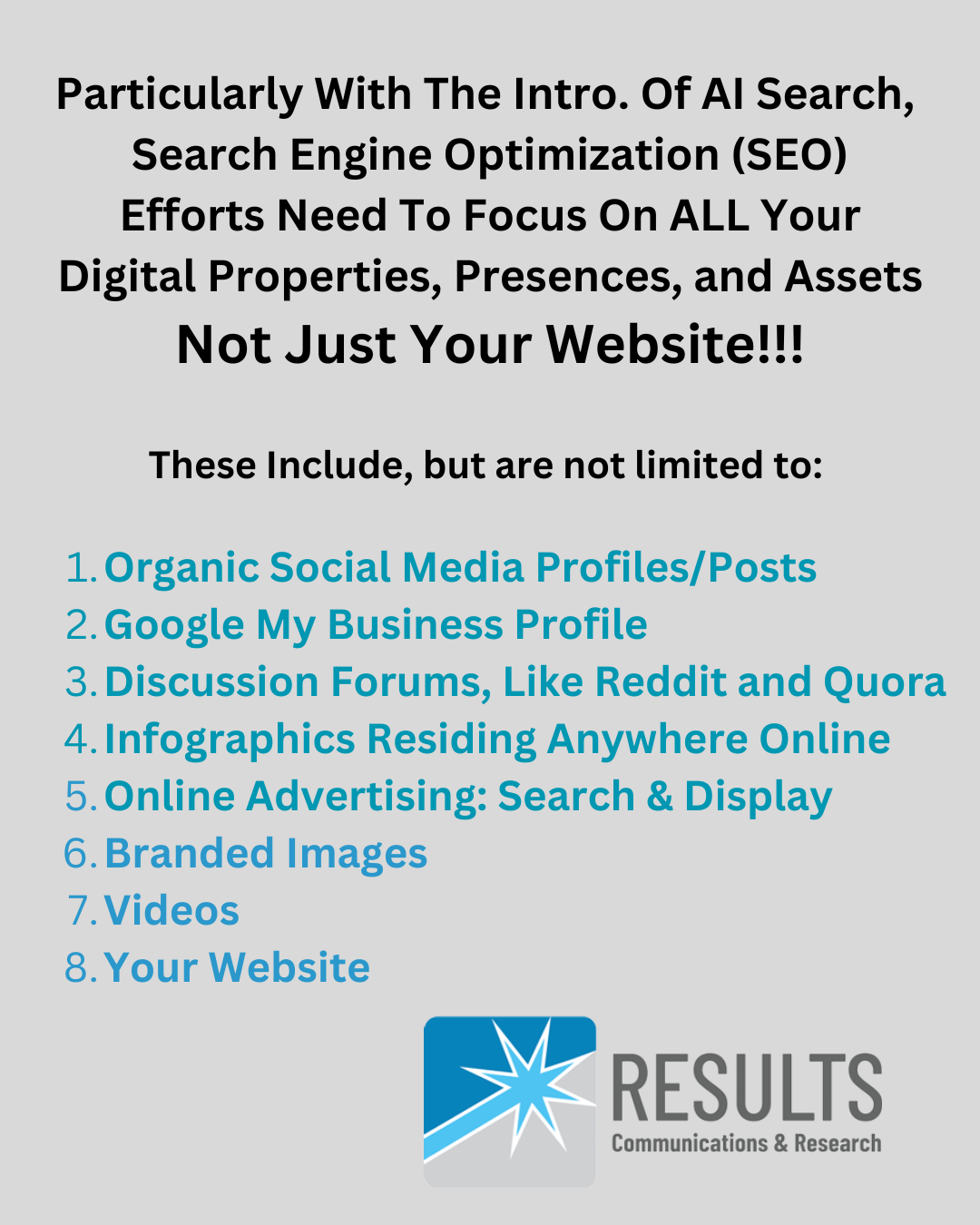
As we’ve explained in numerous spots throughout our website, SEO (Search Engine Optimization) is the practice of ensuring your organization is found online for relevant search-engines searches in relevant geographies. But a huge mistake in 2025, and beyond, would be to only focus on your website and Google My Business Profile being optimized to be found by appropriate searchers/target audiences, as shown in the image below.

Gray image with turquoise lettering that reads "Particularly With The Intro. Of AI Search, 
Search Engine Optimization (SEO)
 Efforts Need To Focus On ALL Your 
Digital Properties, Presences, and Assets
Not Just Your Website!!! These Include, but are not limited to: 
Organic Social Media, Profiles/Posts
Google My Business Profile
Discussion Forums, Like Reddit and Quora
Infographics Residing Anywhere Online
Online Advertising: Search & Display
Branded Images
Videos
Your Website." The image also contains the logo of our SEO consulting and digital marketing agency, Results Communications & Research.

If you’ve been regularly reading our blog or, simply, just reading whatever you can get your hands on related to SEO, you know that search engines’ focus since the 2020 pandemic has been on answering (by providing other organizations’ answers to) questions that searchers have related to a particular topic, product, service, or solution. Search engines care less and less about the source and format of that content, and they’ll snag content from just about anywhere on the internet if it answers a question in a manner that is easily understood/is absorbable, and that allows readers to take action/the next step.

Is SEO Dead? Does SEO Still Matter?

The answer to the above is “no way!” In fact, just the opposite, although some digital marketing experts are saying it is, or are reluctant to use/expand the SEO acronym or search engine optimization phrase to describe maximizing your opportunities for all and any digital assets, presences, or properties to be served up in search-engine results vs. just an organization’s website, Google My Business Profile, and paid search/search-engine ads (think Google and Bing ads).

Hey, right now in this time of constant change on the SEO front, no-one really is the one true expert or SEO guru, so we’re going to take our stand vs. following the crowd or one expert, and say that Search Engine Optimization (SEO) is about making sure all your digital assets, presences (think social media posts and presences and discussion forum presences) and properties serve you well related to being found online for the right search terms, questions, and topics in relevant geographies.

Let’s Chat About What SEO Means In This New Era And How Your Organization Can Plan and Respond To It!

We always love a complimentary discussion of for-profit and nonprofit organization’s digital marketing challenges, so schedule a discussion with our SEO consulting firm today!

AI Search, Being Found On Bing, Being Found on Google, Bing Ads, blog, Blog, Blogging, Consulting, digital marketing agency, Enjoying What You Do, Google Ads, Google Nonprofit Ad Grant, keywords, lead generation, marketing consultant, meta tags, online advertising, organic SEO, paid search, pull marketing, Search Engine Optimization, search terms, SEM, SEO, SEO tags, technical SEO, walking, website

A Day In The Life Of An SEO Consultant

If you’re considering a career in digital marketing, and particularly within that, a specialty or expertise in SEO (search engine optimization), read on to learn what a typical work day look likes.

How An SEO Consultant Starts Her Day

8:30a.m. – 9:30a.m.

Check/read (and send response e-mail) e-mails, which inevitably include the following:

  • Notifications from paid search (SEM) ad platforms (Google Ads or Microsoft (Bing) Ads) about:
    • Policy changes that have caused a Google or Bing Search Ad to be disapproved
    • Ad extensions and ads that have become disapproved because “page destinations” are no longer working (sometimes, clients of ours take down or move website pages to which site links (one form of ad extension/asset) point or ads point and forget to let me know that pages have been taken down, moved, etc.
    • Payment form (credit card) can’t be charged — therefore, the credit card information that a client provided to Google Ads or Microsoft Ads is no longer accurate/has changed
  • E-blasts and e-newsletters about SEO and invites to various SEO webinars and classes (due to the large # of search engine optimization experts we follow)
  • Client questions about how well their website is or isn’t ranking in search engines, particularly Google
  • Questions or comments from other marketing professionals with whom I collaborate, including social media specialists, branding/graphic design specialists, and website designers and developers
This is an image of Gail Snow Moraski, our Boston SEO Company's Founder/Owner Who Is An SEO Consultant. Gail has blonde shoulder length hair and is waring and orange crew-necked sweater that reads "Carpe Diem" She is wearing classes and smiling and is standing in front of a field of black-eyed Susans in her backyard.

9:30 a.m. – noon

  • Use Google Analytics data, Google Search Console data, paid search platforms, and SEO rankings audit reports to analyze and document KPIs (key performance indicators) for upcoming monthly/standing client meetings
  • Have a mid-to-late morning #SEOStrong snack, particularly one with lots of protein like swiss cheese or hummus because you definitely need a sharp brain and a lot of energy to do SEO work!
  • Employ “Answer The Public” and Google Ads keyword planner tools to conduct keyword research in relevant geographies using approved “inputs” from client about what terms they believe their target audiences would use to identify someone who offers the services, products, and solutions to problems they offer
  • Check client Google Ad and Microsoft Bing Ad campaigns (including Google Nonprofit Ad Grant ones) to see how they are performing, including reviewing cost-per-click (CPC) and click-thru rate (CTR); plus, review and apply or dismiss recommendations from Ad platform to improve optimization score, and check for appropriateness of “search terms” for which ad platforms are serving up ads.

12p.m. – 6:00p.m.

  • Review SEO diagnostics reports to determine possible website issues and/or missed SEO opportunities related to a particular client’s website ranking situation.
  • Facilitate client discussion about next steps/implications of their SEO rankings audit, diagnostics reports, and/or monthly KPIs. Where do we go from here to move the SEO needle and drive more relevant searchers to the client’s website in the month ahead?
  • Write a blog post for my own website or for a client website to support SEO by addressing topics and answering questions that are important to clients, but also to show search engines, that the website in-question is being kept “fresh”
  • Write and enter SEO page/post title tags (this might be in WIX, GoDaddy, Joomla, WordPress, Expression Engine, or a propriety software such as a CMS platform used in a particular industry), and submit the revised pages/posts for indexing by Google and/or Bing using Google Search Console and Bing Webmaster tools.

7:00p.m. – 8:30pm

Check e-mail again and/or continue to complete client SEO work of the nature outlined above. Being an SEO consultant is not just a 9 to 5 job!

Considering Hiring An SEO Consultant/SEO Expert?

Reach out today to schedule a complimentary discussion about your particular organization’s marketing challenges and opportunities!

Being Found On Bing, Bing Ads, Google My Business Profile, Microsoft Ads, paid search, Search Engine Optimization, SEM, SEO

How To Be Found On Bing

With all the current jockeying for position by search-engine providers and developers to be the number one AI search engine, as we’ve discussed in previous posts like our one entitled “How To Thrive, Not Just Survive, In the AI Search Jungle,” it’s important for organizations to think beyond Google, as they develop or revise their search engine optimization (SEO) strategies for 2025.

Bing continues to develop a number of AI search tools, so why not test the Bing and Microsoft waters?

How To Dip Your Toes In the Bing Pool

So, what are some easy, first steps you can take to start building a presence for your organization on Bing?

  • Maintain a business profile on Bing the way your organization does on Google with your Google My Business Profile.
    • You’ll be psyched to learn that when you go to Bing Places For Business to set up your Bing Places Profile, you’ll be able to import your Google My Business Profile information and integrate the two Profiles. That means any updates you make to your Google My Business Profile will automatically appear on your Bing Places Profile.
  • You can run Microsoft Ads, formerly known as Bing Ads, to ensure your organization appears high up in search results (learn more about when and why to run paid search advertising).
  • The way you use your Google Search Console account to submit new or revised website content (posts or pages) on your site for crawling and indexing on Google, you can set up a Bing Webmaster account to submit a request for Bing to crawl and index a page or post on your site.

Need Help Ranking Well On Bing?

Reach out to our Boston SEO Company’s team of SEO experts to schedule a complimentary SEO discussion today.

AI Search, Being Found On Bing, Being Found on Google, Bing Ads, Google Ads, Google Nonprofit Ad Grant, marketing best practices, online advertising, paid search, pull marketing, Search Engine Optimization, search terms, SEM

Should I Use A Call Ad Extension In My Google Ads?

Earlier this year, our Boston SEO Company wrote a number of blog posts to help our readers understand the paid-search side of search engine optimization (SEO). Two key organizations who offer opportunities to run ads that will appear at, or near the top of search results for the search terms (known as keywords) and geographies you provide them with when setting up your account, include Google Ads and Microsoft Bing Ads.

We highlighted Google Ads in our headline above because, despite the recent anti-trust lawsuit against Google, and more than 30 AI Search engines vying to be the top search-engine as use of AI search engines grows, Google’s search engine is still used by more than 90% of search-engine users. Regardless, the opinion we share below about whether or not to use a call ad extension (also known as a call ad asset) in your ads pertains to both Google and Bing Ads.

What Is A Call Extension Or Call Asset?

A call extension or call asset is a hyperlinked phone # (housed behind a phone icon labeled “call us” that the advertising platform serves up) that you can include along with your main ad body content when employing paid search advertising (also know as SEM, or search engine marketing). Any time someone clicks on this hyperlinked phone #/phone icon (see print screen below) the organization with whom you’ve placed your advertising will charge you for that click, the same way you pay a certain cost-per-click when someone clicks on the main body content of your ad or a different type of ad asset, such as a sitelink.

Reasons Not To Include Call Assets In Paid Search Advertising

Getting back to the answer to the question in the title of our blog post, the answer is “no, you shouldn’t include a call/phone extension/asset in your paid-search advertising.” We’ve run countless Google Ads campaigns for clients and our own business, and are now running Bing Ads for our own and client organizations. Based on our own experience and what we’ve heard/learned from other marketing professionals, our reasons for this are simple, and outlined below.

Call Assets/Call Extensions Waste Advertisers’ And Ad Clickers’ Time, Plus Advertisers’ Money Because:

  • Bots may click on call assets/extensions and each click on your hyperlinked phone #/phone icon that represents your call asset/extension will cost you money. As we explained above, the same way that search advertising platforms charge you each time someone clicks on the main ad body content of your ad or other ad extensions like site links, paid search advertising platforms will charge you for clicks on hyperlinked phone #’s.
  • In addition to the actual fee you pay to an advertising platform for clicks on phone # assets, you’ll also be paying for the time of your organization’s team member who answers the phone and interacts with someone who isn’t the right fit for what your organization offers, and of course, if they aren’t the right fit, the ad clicker will have also wasted their time. Even if your organization is a nonprofit one and not paying for your advertising clicks because of having a Google Nonprofit Ad Grant in place, you still don’t want to waste your team’s time or that of an ad clicker.
  • Searchers, i.e., individuals who have your ad served up to them, are usually in a big hurry. Search advertising platforms often serve up your ads to individuals who aren’t the right fit for your product, service, and solution, despite your ad body copy and keywords indicating who would be the right fit. Searchers often don’t take the time to read ad body content, and they may simply click on your call extension without visiting your website to see if your products, services, and solutions are the right for them. We’ve seen this happen over and over again.

Here’s an example that supports our above thinking. As you’ll see from the below print screen, we typed “designers near me” into Google. These ads (identified by the word “sponsored”) appeared. But, the search terms we entered into Google are very vague. Are we looking for a home designer, an interior designer, a graphic designer, etc.? If we clicked on the “Call Us” phone icon (call asset/extension which is hyperlinked to a phone #) without reading the ads and were looking for a graphic designer vs. a home designer or home renovator, we’d be wasting the advertisers’ money and time and our own time.

In sum, while it might seem ideal to make it easy for searchers to call you right away when they have an ad served up to them, you are better off from a financial standpoint, and good will standpoint (therefore, avoiding clickers getting frustrated with your organization) if you force them to 1) read the ad and 2) visit your website to learn more before they call you.

Check Out These Other Recent, Helpful Blog Posts For More Google Ads Wisdom From Our Boston SEO Company

Need Help Optimizing Your Google Ads Or Bing Ads Or Getting Your Paid-Search Advertising Spend Down?

Reach out today to schedule a complimentary paid search advertising discussion about how our team of SEO experts can help you with the above.

Acceptance of Circumstances, Being Found On Bing, Being Found on Google, Bing Ads, Google Ads, online advertising, paid search, Search Engine Optimization, SEM, SEO

Why Run Microsoft Bing Ads?

March 2025 Update To Previously Published Blog Post:

You can find some information at the bottom of this post about the cost-per-click and click-thru rate we experienced related to running Microsoft Bing Ads for our own company, and we’ve been running Bing Ads now for a number of months for one our clients, and they also achieved an impressive cost-per-click related to their SEM (Search Engine Marketing) ads on Bing. While we continue to run one campaign for the client in-question on Bing, we paused a number of their campaigns recently. Why? Because while the cost-per-click was far cheaper than it was for Google Search Ads, the ads did not “convert” well, i.e., Bing ad clickers who visited the client’s website did not take desired actions such as e-mailing, calling, or submitting an inquiry form nearly as much as Google Ads clickers did. This ultimately meant that the cost-per-conversion was far higher for Bing Ads than it was for Google Ads, even though the cost-per-click was far lower. We can’t say or predict if this would be the case for another client or advertiser.

Why Microsoft Bing Search Ads Might Have A Higher Cost-Per-Conversion Than Google Search Ads

Our theory for why the Microsoft Bing Ads achieved a much higher cost-per-conversion than Google Ads is this. We believe that, because far fewer people use Microsoft Bing’s search-engine tool to complete a relevant search in relevant geographies, Bing takes greater liberties related to the search terms for which it will serve up an advertiser’s ads. While, as with all search engine marketing/paid search ads, you provide Microsoft Bing with keywords — both positive ones (ones you want ads served up for) and negative ones (ones you don’t want ads served up for) — and you can also use “phrase match” keywords to add further limitations to which search terms Bing can serve up your ads, we still found Bing taking far too many liberties. Therefore, ads were being served up to people who weren’t the right fit, and some of those “wrong fits” were clicking on the ads. But, of course, because they weren’t the right fit for our client’s products and services, they weren’t taking any kind of inquiry type action on the site.

Original Post:

Recently, we’ve been hearing more about organizations running paid search ads on Bing. And, more clients are interested in employing them to see how effective they are in creating awareness, generating leads, and causing sales of products or engagements for services. Here’s some of the reasons why Microsoft Bing Search Advertising is suddenly becoming hot:

  • if available data is accurate, there’s been a recent uptick as of the time of this blog post (June 2024) in the % of search-engine users who are using Bing vs. other search engines like Google
  • searchers using Bing’s search engine skew older, and therefore, may have higher incomes — ultimately, making them more likely to make a purchase
  • Bing searchers tend to be more mission-driven and are using Bing’s search-engine to really hone in on information that will answer their question(s) or allow them to complete a desire action — ultimately, leading to a strong ad click-thru rate. And, since they tend to spend a longer amount of time on the websites they visit as a result of conducting a search, they tend to “convert” better
  • since to-date, far fewer advertisers advertise on Bing vs. Google, there’s less competition to have ads shown to searchers on relevant search terms who meet other targeting criteria, such as geography
  • cost-per-click paid for search ads on Bing vs. Google tends to be significantly lower (we’re talking 50% or more), which means an advertiser’s budget goes much further
  • as with Google Search ads, whose ads appear on Partner sites, such as YouTube, Bing ads can appear on Yahoo and LinkedIn

Our Boston SEO Company Now Offers Microsoft Bing Advertising

As part of our overall, and paid SEO services, effective June 2024, our Boston digital marketing agency and SEO Company is offering Microsoft Bing search advertising services to existing and new clients. As a component of the SEM (Search Engine Marketing/paid search) portion of an overall SEO strategy, these ads can either complement current and planned Google Ads, or be used as the primary/only form of paid search advertising.

With over 15 years of experience related to Google Search advertising, we’ve got lots of very relevant experience related to search marketing, and we can help you import existing Google Ads campaigns into Microsoft Bing’s advertising tool.

This image has a pale green background to reflect the color that Microsoft Advertising uses in their branding in keeping with the following image message "Our Boston SEO Company & Digital Marketing Agency Is Pleased To Announce That We Are Now Offering Microsoft Bing Ads Advertising Services (In Addition To The Google Ads Services We've Offered For 10+ Years." The image also contains the logo of our Boston SEO Company and Digital Marketing Agency, Results Communications and Research

Reach Out Today To Get Your Microsoft Bing Ad Campaign Going!

As we pointed out above, it’s easy to import an existing Google Ads campaign into Bing, so you don’t have to recreate the wheel if you decide you want to run identical search campaigns on both Google and Bing simultaneously. Reach out today and our team of SEO experts will be glad to get you started on reaping the benefits of advertising on Microsoft Bing!

Bing Ads Deliver Strong Results

July 9 2024 Update: To test the waters and get to know the Bing Ads manager tool better, we ran Bing Ads for our own business. We were very pleased with the following Bing Ads KPIs (key performance indicators):

  • Very strong click-thru rate (CTR): during our 8-day pilot, our ads generated a very strong CTR of 24.68%. We checked the search terms report which shows the actual terms that someone entered in Bing for which ads were served up, and we were pleased with the search terms we were seeing.
  • Extremely reasonable cost-per-click: just 22 cents! Far lower than what we experienced when we ran Google Ads for our business and extremely favorable for B2B (business-to-business) services advertising.

While to-date, we haven’t generated any leads — inquiries or sales — from the ads (unfortunately, we believe a lot of competitors search on relevant terms to see what their competition is doing, and then, click on our ads), we like to practice what we preach about landing pages, so the ads caused us to revisit our SEO services ads landing page to make sure it was more effective!