If I take the time to write a post about an ad campaign, it’s because I really like it or I really dislike it, from a marketing standpoint.
Note when I use the term “TV ad” in this blog post, I’m using it broadly. It could mean a network TV ad or an ad that runs on cable TV or streaming channels.
How A TV Ad Campaign Can Impact A Company’s Brand
There’s no way a company/brand as large as Liberty Mutual hasn’t had their own internal marketing people, and their marketing agency, slicing and dicing the results, as far as their recent TV ads go — so they wouldn’t be running such campaigns if they weren’t effective. But, as someone with a 35+-year-marketing career who has been the keeper of small-to-large organizations’ brands, I just don’t get or even like the recent campaigns. They honestly make me queasy for these negative-impact-on-their-brand reasons:
It does not seem a good branding practice to have actors, and now a small animated creature, saying the name of your organization/brand wrong. For months now, I haven’t liked the whole “liberty, biberty” thing, but again, it’s likely working for Liberty Mutual as far as driving website traffic, inquiries, and actual engagement for services, or why would they have expanded on it vs. eliminated the use of the “liberty, biberty” phrase by actors and creatures?
It’s unclear what the new creature is and “it” just feels annoying, and it actually is annoying the people it interacts with in the TV ads.
Do you want your brand associated with lack of intelligence or lack of effort — I mean, the people played by the male actor, recent female actress, and now the creature, who either can’t make or take the time to get the name of the organization right? Or, just aren’t smart enough to do that?
Insurance companies for years and years have had various actors play the part of various pseudo-spokespeople for their brand, sometimes, with obvious idiosyncrasies, habits, and phrases. And, sometimes, these ads they make me giggle, causing memorability. But, Liberty’s ads don’t have me giggling. Think of Jamie and Flo for Progressive, or Jake from State Farm. Instead, Liberty’s ads really make the brand seem like a silly and not creditable one because of making fun of their own name. I’d put my energy into LiMu Emu if I were Liberty Mutual vs. the new non-identifiable, annoying creature. Maybe it’s just me, so I welcome hearing what other brand and marketing experts have to say about it.
We never like to recommend, or try to implement, a new form of online advertising, until we’ve tried/tested it with our own business. That way we can understand the pros and cons of running advertising on a new advertising vehicle, plus all the “inputs” we’ll need to provide to the tool to launch the campaign. That makes it easy to know what questions we need to ask of our clients related to a new ad campaign launch on a vehicle that is new to them, or what we need their approval on.
We waited to try this new vehicle until they offered pay-per-click (PPC) vs. just pay-per-impression (CPM) advertising because, quite frankly, most of clients are small-to-mid-sized businesses (SMBs) and nonprofits and they have far smaller marketing/advertising budgets than large firms and need their ads to really work for them and generate leads and sales vs. just awareness-generation!
Results Communications & Research’s ChatGPT Ad
As of the original publish date of this blog post, It’s been about 1.5 weeks since we rolled out ads for our own business, Results Communications & Research, on the ChatGPT LLM-powered (large-language-model-powered) answer engine/AI search platform. We’ve documented below — and will continue to document — our 2026 journey with this new form of online advertising. So, be sure to check back!
Days 1 & 2 (June 11 and June 12) – set up our ad and associated targeting for our campaign at ads.openai.com (ChatGPT is owned by OpenAI) — it was not a large lift at all! Needed to determine and document in OpenAI’s ad tool how much we were initially wanting to spend for a click (we initially put this at $3.50) and our daily budget ($25), plus in what geographies (Providence RI and Boston MA) we wanted the ads to appear. And, also provide context hints (OpenAI instructions explained this exercise this way: “describe the conversations, topics, or keywords where your products or services may be relevant; these hints guide matching, but aren’t exact-match targeting rules.” We also documented the images and content we wanted to use in our ads. We are testing two ads — one with longer and one with shorter headlines — but to keep something consistent, so we’d feel comfortable drawing conclusions about our headlines, we used the same image in both ads. We also had to share with the ad platform what page of our website we wanted ad clickers to land on (we created a brand new page on our WordPress website for such purposes — which is an online advertising best practice).
Day 2 (June 12) – launched our campaign by activating it in our OpenAI Ads dashboard.
Day 5 or 6 (June 15 or 16) – of course, being the digital marketing and analytics geeks that we are, we checked our advertising dashboard at openai.com countless times to see if the ads were being served up and generating impressions and/or clicks. Seeing zero movement on either the impressions or clicks front, we decided to expand our geography to NYC and our daily budget to $35 and what we were willing to spend for a click to $5.00, in case what we were willing to pay for a click (and the competition to have ads shown by competitors in the same geography for the same types of prompts) was causing the ads to not be shown or we needed a bigger geography to have enough opportunities for our ads to be shown to relevant “prompters” on ChatGPT.
Day 7 (June 17) – we saw in our advertising dashboard that our ChatGPT ads were starting to accrue impressions, and therefore, were being served up, but not to any great degree.
Day 8 (June 18) – we increased what we were willing to pay for a click to $7.50, and also added in the whole state of New Hampshire to our geographic targeting.
Day 9 (June 19) – seeing an alert in the OpenAI ads platform that we were often being outbid by competitors because of what we were willing to pay for a click, we increased our click bid to $10.00 from $7.50 – our first 2 clicks were achieved somewhere between the 18th and 19th, and at that point, our ads had a 0.66% click-thru rate (meaning less than 1% of individuals having our ad served up to them, clicked on it — not surprising for reasons outlined in the next bullet.)
Day 12 (June 22) – we just checked this morning and the increase in budget and what we are willing to spend for an ad click, plus the expanded geography seems to be paying off! As of this morning, our ChatGPT ads have generated 2,762 impressions (been served up that number of times), 13 clicks (a 0.47% click-thru rate), and an average cost-per-click of $6.44. We aren’t surprised by any of this. We had seen competitors running ChatGPT ads in our space when we were entering relevant prompts into ChatGPT, so we knew as a business-to-business advertiser we were more likely to have to pay more for a click than a business-to-consumer advertiser might. We also know that ChatGPT is a different animal than Google Search ads — the new form of ads discussed in this post is served up to individuals entering prompts into ChatGPT that might indicate they’d be interested in our services, but it’s not the same as someone entering “keywords” into Google and then Google serving up ads to those individuals because an advertiser provided those keywords as ones they wanted their ads to be served up for. We changed our daily budget to $50.00 today — we should have increased the daily budget a few days back in keeping with our increasing the amount we were willing to pay for a click! We also paused the shorter of our two ads since the longer ad was performing far better. To-date, we have not generated any leads — in the form of phone calls, e-mails, or appointment set-up — from these ads. We’re not discouraged by this at all, since, when it comes to a business engaging a firm for B2B services — or even reaching out to them — there can be a long lead time!
Because businesses often take some time before purchasing business services, and therefore, like to research a number of companies before they decide to reach out to the one organization or the few organizations whom they are most interested in, we have yet to receive any inquiries from our ads, but still hope to get some inquiries from those who have clicked on the ads. At least we’ve generated some “awareness” among appropriate parties. We’ve also found in our many years of running online ads for our own business, that often, fellow marketing agencies/competitors click on our ads to see what we are offering and what we are all about. We did ensure our landing page for our ad clickers adhered to best practices, such as demonstrating why we are experts, including “social proof,” therefore, a review or testimonial, and much more!
Ultimately our ChatGPT ads yielded:
11,321 impressions (this number of sets of eyeballs viewed our ads as part of entering an appropriate prompt into ChatGPT)
46 clicks
0.41% CTR (we aren’t concerned or scared off by this low click-thru rate — we’ve seen similar with Reddit and nextdoor.com ads
Average cost-per-click (CPC) of $7.92 – not horrible for a B2B (business-to-business) lead
As we recommended at the top of this blog post, keep coming back to learn more about our ChatGPT advertising journey! We’re all in this together when it comes to understanding this particular form of new advertising and how effective it will be in generating leads and sales, not just awareness, and if ROI makes sense for advertisers like our clients who need their ad $$ to work for them pretty quickly.
While our firm has developed a specialty in, and has gotten well known locally for search engine optimization (SEO), i.e., both paid and organic tactics that drive individuals who are actively searching to identify someone who offers the products, services, and solutions to products you do to your website, we also have a lot of experience with “push marketing.” Unlike SEO-related marketing and tactics (pull marketing), push marketing is all about putting the idea about your organization’s products, services, and solutions into the heads of individuals who aren’t actively searching to identify someone like you, but who still might be a great fit for your product, service or solution, based on various demographics and behaviors. And, our blog post is focused on one form of push marketing — display advertising.
Who Does Display Advertising Target?
Like all forms of push marketing (think print, e-mail, and radio marketing), display advertising (advertising that includes an image vs. just text) allows you to target individuals and/or businesses based on one or more of these criteria about the individual or business:
the geography in which they live or are located
their age, gender, and household income, if an individual
key life events, such as graduating from college, having a baby or retiring, if an individual
their hobbies or interests
their role at a company
their recent purchase, or research conducted related to a potential purchase
the size or nature, if a company
So, What Is The Biggest Challenge Of Display Targeting?
Over the years, in both corporate marketing and consulting/agency roles, we’ve run a decent number of Google Ads, Facebook/Instagram, Reddit, Nextdoor.com and other “display campaigns” that have employed the targeting detailed above. But, with recent campaigns, it’s really struck us what one of the biggest challenges is related to running such campaigns to pursue individuals who aren’t necessarily looking to buy your products, services or solutions, but who might be a good fit for them.
And, that display advertising challenge is this. Many consumers and/or individuals associated with a business often click on ads, not because they have an immediate need for the product, service, or solution advertised nor will they ever have such a need. But rather, they click on ads out of what we call “the curiosity factor.” Something about the language and/or image in the ad — known as the “ad creative” sounds interesting or intriguing to them and they click on the ad to learn more just because they are curious.
How Does The Curiosity Factor Impact Display Advertising Results?
Here’s how individuals clicking on display ads simply out of curiosity impacts display advertising results:
Since for display ads, you often pay for ad “click,” you often pay for clicks that will never become a lead or sale.
The conversion rate for your ads is far lower than what you see with “paid search” campaigns (where ad clickers are in active search mode to identify someone like you) and your cost-per-conversion may end up being far higher than what you see with push marketing. The last statement depends on how much your cost-per-click is for your display campaign since often the cost-per-click is far lower than for a paid search campaign.
Ultimately your campaign ROI or ROAS (return on ad spend) ends up being quite low and doesn’t warrant continuing to spend on the campaign even though you’ve generated a lot of awareness of your products, services, and solutions thru your display ad spend.
Need Help Determining Whether Or Not It Makes Sense To Run A Display Advertising Campaign?
Because we believe “traditional,” i.e., non-digital media and marketing is not dead, and often has a strong place in an integrated marketing plan, we’ve been recommending print advertising to clients, as appropriate, and helping to launch and monitor print campaigns.
What Is a Print Campaign?
Normally, when someone refers to a “print campaign,” they are referring to one or both of the following:
An advertisement that appears in a printed newspaper in one or more spots within an edition, and in one or more editions of the newspaper
An advertisement that appears in a printed magazine in one or more spots within an edition, and in one or more editions of the magazine
Keep in mind that often media/publications that offer print advertising will also share your ads in a digital version of the publication on their website, but that is not always the case. So, this blog post is focused on making sure hard copy/printed publication advertising is both effective and measurable.
How Do You Ensure A Print Campaign Is Effective?
Choose newspapers and magazines that your target audiences are likely to read
Include calls-to-action like “schedule a free consultation today.”
Don’t have too many competing messages or make the ad too cluttered
Use fonts appropriately — make sure there’s a hierarchy, so that the most important ad messages/ad content are in larger fonts
Provide several means for the ad viewer to get in touch with you, such as: a QR code that goes to the ad landing page (this is discussed below), the spelled-out URL of ad landing page like https://allintheresults/seospecial, a phone #, and if appropriate, an e-mail address. Never assume everyone wants to do business with you electronically or digitally. Always provide options for those who are less technologically savvy or who don’t like to use technology.
How Can You Track Print Campaign Results?
As mentioned above, ideally, if you are running a print campaign you would have a devoted landing page specific to the print ad in-question, and if the print ad is running in more than one vehicle, distinct landing pages for each of the vehicles the ad will run in. You can use the identical landing page for both a newspaper and a magazine you plan to run an ad in. Just create the website page under one of the URLs you plan to use in a specific publication, and then, copy the page and assign it to a distinct URL for each vehicle. Distinct page URLs will help you, the advertiser/marketer, to determine which ads are driving traffic to the website (just use Google Analytics to check on page URL views).
Whether they be phone, e-mail, or inquiry form submissions, in advance of the print campaign dropping, let appropriate internal staff know about the nature and timing of the campaign and ask them to record how inquirers learned about you. You can also add that question to your online inquiry form. Many marketers/advertisers include a drop-down menu (containing various marketing vehicles) on their inquiry form from which inquirers can choose “how they learned about you.”
Conclusions About Print Advertising
If you’re going to spend the time and $$ executing print ad campaigns, be sure that:
The ads themselves are effective and are geared toward generating leads, sales, and engagements for your organization as discussed above.
Ensure you put the right tracking mechanisms in place before you launch the print ad campaign, so you can evaluate the ROI of the campaign.
Need Help Creating, Executing, and Evaluating A Print Campaign?
We can’t believe it either, but today (April 1, 2025) marks 11 years of Results Communications & Research (Results C & R) being in the marketing agency and SEO company business.
As we always have been, we are very grateful to the many talented marketing consultants, marketing agencies and their staff, and other marketing professionals we’ve had the pleasure to collaborate with, and to learn from. We mention a few of those marketing collaborators on our Our Team page, but the list is so long, it’s hard to give a shout-out to everyone we’ve enjoyed meeting, knowing and working with the last 11 years!
And, we are incredibly grateful to the close to 150 client organizations — both for-profit and non-profit — with whom we’ve brainstormed and strategized to achieve the best possible level of awareness, sales leads, and actual sales (both product and service sales). Many of our current clients have been with us a number of years. You can access a list of our past and current clients to see examples of industries we’ve served by visiting the Clients page of our website.
AI Is Not New To Google Ads/Google Ads Is Not New To AI
Related to our above desire to continue to grow our Google Ads skills, we want to remind our readers that AI is not new to Google Ads and Google Ads is not new to AI. For years, Google Ads has been able to offer “display” ad campaigns that are targeted to individuals who show affinity to certain products or services because of past buying or researching of them, having interests related to them, visiting websites focused on them, or reading about them on a variety of diverse websites.
AI and Writing Website Content, Particularly Blog Posts
And, speaking of AI, another area in which we hope to do more client work in the coming year is blog writing for clients. We’ve offered blog-writing services for years — and a number of clients have taken us up on it — but because we really enjoy writing, we hope to do more of this work for clients.
We don’t think AI search-engine/tools like ChatGPT will, or should ever, replace humans when it comes to website content and blog post writing. There’s great evidence that, at least some of what is spit back by AI search engines is not accurate. Plus, we don’t think an AI tool can ever bring the behinds-the-scenes knowledge or heart ‘n soul of an organization to website content writing or blogging. Only the organizations, themselves, truly understand what challenges their target audiences face — what their pain points are — and what they most need help with and how the organization’s products and services make a difference in their client’s/customer’s lives.
Traditional Marketing Opportunities Are Often Missed Ones
Our Principal, Gail Snow Moraski, in a photo from around 2014, the year she founded Results C & R
Many Thanks and Let’s Catch Up!
Many thanks to the clients and marketing professionals we continue to collaborate with!
If you’re a past client, a prospective client we spoke with, or a fellow marketing professional with whom we collaborated in the past, or if you’ve interned with us in the past, let’s catch up. Schedule a time to do so today!
You don’t have to guess or rely on information provided by a prospect (who reaches out to your organization because of an ad or some other marketing activity) to figure out if the online ads you paid to have placed on an external website are working for you. It’s much more accurate to gauge the effectiveness of your online ads through information available via GA Google Analytics than rely on individuals who answer inquiry calls for your organization, or on the caller to remember how they learned about you.
Using Google Analytics (GA4 Analytics) To See If Your Online Ads Are Generating Results
Let’s say you bought an ad on my website, allintheresults.com. You can check your Google Analytics traffic acquisition reports to see if any readers of/visitors to the allintheresults.com website were “referred” to your site because they clicked on your ad that was displayed at allintheresults.com
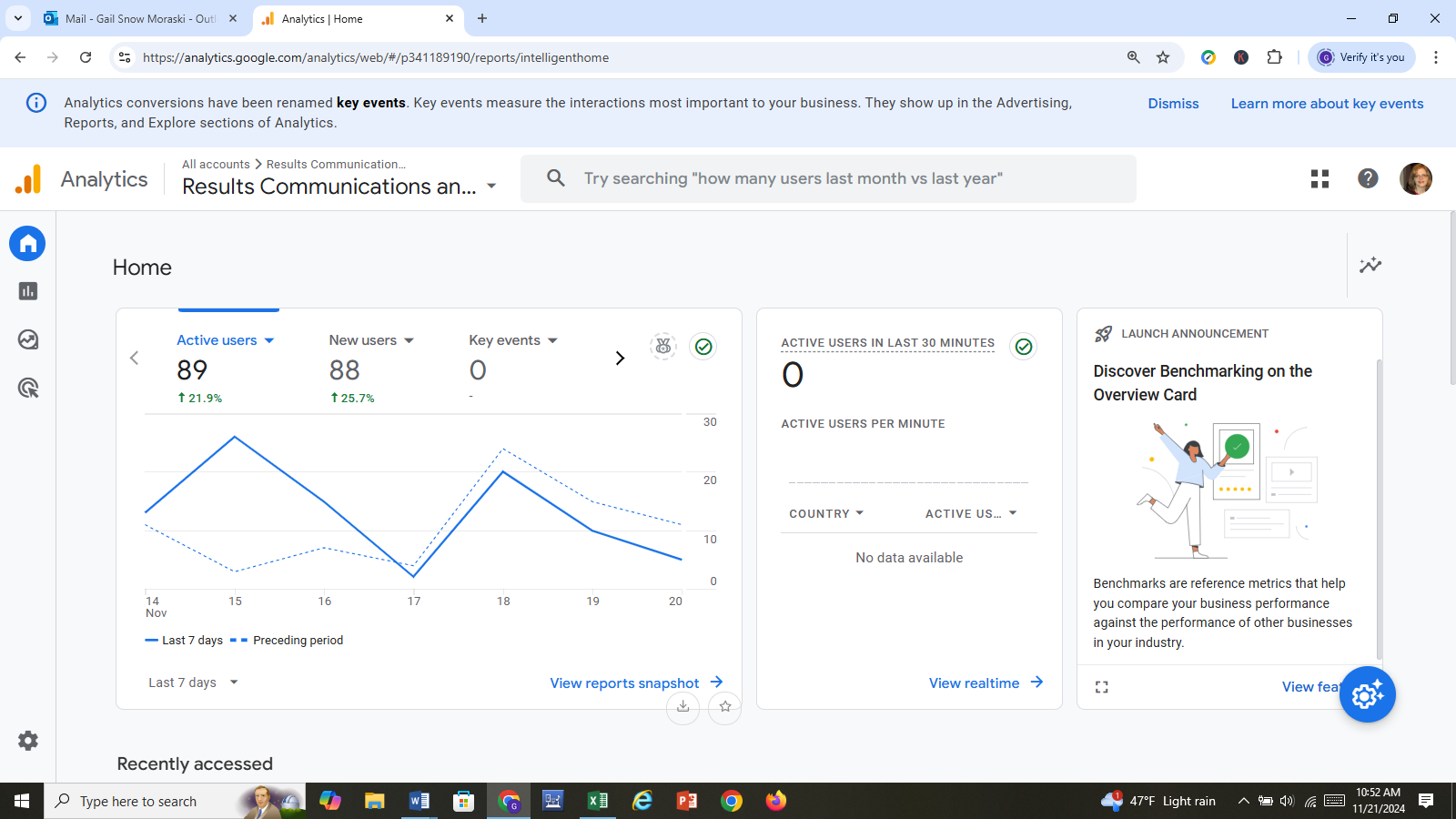
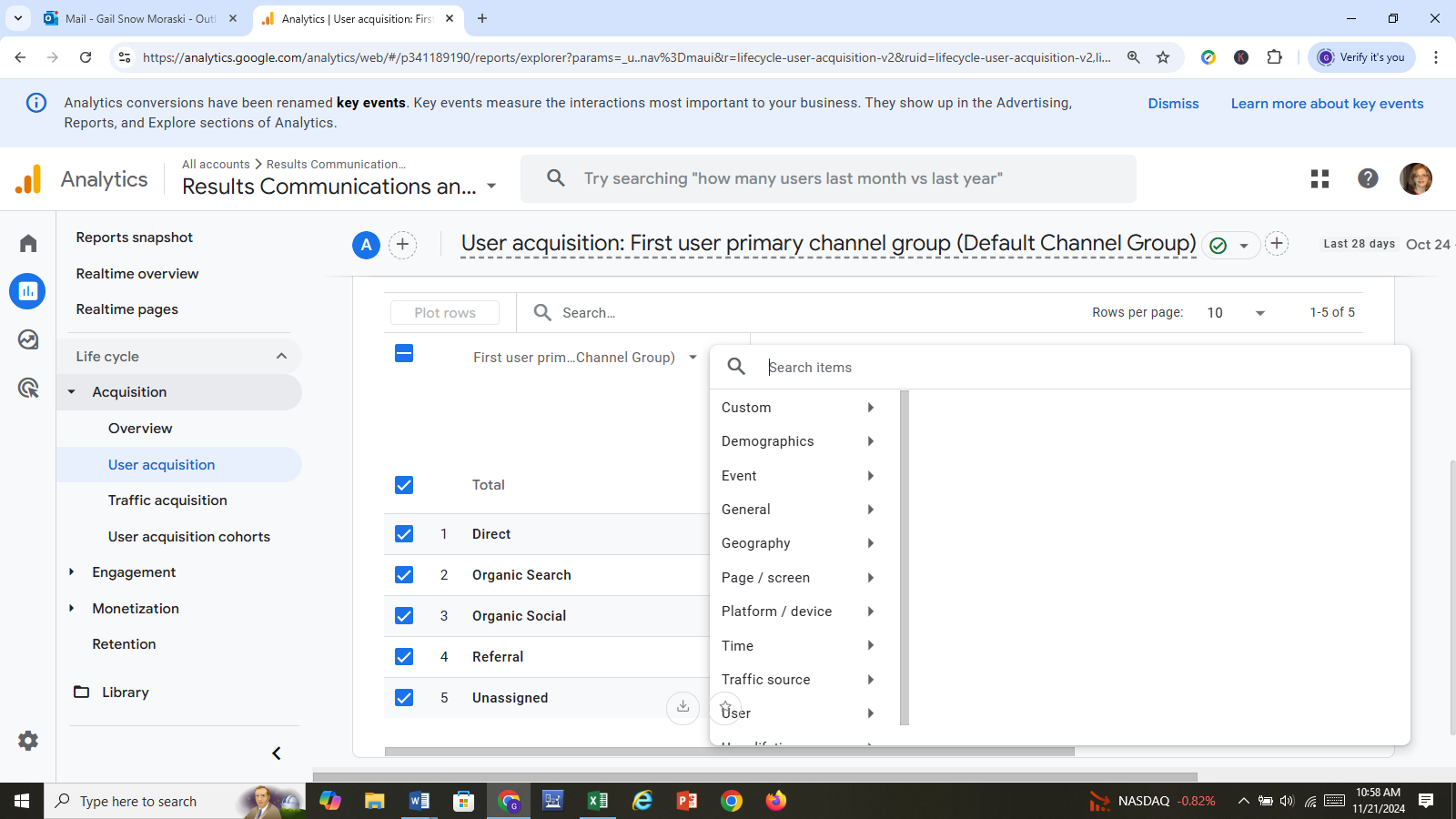
STEP 1. Log into your Google Analytics Account at https://analytics.google.com.
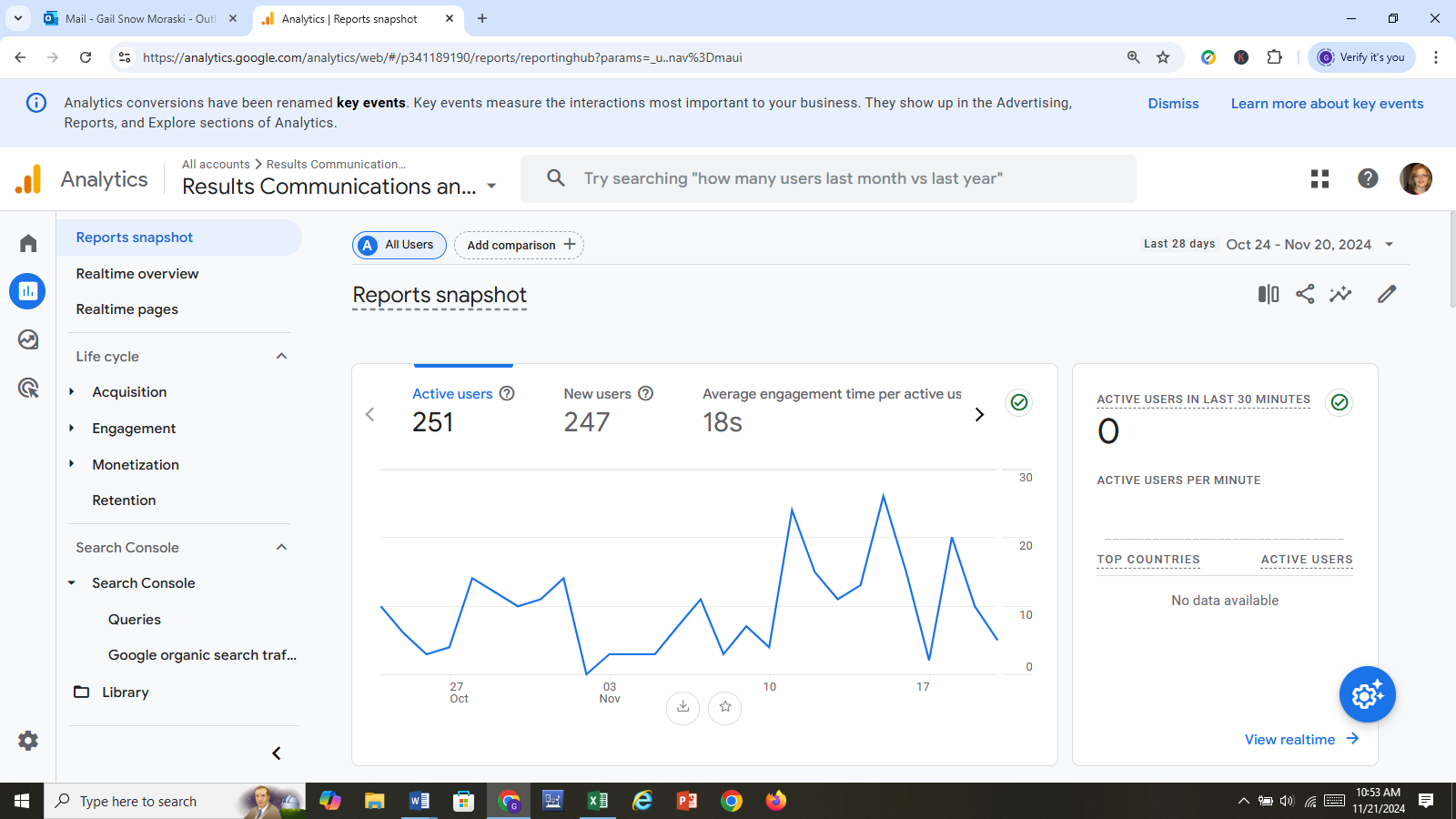
STEP 2. Click on the reports icon (square with bar graph in it) found in the menu bar on the left-most side of your dashboard
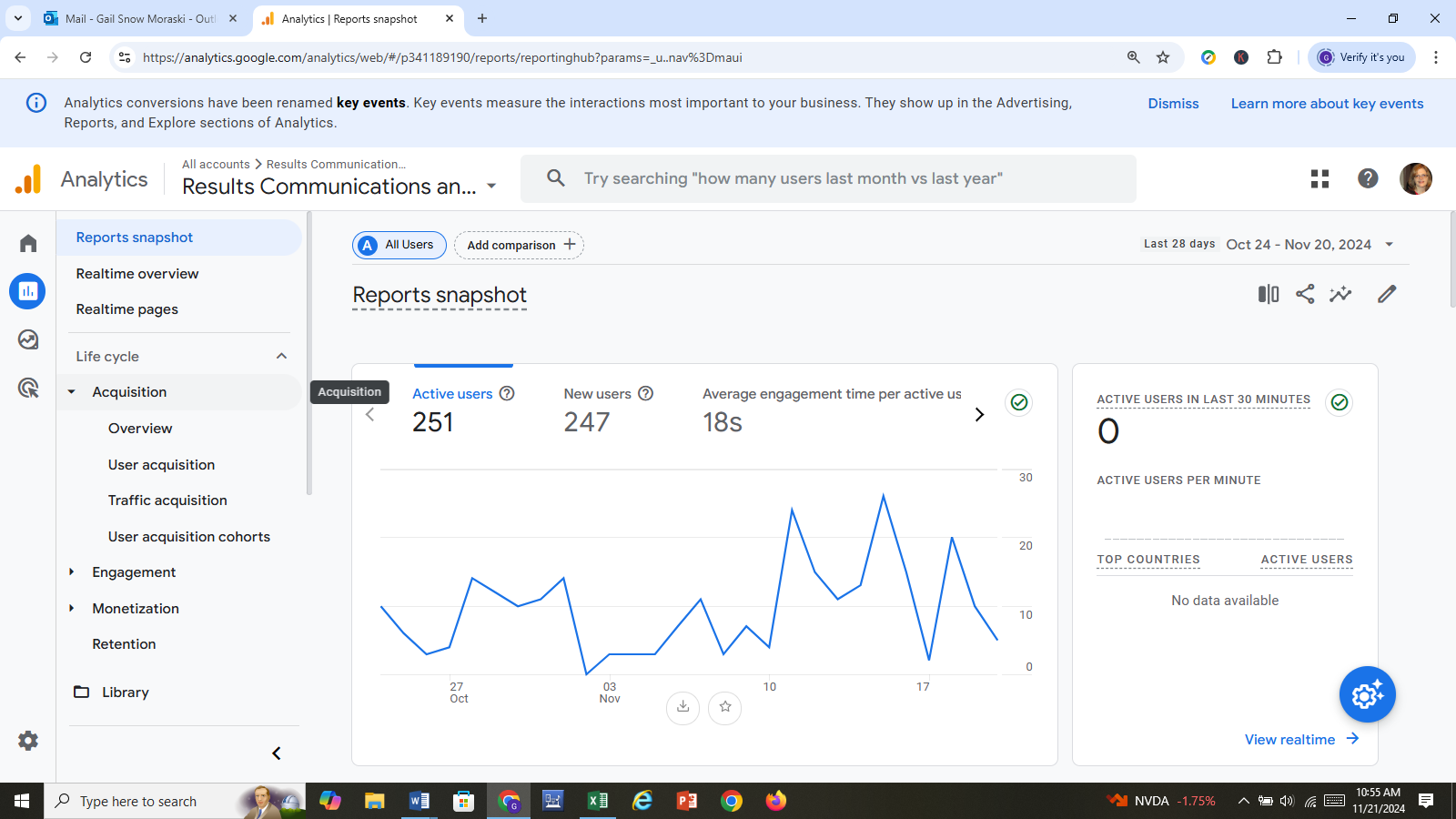
STEP 3. Click on “Acquisition”
STEP 4. Click on “User Acquisition”
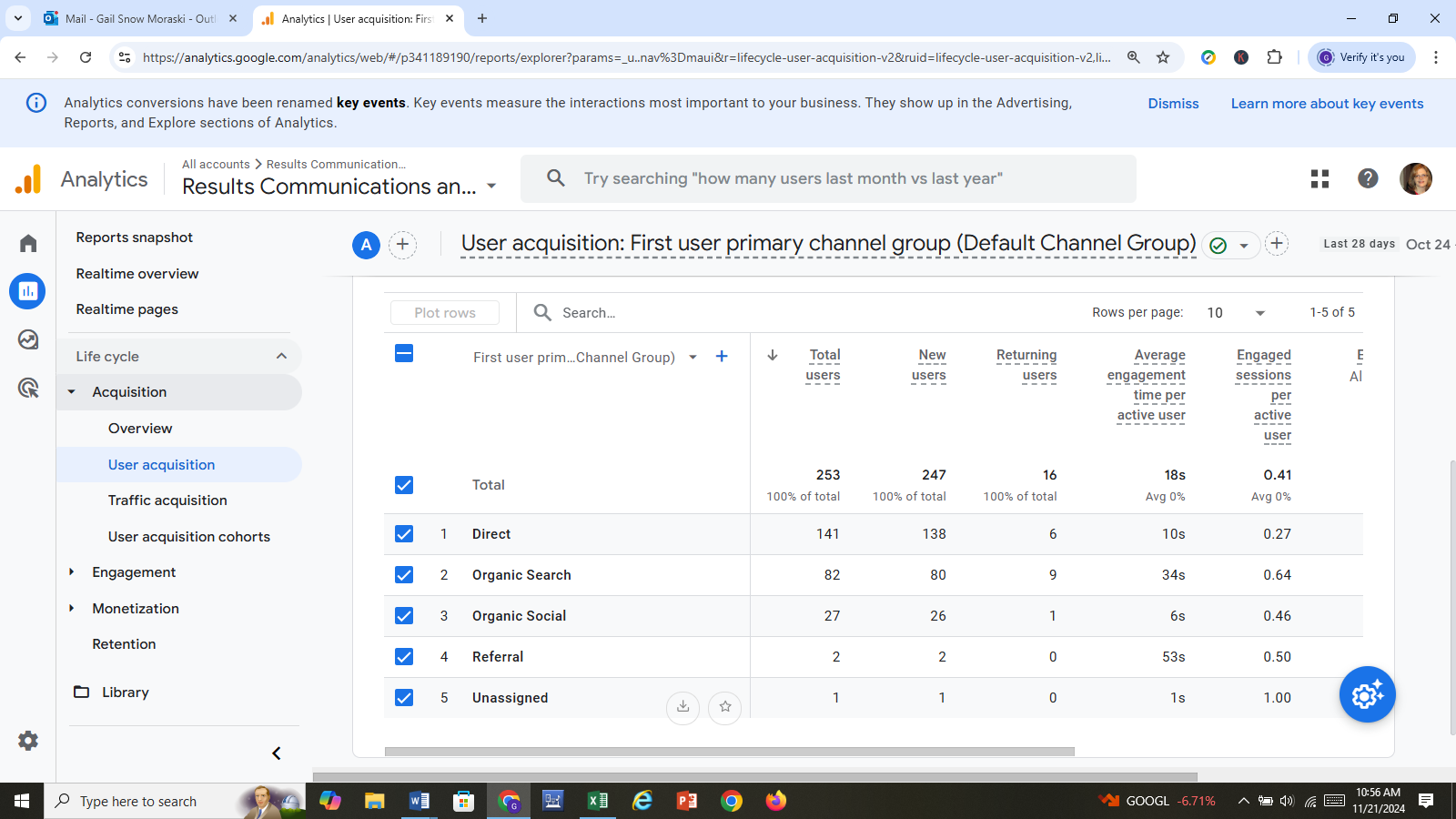
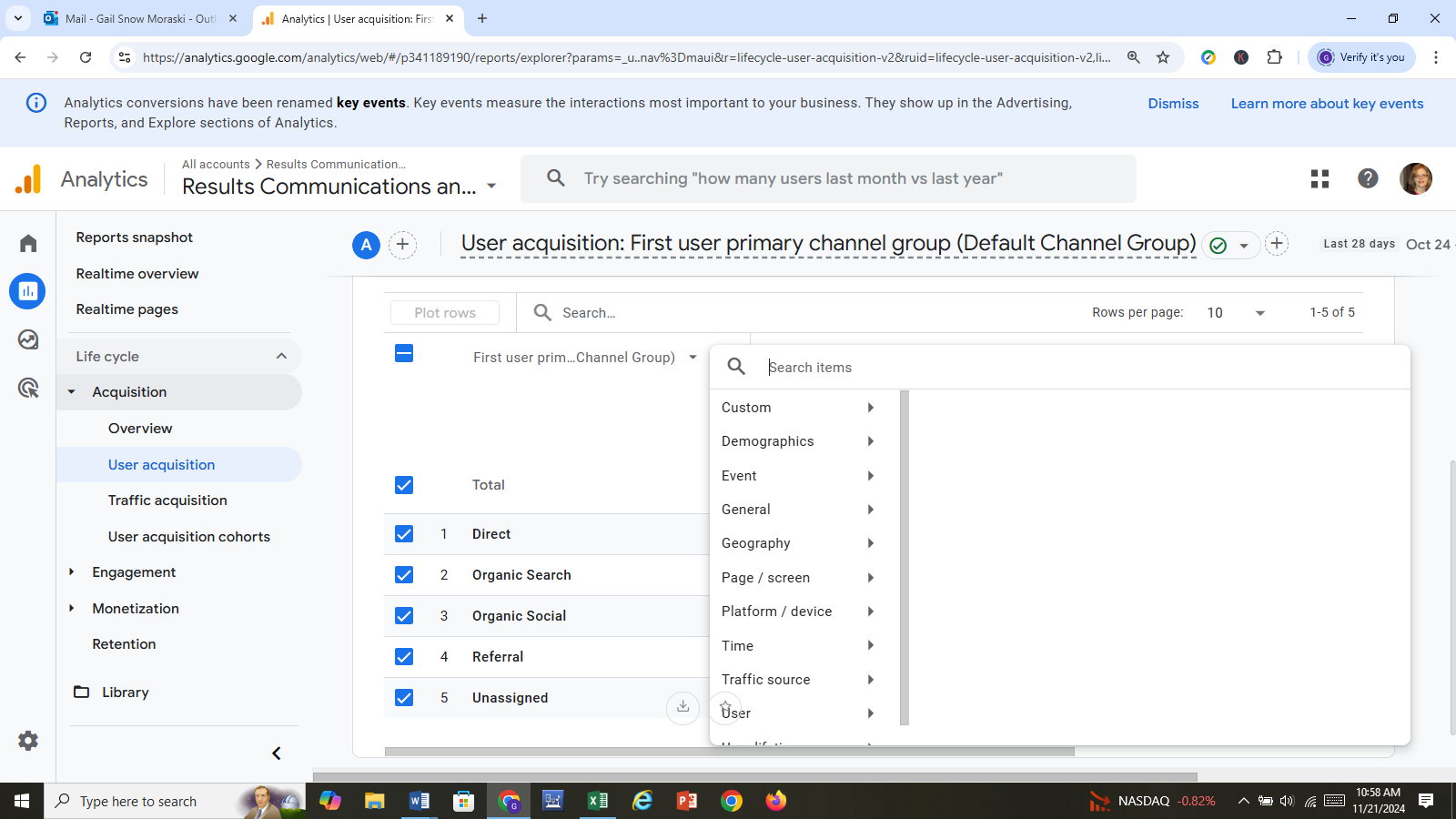
STEP 5. In the center of the screen where it shows your various sources of traffic, including referral traffic, click on the “+” sign to the right of the words “First User…Primary Channel Group”
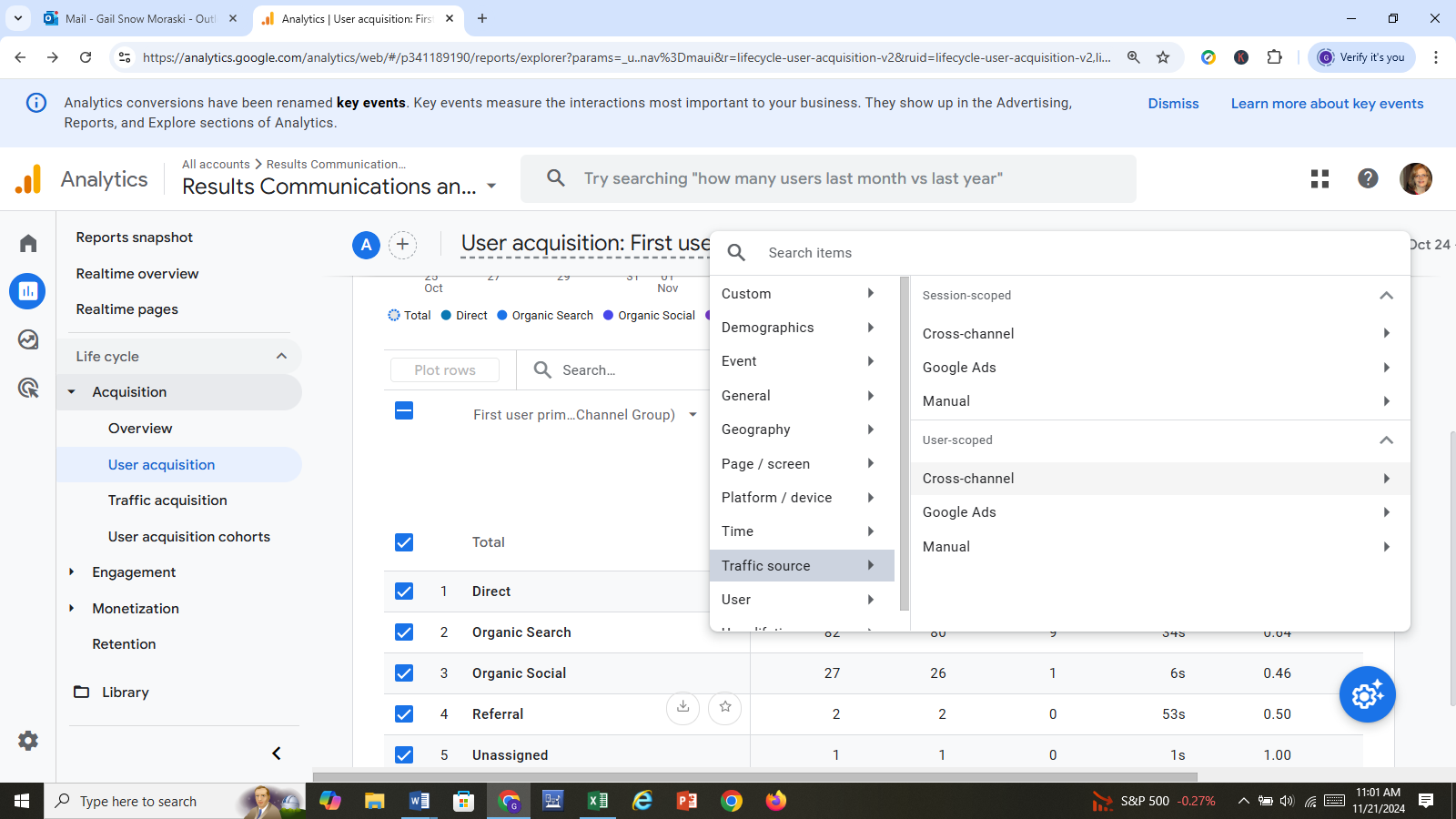
STEP 6. Select “Traffic Source” from the menu that appears
STEP 7. Then select “Cross Channel User Source,” and then, “First User Source/Medium”
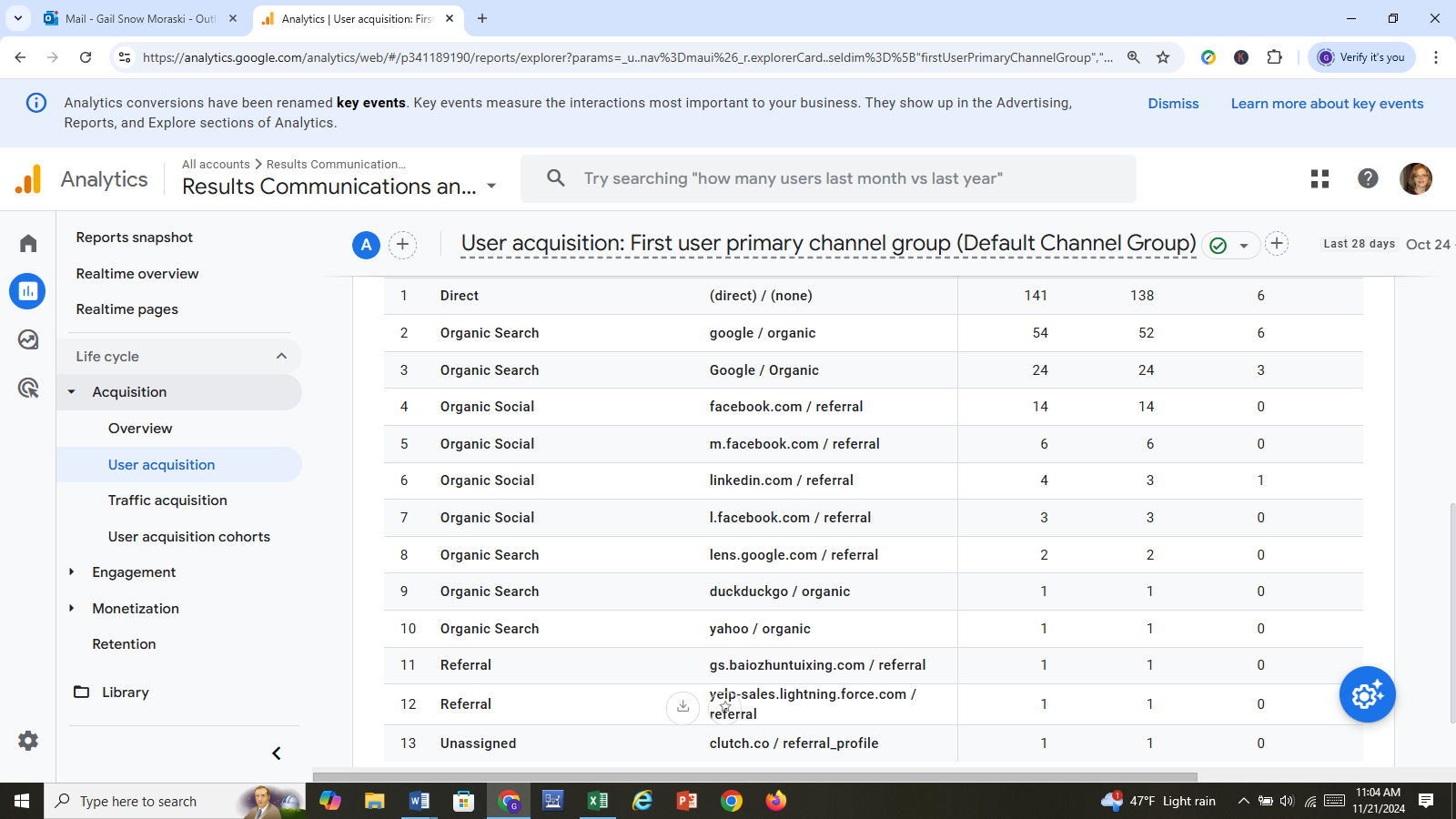
STEP 8. Now scroll thru the report generated (note make sure you scroll thru all the pages of the report) and look for any website that is listed as a referral source. If ads you were running on allintheresults.com were driving traffic to your website, you would see that as a referral source and the number of users that landed on your website as a result of clicking on your ad housed at allintheresults.com
My SEO consulting firm is not currently running any external ads on social media, but you’ll see having a social media presence on LinkedIn and Facebook is causing individuals to click on links in our profiles or our posts to visit our website.
STEP 9. Check the two left-most columns in the report that is shown in the middle of your Google Analytics screen to see if a website is listed as a referral in the left-most column or if the word “referral” is listed after the name of the website in the second column. If that is the case for a particular website, then that means visitors are coming to your website because of clicking on an ad (that has a hyperlink to your site associated with it) or from a backlink on an external site. And, you can see in the report the number of visitors who came to your site from the external site in-question.
If you don’t see the website listed from whom you purchased an ad, then, it’s very likely the ad has not generated any clicks, and ultimately, visits to your website. But, you should reach out to the website you bought the advertising with to discuss this.
Our SEO Consultants Are Here To Help With All Your Online Advertising Needs
Because one of the services my agency offers is PR — and we’ve had some decent success obtaining meaningful media coverage for some of our for-profit and non-profit clients (as documented in our Public Relations Portfolio) — of course, we reached out to The Patriot Ledger to see if they wanted to do a “then and now” story about our South Shore organization since they covered our story nine years back. We’re still awaiting news, literally and figuratively on that one, but we figured why not go ahead and share a similar version of that story on our blog using the highlights we shared with them? So, here goes…
I prefer to refer to my business as a digital marketing agency vs. a marketing consultancy because we do as much as hands-on work as we do developing & recommending marketing strategies.
Our story actually began with me launching my own WordPress website without the help of anyone else, and my officially hanging my digital marketing agency’s shingle via that site. And, if I knew as much as I know about WordPress and website development now as I knew then, I would have originally launched my site with WordPress.org (the platform that it’s on now) vs. WordPress.org, so I could use the many great WordPress plug-ins from the get-go! Or, I might also have considered Joomla instead, but owning a business and getting it right is all about the journey. And, you can’t learn what you need to learn without making a few mistakes and getting your hands dirty, right?
What’s been particularly challenging as an organization who helps others with their own marketing is, sometimes, as I’ve been known to share, “the cobbler’s kids have no shoes.” That means often we are so busy helping our clients with their marketing, we don’t have time for our own. The aforementioned said, we make every effort to have our firm’s own marketing activities (such as our website and social media profiles) serve as a shining example of how to maintain a strong online presence, and it’s great that we’ve been able to use our own business to test and try out various marketing activities — therefore, serve as a bit of a guinea pig — before we test or try something brand new with clients.
I believe and hope my story can motivate and inspire others considering opening their own business. Before, or right after I launched my business, I was told by one individual who works with entrepreneurs that 80% of female marketing consultants fail. I refused to be a statistic, and regularly told myself that during the first 5 years, which were the hardest. It takes a good five years to get the word out there and have business come to you organically/naturally thru referrals, leads, and recommendations from others — made by former co-workers and clients, existing clients, other marketing consultants and agencies, and other organizations who serve the same vertical/target audiences whom you serve.
My philosophy and dreams when I started my business have remained pretty constant and I’m pleased to report I’ve followed them. I’m particularly proud that I’ve been able to continue to offer what I believe, based on research, are very reasonable rates to small for-profit and non-profit organizations. Due to my years of experience and expertise, clients have access to the same level of knowledge and skills that they’d have access to via a larger marketing agency, but at much lower rates than what a larger agency might offer. And, because we have significant experience in both traditional marketing AND digital marketing, we can offer the majority of services a larger, full-service agency can.
The biggest lesson I’ve learned that I’d love to share with others starting a business is this: don’t think of others in your space as competitors. Think of them as collaborators – people who serve the same target audiences who may need your services.
Our Impact: Local (South Shore of Boston), National, and International
I’ve helped a number of young adults who grew up on the South Shore, or elsewhere in MA, get hands-on experience that they were able to parlay into a post-graduation job elsewhere.
Related to the above, I’ve had the great fun and pleasure of working with my nephews, my brother, my brother-in-law, and my late sister-in-law on various client projects.
I’ve also met with a number of college or graduate school students looking to pick my brain about careers in marketing and learn from me – including one in my neighborhood who found me thru a Google search! Yes, because early on I recognized I needed to create a Google My Business Profile for my own business to be found by local, relevant searchers and this is something I regularly help my clients with now!
I’ve given a large number of pro bono hours to nonprofits as part of a totally free consulting/volunteer situation or discussion, or as part of their paid arrangement with me. I’ve had a number of very interesting local nonprofit clients, including ones in the faith-based space, arts and music space, ones serving vulnerable populations, ones serving individuals with special needs, and one providing financially challenged teens the opportunity to serve vulnerable teens abroad, and more! Some have an international impact.
One of my specialties is helping nonprofits apply for a Google Nonprofit Ad Grant. I, then, often stay on and manage the Grant for them – $120,000 in free Google Search advertising annually. I can explain more.
I also have a number of for-profit clients on the South Shore, but my client base is national and I have had clients in New Orleans, CA, Texas, and more!
I’ve served over 120 for-profit and non-profit organizations in the 10 years I’ve been running my digital marketing agency/SEO company.
I had no idea when I launched my business that I would become an expert in something that I only had very little knowledge of at the time when I launched my business – search engine optimization (SEO). Many of my referrals for or sub-contracted work come from other agencies, marketing consultants, and website designers who need to pull someone into their client work/project who knows how to get websites and Google My Business Profiles ranking well in Google via organic and paid search (Google Ads) SEO activities. I’ve become a self-taught SEO expert and very proud of it. I just read and watched everything I could get my hands on, took Google Ads certification classes, and attended free webinars. I still do that daily as Google’s Search Engine will be switching to an AI one, and I’m already helping my clients be proactive about that and prep for it (Google SGE).
As indicated above, while I do sub-contracted or referred work for other agencies, marketing consultants, and website designers, many of my clients are my own clients, and I usually have a plate of about 12 – 15 clients for whom I’m doing ongoing, digital marketing work for on a monthly basis, plus also juggling several one-off/one-time clients at the same time. At any given point in time, I’m normally doing work for about 17 – 25 clients with the help of some fabulous interns and associates, as they were/are available.
I’ve given a number of free workshops for SCORE and other organizations serving entrepreneurs, and I’m a SCORE volunteer and have provided tons of free advice to entrepreneurs by meeting with them on a complimentary basis. And, related to all of this, I’ve had a blast partnering with fellow marketing experts to give presentations that address multiple marketing areas of expertise! Thank you! You know who you are!
I’m a data geek and SEO geek and proud of it. I’m a huge data slicer and dicer and that’s what separates me from a lot of others in my space. I always say I won’t encourage clients to start or continue with marketing activities that don’t make sense for them based on what data is showing. I consider myself to be my clients’ accountability partner, and I’m not afraid to give tough love when I need to. I’m not afraid to voice a different opinion than other marketers. If I think something isn’t going to work, or isn’t working, I speak up.
I’m also proud that my marketing agency survived our recent COVID-19 pandemic and was extremely proactive about providing helpful insights from the very start of the pandemic for marketers to appropriately respond to the pandemic/pivot, such as these blog posts about using paid ads during the pandemic and how to make sure your social media presence wasn’t offensive and was relevant.
I give back significantly to the community. I was involved with the Braintree Relay For Life Committee for a while, and now, I do a number of charity walks in addition to all the other beneficial work I mentioned above.
Our Focus On Health & Wellness
If you’re a regular reader of our blog, you’ll know that I’ll throw in a good blog post about walking once in a while. You can use the categories search tool/drop-down menu to search on “walking” to see the various walking topics about which I’ve written.
Since my corporate marketing days, I’ve always loved to share health & wellness tips — whether they be with fellow employees as part of an internal communications role, or with members of a health plan I worked for, and from the get-go with Results Communications & Research, I’ve aimed to inspire those with health (and other challenges) to never give up, and keep fighting via my “Keep Up The Fight” website page. And, I recently put up a new blog post about an invisible disease with which many health warriors who have battled or are battling other forms of illness have to contend.
Our Thank You
My digital marketing agency/SEO company and I would have never made it this far without all the help of great collaborators, cheerleaders (friends, family, my husband Jay, and other fellow small business owners), and most importantly, our clients who looked to us for expert marketing guidance and assistance. We have many clients with whom we’ve served as an outsourced marketing department for years, and we thank you for your faith in us! We’ve so enjoyed being a part of your business family! We also thank those who we haven’t had the opportunity to work with for as long as some of our long-term clients, but have enjoyed or are enjoying being a part of your organization’s success story.
What’s Next
I don’t know what the future holds for Results Communications & Research, but I’m excited about what’s to come! And, I know I will continue to try to give back as much as possible with the platform that this fun, educational, and interesting business provides!
Want To Benefit From The Marketing Services Of A Digital Marketing Agency/SEO With A Long Tenure And Who Gives Back?
As a Greater Boston digital marketing agency and SEO company, we’ve implemented and executed countless online and traditional marketing activities to drive traffic to our clients’ websites, particularly online advertising campaigns that include Google Ads search advertising. Since we’ve already outlined in a former blog post what makes for an effective landing page (and what a landing page is to begin with), we won’t repeat that information here. Instead, we want to focus on why what we consider to be a “self-serving” landing page can hurt your organization.
Why You Shouldn’t Make Your Website Landing Page All About You
As we’ve explained in a number of past blog posts, in the marketing and marketing-activity-results-tracking world, a “conversion,” is a desired/desirable action that a website visitor takes on your website. A website visitor conversion could be:
Signing up for your e-newsletter
Clicking on social media icons that link to your various social media profiles to visit them
Completing an inquiry or contact form
Clicking on a hyperlinked e-mail address to send you an e-mail
Clicking on a hyperlinked phone number to call you
Downloading a white paper or a pdf housed on your website
Purchasing a product, service, or solution, including tickets to an event
Providing an e-mail address, via a gatekeeper type system, in order to download a document housed on your site, or to complete some other activity
We think you get the picture!
A mistake we often see marketers/advertisers make, though, is focusing too hard/much on the actions that THEY want visitors to take on their website, i.e., the actions THEY consider desirable vs. focusing on the actions that visitors may want to take and the tasks they hope and want to complete when they visit a website that offers the products, services, and solutions you do.
What The “Bounce Rate” Can Tell You About Your Landing Page
GA4 Google Analytics allows organizations to view the “engagement rate” for all your website pages and posts, including your landing pages (even if those are hidden from the navigation that the general public sees, and are only used in conjunction with specific marketing activities/campaigns). The inverse of a website page’s engagement rate is known as the “bounce rate,” and that can be calculated by subtracting the engagement rate from 100% (if a page’s engagement rate is 60%, then the bounce rate is 40%).
If a large percentage of visitors “bounce” from a website page or post, it means many prospective customers or customers left your website from that particular page or post without interacting in any way with the page or post (e.g., scrolling down on it, clicking on links/calls-to-actions/call-out buttons contained on it to visit other pages of the site, starting or completing a form contained on the page or post, etc.). The higher the bounce rate is, the less likely the page satisfies the needs of various visitors to complete desired tasks/take beneficial actions on your site — tasks and actions that are of importance to THEM vs. YOU.
How To Lower Your Landing Page Bounce Rate
Granted there will likely be some overlap between the actions A VISITOR might hope and want to take on your site and the ones YOU hope and want them to take on your site, but you and/or your team should go thru the following exercise to make sure your visitors’ needs are met more often than your own, and that they are a priority.
Make a grid, such as the one shown below, that lists all the tasks that you want visitors to complete on your site, as well as the tasks you believe visitors want to complete on your site. Really think hard and try to walk in target audiences’ shoes! Keep in mind that many individuals already receive e-mails from countless organizations on a daily basis, and many are reluctant to have their name added to another e-mail list. They know what will likely follow is a stream of e-mails to sell them the product, service, or solution they were investigating on your website, or ones asking for a donation, etc. Will you cause them to “bounce,” and lose them altogether as a potential customer because you kept certain content “gated,” or your marketing activity took them to a landing page that only allowed them to visit that particular page of your website vs. quickly/easily visit other pages of your site?
Review the grid you created and highlight those activities that you believe would be considered desirable/beneficial to both parties, i.e., your organization AND website visitors. Functionality should then be created/installed and included on your landing page to allow for completion of those tasks.
Then, review the activities which you believe are more valued by visitors (less preferable to your organization), and consider for which of those actions you’d be willing to provide functionality on your site for visitors to complete them. A great example, is requiring individuals to reach out to schedule an appointment to get pricing information. Even if your pricing is customer-specific/customized, many prospective clients may be reluctant to reach out, particularly if they aren’t in a financial position to invest in your product or service immediately. Think about what/how much downfall there would be to providing visitor functionality to get an estimate/access pricing information, and whether you’d be better off keeping visitors happy and on your website longer, or better off letting them bounce. Only you will know the answer to the aforementioned and the implications of trade-offs.
Ultimately, the more the scale swings in the favor of your website visitor vs. your organization when it comes to desirable action-taking, the more your organization will likely be to succeed at providing a great user experience, ranking better in search engines, and ultimately driving sales from satisfied visitors who were able to obtain the information, and complete the tasks they wanted, without being on the receiving end of what might be perceived as too “hard of a sell” by your organization or a too “self-serving” website.
Get Complimentary Advice On Landing Pages From Online Advertising Experts
As we’ve shared in other blog posts, we don’t love the use of the phrase “traditional marketing” to refer to activities that marketing teams at organizations, and advertising agencies, employed prior to the arrival of the internet and the digital marketing tactics made possible by it, but it’s become a tradition now to use the word “traditional,” and it’s something we don’t see changing. As we just alluded to, digital marketing activities are those that require the internet for execution and/or present information in a digital fashion or on some form of digital media.
Per our blog post heading, the aim of this discussion is to provide some insight on the difference between traditional and digital marketing and when to use each form. Most organizations will benefit from employing a combination of traditional and digital marketing for the reasons outlined below.
What Is Digital Marketing?
As we expressed above, digital marketing activities are those that require the internet or other digital technology/platforms for execution. Unlike traditional marketing opportunities that are all about putting the idea of your products, services, and solutions in the heads of individuals who might be a good fit for them, many digital marketing activities, such as organic search/SEO, paid search advertising, and social media posting are focused on getting information in front of individuals who are actively searching for your particular organization and/or the products, services and solutions you provide. Digital marketing activities include:
E-mail marketing – sending an e-mail/e-blast to existing clients, or to prospective customers who meet your target-audience criteria, e.g., meet certain age, geography, income, gender, job title, industry, or other demographics.
Display advertising/social media advertising – this includes running paid ads that are served up by a social media platform, such as Instagram or Facebook (you can buy ads on the two aforementioned platforms together) to people meeting the targeting requirements you set, such as those outlined above for e-mail marketing; plus, Google Ads offers display (image) advertising to allow you to reach individuals whose behaviors, interests, and demographics make them a good fit for your products and services.
Search Engine Optimization (SEO) – employing free/unpaid/organic tactics such as optimizing behind-the-scenes meta/SEO post and page title tags to ensure your website and Google My Business Profile rank as well as possible in Google and other search-engine results for relevant searches conducted by your target audiences.
Paid search advertising – think Google Ads or Bing Ads – these are ads that are served up a the top of search results for search terms used by target audiences that are relevant to the products, services, and solutions an organization offers. This former blog post addresses when it makes senses to employ paid search/paid SEO tactics.
Banner advertising – this is advertising that is bought from an external website that serves the same target audience your organization wants to reach.
Other – the above list is not exhaustive, but highlights the most common forms of digital marketing. Other examples of digital marketing include, but are not limited to, digital billboards or transit posters, and ads that run on a TV-type monitor at transit stations, such as subway stations.
Broadcast Advertising – radio and TV (network and cable — of course now, you can also run advertising on streaming channels and stations)
Print Advertising – magazine, newspapers, and other print publications
Direct Mail – a postcard or letter is mailed to a purchased or existing list of current or prospective clients
When the list is purchased, the names and addresses you obtain would meet certain criteria that you specify, like geography, age, gender, income, job title, industry, etc.
Outdoors Advertising – billboards (static poster, and now digital options as well)
Transit Advertising – posters and signage (static, and now digital options as well) that appear inside a bus, train, or subway car, or on train, bus, or subway platforms. You can also “wrap” a bus or train, or a bus stop kiosk, with your branding.
Mall or movie theater advertising – posters and signage (static, and now digital options as well) that are placed throughout mall corridors or advertising that appears at the beginning of a movie while one is waiting for a movie to start.
Event Attendance/Tabling – the aforementioned could refer to having a table at a community or some other event where prospective customers can walk up to your table to obtain information about your organization and your products and services.
Tradeshow Attendance/Booth – the aforementioned is all about setting up a booth at a trade show which is expected to draw your target audience, and sharing information about your products and services with booth visitors.
PR/Publicity – distributing press releases to gain media coverage of an announcement made by your organization, or pitching your story to media/reporters who serve your target audience in hopes the media/reporter will “cover” your story.
Other – the above list is not exhaustive, but highlights the most common forms of traditional marketing. Other examples of traditional marketing include but are not limited to distribution of branded, promotional items, and lobby merchandising (if your organization has physical locations that customers can visit).
Why Most Organizations Should Employ Both Traditional and Digital Marketing Tactics
As we’ve discussed with many of our clients, some target audience members may not be “online” regularly. Perhaps, their busy personal and work lives just don’t allow for them to be regularly viewing social media posts and profiles, and/or conducting search-engine searches. Or, they may just not like being online.
While, individuals who visit your social media profiles and/or land on your website because they conducted an appropriate search-engine search might be warmer/hotter leads — therefore, they may be more poised to buy your products, or engage you for your services/solutions in the near future — some other target audience members may need some prodding or reminders (delivered to them via traditional media) about your products, services, and solutions.
Sometimes, there’s just not enough people searching regularly related to the products, services, and solutions that your organization offers. Target audiences just don’t know you and/or your products and services exist. All the more reason to employ some traditional marketing tactics.
Free Marketing Brainstorm With Marketing Experts
Our Boston marketing agency has experience related to executing the majority of the digital marketing and traditional marketing tactics above. Unsure which tactics to execute when, or need more detail on what’s involved in executing them, and/or more information on production and media-buy costs?
Our Boston Digital Marketing and SEO Services Company’s History
When we hung our shingle for our Boston digital marketing agency 9 years ago, via the launch of this website (April 2014), we had no idea what lay ahead of us. I say “we” because at the time I launched this firm, I knew I’d be able to call on a couple of family members to help me if needed, particularly my wonderful sister-in-law, Sharon, who served as both a cheerleader and a “tasker.” Sadly, our family lost Sharon a number of years ago to cancer, but I strongly believe she continues to cheer me on and has caused many good things to happen on the work front for Results Communications & Research.
I won’t repeat what I’ve shared on other pages or blog posts on our site, but if you want to learn more about my and my digital marketing firm’s journey or the diverse nature of the clients we’ve had the great privilege to serve, check these pages and posts out!
As I call out in this previous blog post about which type of marketing agency or consulting firm to hire, no marketing agency or PR firm can be all things to all people, or be good at all things! So, as our agency has evolved over the years, our team has put many of our energies and learning time into becoming the best possible SEO experts for our clients — helping them be found on Google and in other search engines for high-volume, relevant search terms, via both paid search (Google Ads) tactics and organic search tactics. We’re proud of the very favorable reputation we’ve developed in the Greater Boston area (and beyond) related to the aforementioned, but we’re particularly proud that we have helped numerous nonprofit/cause/charitable organizations apply for and obtain Google Nonprofit Ad Grants and/or optimize such a Grant that they obtained for themselves.
Google Nonprofit Ad Grants are very generous “Google search” online advertising grants that support nonprofits appearing at the top of Google search results for relevant search terms — also known as keywords — used by their target audiences. Ultimately, such advertising creates greater awareness of the organization and their services, and eventually, greater support of and advocacy for the organization’s mission.
As our 9th anniversary approached, I gave great thought to how we could celebrate it in a meaningful way. We’re all about giving back and paying it forward, anyhow, but we wanted to do something to express our gratitude to all who have helped us along the way in our business-building journey!
I really wish we could extend the following opportunity to all nonprofits that inquire about it, but one of our many blessings related to being in business for nine years is that we have an extremely full plate and have for a number of years now. Again, we want to thank all our marketing collaborators and our clients for that — so many of you have been great about making referrals and/or sub-contracting work.
So, here’s the opportunity:
If you are a U.S. nonprofit wanting & needing help applying for a Google Nonprofit Ad Grant, e-mail me, by April 30, 2023, to express your need and desire for help with the Google Nonprofit Ad Grant application process at gail.moraski@allintheresults.com and put “May Google Nonprofit Ad Grant Drawing” in the subject line. In May, I’ll randomly select two names from the list of entries we receive and we’ll work with your organization on a pro bono (complimentary/free) basis to help you apply for — and hopefully obtain — a Google Nonprofit Ad Grant. Keep in mind that if your organization is not certified as a 501(c)(3) organization or you are a government agency or health care provider (think hospital, physician, etc.) or an educational organization like a college or university, you will NOT qualify for a Google Nonprofit Ad Grant.
We Can’t Wait!
We can’t wait to see what’s down the road for our Boston SEO company! If we continue to be as blessed as we have been, it means we’ll have the great fortune to continue to meet exceptional business owners, entrepreneurs, nonprofit organizations, and marketers and to collaborate with them to make great things happen on many fronts!
Learn More About Our Google Nonprofit Ad Grant Services And Nonprofit Clients Whose Google Ad Grants We’ve Managed